




straw baler
When people talk about a straw baler, many people immediately think about simple bale packaging. But in reality, if you have worked with different straw - wheat, rice, especially after the wet season - you understand that the key here is not the press itself, but what happens before and after it. Too dry and it crumbles, too wet and it rots. And this is where the real calculations begin.
The main mistakes when choosing and why the type of press decides everything
The most common mistake is to chase the cheapest or, conversely, the most powerful unit. I saw farms that used old roll pickers for small fields, and then struggled with transportation: the rolls rolled and fell apart. For commercial production where straw needs to be sold or transported far,balerrectangular (bale) is often the only reasonable option. The bale is dense, stable and stackable.
But there is a nuance here too. Pressing density. If it is low, you are transporting air and spending more on logistics than the cost of the feed itself. If it is too high, the fibers can be damaged, this is especially critical for straw used for bedding or as part of the diet. Some models, especially older ones, do not allow adjustment. And this is already a direct loss.
Worked with different equipment. I remember how one bale picker constantly jammed on the rice straw - it was more viscous and wound up on the shafts. I had to modify the feed system with my own hands. This is about the fact that there are no universal solutions. The technique must be adapted to the culture and scale.
Critical parts that are not visible in the catalog
Everyone looks at productivity (tons per hour) and bale size. But from experience, reliability is determined by “little things”. For example, the type and material of the teeth of the picking device. On rocky or uneven fields, cheap stamped tines will bend and break after the first season. Better forged or reinforced.
Linking system. Cheap polypropylene twine against mesh or wire. For rice straw, which is hygroscopic, the twine may become soggy when stored outside - the entire bale will unravel. The mesh is more expensive, but it holds its shape even in high humidity. This is not just a difference in price, it is a difference in the safety of the product.
And one more point - energy consumption. It seems that the tractor PTO is all. But if the press has a poorly balanced flywheel or a heavy plunger, the tractor “suffocates” and consumes 15-20% more fuel. This is the hidden cost that is only calculated after the season.
Experience and technology: where the industry is heading
Nowadays there is a lot of talk about “smart” agriculture. In the context of pickers, this is not just a fashion statement. Humidity sensors in the pressing chamber are a really useful thing. They can signal that the straw is not ready for baling (moisture content above 18%) and thereby prevent spoilage of the entire batch. I saw such a system in operation on one of the modern combines - the savings on quality are colossal.
Interesting solutions are also offered by manufacturers who are deeply involved in the topic of agricultural machinery. Here, for example,Hulunbuir Machinery Manufacturing Company ?Jiujia?(their website iscn-fascar.ru). They position themselves as a modern integrated enterprise with a full cycle from R&D to service. What is important is that they focus on technology for crop production and livestock production - and these are related areas. Such a producer will likely have a better understanding of the end use of the straw (be it feed or bedding) and can incorporate appropriate parameters into the design of itsstraw baler.
Their approach as an integrated enterprise is interesting. When developers, engineers and service engineers work together, this often means that the machine is designed from the ground up with real-world field conditions and subsequent service in mind. Simple components to replace and availability of spare parts are what farmers are willing to pay for.
Practice: case from the farm and conclusions
I had experience in one rather large farm. We switched from roll pickers to bale pickers from a new supplier. The first season is a delight: the bales are even, the density is stable. But by the end of the second season, problems began with the hydraulics of the trim unit. It turned out that the fine filters in the hydraulic system were non-standard, and they could not be quickly found in the region. Downtime in the middle of harvesting is a disaster.
I had to urgently look for an analogue and resolder the connections. Moral: the most advanced machine is useless if it does not have prompt service and accessible consumables. Now, when evaluating any equipment, including if we consider equipment from the mentionedHulunbuir company ?Jiujia?, I first of all ask not about the warranty, but about the availability of service centers and spare parts warehouses within a radius of 300 km. It's a practical matter of surviving the season.
And one more conclusion: never buy equipment for one crop or ideal conditions. The field will always present a surprise: somewhere it’s wet, somewhere it’s laying down, somewhere there are stones. The machine must have a margin of safety and, preferably, modularity - the ability to quickly replace, for example, a picking device with a wider one or with different teeth.
Bottom line: what to look for before buying
So, to summarize my sometimes bitter experience.Baler- this is not a separate unit, it is a link in the chain: harvesting - collection of windrows - pressing - transportation - storage. The entire chain needs to be assessed.
First, decide what the straw is for: for sale (the shape and density of the bale is important), for your own needs (maybe a roll will do), for feed (the preservation of nutrients is critical, you should not overheat when pressing). Then look at your fields: topography, typical humidity during harvest, length and type of straw.
And only then study the technical specifications. Pay attention to the possibility of adjusting the density, to the strapping system (twine/net/wire), to the weight and dimensions of the bale itself (will it fit into your sheds, will the floor support it). And, of course, on the reputation and infrastructure of the manufacturer. The presence of such integrated players as?Jiujia?, which are engaged in development, production, and service - this is a good sign for the market. This means moving from just a machine to a technological solution. But checking whether this solution suits your conditions is your direct task. No catalog will do this for you.
Correspondingproducts
Related Products





Best Sellingproducts
Best Selling Products-
 9YCM-850 Film wrapping baler
-
 9LZD-9.0 Finger-disc rake
-
 9JYY-2.5 Roll pick-up-conveyor
-
 9F-70 Rough feed chopper
-
 Mower-conditioner model 9GQY-3.2
-
 4BYHD 4BYHS-3.9 Pulling machine for beans
-
 Baler for forming rectangular bales model 9YFQ-2.2D (cross type, for export to Russia)
-
 9LZ-6.0 Finger-disc rake
-
 9FZ-2.0 Finger-disc tedder
-
 9YG-2.24D Round Baler (S9000 Excellence)
-
 9GD-2.5 Single-blade trailed mower (updated version)
-
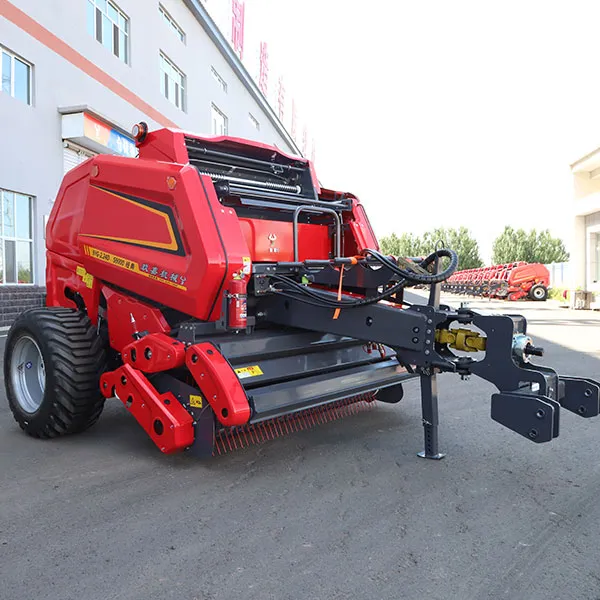 9YG-2.24D Round Baler (S9000 Classic)