




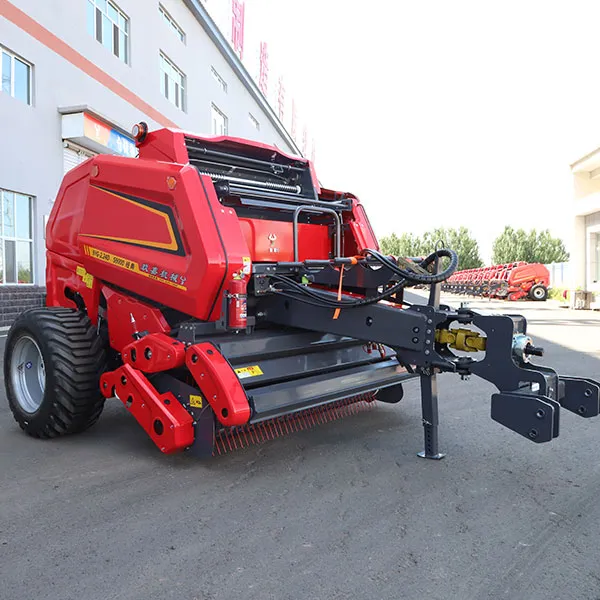
hay bale baler
When people talk about a hay bale baler, many people immediately think of simple collection and baling. But in practice, if you approach it so superficially, you can quickly run into problems - from uneven bale density to premature wear of components. The key point that is often missed is that this is not just a packaging machine, but a tool that directly affects the safety of feed, logistics and, ultimately, the economics of the farm. I myself have worked with different models, and the difference in results under seemingly similar conditions is enormous.
Main mistakes when choosing and using
The most common mistake is to chase maximum productivity without taking into account the structure of your farm. I saw how they bought a powerful self-propelled picker for a relatively small field with uneven terrain. The result is constant downtime, excessive fuel consumption and unjustified load on equipment. For small and medium-sized areas, a trailed option with a properly selected tractor power take-off power is often more reliable and economical.
The second mistake is ignoring the moisture content of the hay. It seems that if the hay is visually dry, it can be baled. But even slightly increased humidity inside the windrow is a risk. You press it, you get a beautiful bale, and after a month it starts to “burn?” from the inside or become moldy. I had to draw a simple rule from my own experience: it is better to leave the hay in the windrows for an extra day than to risk the entire batch. Modern presses, by the way, are beginning to be equipped with sensors that indirectly indicate this problem, but you cannot rely entirely on technology here.
And the third is neglect of setting. Many operators, especially during the season, forget about adjusting the pressure, cutting length (if there is a chopper) and belt tension. As a result, the bales are of different densities, do not hold their shape well during transportation, or overload the bale chamber. These are not trifles, but direct paths to unscheduled repairs. I myself encountered when, due to the weakened tension of the needle conveyor drive, piping began to skip - I lost half a day to eliminate and redo the defect.
Key nodes to look at first
The heart of any baler is the bale chamber and the binding unit. The design of the chamber (with a variable or constant cross-section), the material and shape of the pressing plates - not only the density, but also the uniformity of the bale depends on this. Cheap models often suffer from the fact that the cross-section of the bale is not rectangular, but diamond-shaped, which creates problems when stacking. The binding knot is a separate topic. The needle mechanism should work clearly, without delays. Twine or mesh? For hay, twine is more common, but if you are working with wetter material or for long-distance transportation, then the mesh provides better contraction and preservation.
Pickup with reel. It would seem like a simple detail. But the uniformity of filling the chamber and, as a consequence, the stability of the weight of the bales depends on how carefully it feeds the mass into the feeding apparatus. If the reel breaks? the roller becomes clogged, jerks in work begin, and the load increases. In fields with light, fluffy hay, this is critical.
Drive and transmission. The important thing to look at here is overload protection - shear bolts or fluid coupling. In conditions where a stone or piece of metal can get into the windrow (this has happened), this will save you from serious damage. Personal experience: once a shear bolt on a pick-up gear saved me from having to replace the entire gearbox. A trifle, but important.
Experience with equipment from ?Jiujia?
Recently, more and more equipment from Chinese manufacturers has appeared on the market, which have seriously improved the quality. In particular, we had to test a hay bale baler fromHulunbuir Machinery Manufacturing Company ?Jiujia?. I went to their websitecn-fascar.ru, to clarify the details - the company positions itself as a modern integrated enterprise with a full cycle from development to service. The narrative emphasizes smart manufacturing for agriculture and livestock, which is trendy right now, but it's important that it's more than just words.
What can you note about the car itself? The design is quite thoughtful for its price segment. The bale chamber had good compaction, the bales were dense and even. I was pleased with the strapping system - it worked for the season without serious failures, although different twines were used. The obvious advantages are a clear and accessible hydraulic circuit and maintainability. Spare parts, according to representatives, should be available, but this issue, as always with new brands, requires the test of time.
There was also a minus, rather an operational one. When working on very light, overdried hay, the pick-up sometimes “seized” a lot with gaps, I had to slow down. Perhaps this is a matter of fine tuning the reel or refining the teeth. But in general, for standard conditions in the middle zone, the unit proved to be reliable. If we talk about the company as a whole, then their approach, described oncn-fascar.ru- the combination of R&D, production and service - is felt in the thoughtfulness of the overall layout of the machine, where the emphasis is on maintainability and ease of maintenance in the field.
Practical tips for seasonal maintenance
No one, even the most reliable baler, will forgive a negligent attitude to maintenance. The main thing is a daily run-in. You can’t give a full load right away in the morning. Let it run for 5-10 minutes at idle speed, check the lubrication of all pressing and rubbing units. Particular attention should be paid to the grooves in the bale chamber and the binding needles. The slightest contamination and the twine begins to tear or the loop lies crooked.
Cleaning. It seems obvious, but many people forget to clean their car at the end of the day. Hay residues, especially with dew or light moisture, are a source of corrosion and sticking of mechanisms. Spending 15 minutes cleaning with a brush and pressurized air can save you hours of repair work later.
Control over consumables. Twine, knives (if any), belts, hydraulic filters. All this should be at hand. Personally, I always carry a small kit with me in case of field repairs. Once, due to a burst high-pressure hydraulic hose, I lost almost a day while looking for a replacement. This is now a mandatory reserve position.
Instead of a conclusion: about expediency
Ultimately, choosing and operating a baler is always a balancing act. A balance between price and reliability, between productivity and accuracy of work, between the complexity of equipment and the capabilities of your service. There is no perfect car for everyone. For a large farm with flat fields, one technique is justified; for a small farmer with scattered plots, a completely different one is justified.
Is it worth considering such manufacturers as?Jiujia?? If your budget is limited and there is a need for a reliable unit for standard tasks, yes, it’s definitely worth it. Their technology, judging by experience, has already moved beyond the stage of simple copying and offers clear solutions. But the key is the availability of service support in your region. Without this, any, even the most advanced machine, will turn into a pile of metal at the first serious breakdown.
The main thing to remember is that a hay bale baler is not an autonomous robot, but a tool. And the result of its work depends 50% on proper setup, timely maintenance and the operator’s understanding of what exactly he is doing in the field. Without this, even the most expensive model will not give what is expected of it.
Correspondingproducts
Related Products




Best Sellingproducts
Best Selling Products-
 Self-propelled mower-conditioner 9GYZ-4.9
-
 9GD-2.5 Single-blade trailed mower (updated version)
-
 9LZY-9.0 Finger-disc rake
-
 9F-70 Rough feed chopper
-
 Trailed single-drum combine harvester 4DQ-5 for bean threshing
-
 9GL-2.5/2.9 Trailed mower rake
-
 9YG-1.25A Round Baler FASCAR
-
 9YG-2.24D Round Baler (S9000 Excellence)
-
 9YG-1.25 Round Baler
-
 9YG-1.0 Round Baler
-
 9JYY-2.5 Roll pick-up-conveyor
-
 9YG-2.24D Round Baler (S9000 Classic)