




belt baler
When people say 'belt baler', many people immediately think of the belt itself. But this is just the tip of the iceberg. In fact, the key is the entire roll formation system: tension, chamber geometry, synchronization of feeding and pressing. A common mistake is to chase maximum density at any cost, and then wonder why the bearings on the camera shafts fail after a season or the tape begins to “walk.”
From theory to field: where the nuances lie
Take, for example, the samebelt balerfrom 'Jiujia'. It looks like a classic scheme. But when we started working with it on forbs with high humidity, details emerged. Their system of initial pressing in the supply channel turned out to be very sensitive to adjustments. Press too hard and the wet mass gets stuck, creating a jam. Weak - and the beginning of the bale is formed loosely, then the entire bale goes 'humped'.
Here you can’t just set it according to the manual and forget it. You have to literally feel the material. It happened that at the beginning of the day the grass was one, after lunch - another, and you already had to turn the hydraulic regulator of the feed piston. This is not a disadvantage, but rather a feature that requires the operator to understand the process. The machine does not “do everything for you”; it provides tools for high-quality work, but you need to know how to use them.
Or a moment with the tape itself. Many manufacturers save on its guides. As a result, after several hundred bales, the edges begin to etch. The same Hulunbuir company for the production of machinery, Jiujia, has made reinforced rollers with a polymer coating in its latest models, which wears out the edges of the blade less. Trifle? On paper - yes. In practice, it’s an extra season before replacing an expensive set of tapes.
Bale density: a double-edged sword
Everyone wants a tight bale. It’s logical: more weight in one roll, less transportation. But there is a physical limit here, which rests on the strength of the belt and the entire frame of the pressing chamber. I have seen cases where craftsmen reconfigured the hydraulics to apply more pressure. The result is like a bale like a stone. But firstly, the belt works to the limit, and secondly, when distributing such a monolith may not loosen properly, the cattle are reluctant to eat.
Therefore in goodbelt pressIt is not the maximum, but the stable and adjustable density that is important. So that you can make it a little looser for haylage (for better penetration of preservatives), and make it tighter for dry hay for long-distance transportation. The mentioned manufacturer from the website cn-fascar.ru has included several preset modes with different pressures in the chamber in its models, which is very convenient. There is no need to guess every time how many revolutions to turn the valve.
And there is also the issue of uniformity of density throughout the entire volume of the roll. Cheap machines often suffer from the fact that the middle of the bale is dense and the edges are loose. This is a problem of kinematics and belt width. When the tape is narrow and the chamber is wide, it simply cannot transfer pressure to the edges effectively. You have to monitor the formation of the roll: if you see that the edges are starting to lag behind, you need to either reduce the overall density or accept losses. In modern devices that are positioned as 'intelligent', such as some lines from 'Jiujia', this is monitored by a system of sensors, slightly adjusting the tension in real time. Works? In general, yes, but it adds complexity and cost.
Cohesion on the field: about rebounds and losses
Often the conversation turns only to pressing, forgetting about selection. And it depends on how much raw material you collect. The width of the pick-up, the shape and speed of the teeth, and the cutting height all have an impact. On rocky or uneven fields, for example, a low-set pick-up is guaranteed to break teeth and cause a lot of hassle.
Working with different equipment, I noticed that integrated manufacturers who make both a pick-up and a press have bothHulunbuir Jiujia Machinery Manufacturing Company, synchronization is usually better. Feeding mechanism and picking speed are better balanced. If you take a unit from a company that buys a pick-up on the side and connects it to its chamber, there may be surprises: sometimes the feed doesn’t keep up, sometimes, on the contrary, it choke.
This is especially critical for belt balers because they have a continuous process. Rotary, for example, forgives small pauses in feeding. But here a stop is a potential jam in the chamber, which then needs to be dismantled manually, wasting time. Therefore, I always look at the assembled unit: how the pick-up sits, are there any obvious “crutches” at the attachment point, what kind of drive (from its hydraulic motor or from the power take-off shaft). The latter, by the way, is important for uniformity: the hydraulic drive is smoother and easier to control in difficult areas.
Service in the field: what the brochures are silent about
Everything in the catalogs is smooth: service intervals, lubrication points. The reality is that the main problem withbelt balerat the height of the season it’s dust and straw that gets clogged literally everywhere. Particular attention is paid to tension units and belt guide rollers. If there are no labyrinth seals of a decent standard, the bearings will not last long.
I remember at one of my early works with a device similar in design to those made by Jiujia, there was a problem with dust from dry hay. It packed into the cracks between the tape and the side of the chamber, became sintered due to friction and began to act as an abrasive. They found a homemade solution - they installed homemade sealing brushes made of hard bristles. Now I see that many manufacturers have begun to install similar solutions from the factory. Progress.
Another practical point is access to nodes. Ideally, to replace a roller or tensioner, you do not need to disassemble half the device by unscrewing two dozen bolts. A good design allows you to remove the assembly, replacing it with a pre-prepared one, and quickly continue working. This minimizes downtime. On the website cn-fascar.ru, in the descriptions of their modern technology, I see an emphasis on modularity and fast service. This is exactly what is valued in the field, and not at the exhibition.
Final Thoughts: Choices and Expectations
So what is modernbelt baler? This is no longer just an alternative to rotary. This is a complex system for those who are ready to delve into the details and want to obtain a consistently high-quality bale with minimal losses. It is more sensitive to settings and conditions, but with the right approach, the returns are higher.
When choosing between models, whether from a well-known giant or from such a specialized integrator as the Jiujia company, you need to look not at the maximum characteristics, but at the thoughtfulness of the little things: how the guides are made, how convenient it is to adjust the tension, how critical components are protected from dirt, how repairable the design is in the field.
Personally, for me, the indicator is when, after a hard day at work, I don’t have to spend hours picking out the packed mass from hard-to-reach places or wondering why the bale is falling apart. When the machine works predictably. And in this regard, those devices that combine development, production and, what is important, feedback from the same practitioners, often turn out to be closer to the real needs of the economy than the advertised 'flagships' with a bunch of unnecessary electronics. The main thing is to find your balance between manufacturability and reliable, easy-to-maintain mechanics.
Correspondingproducts
Related Products






Best Sellingproducts
Best Selling Products-
 9GL-2.5/2.9 Trailed mower rake
-
 9GD-2.5 Single-blade trailed mower (updated version)
-
 9LZY-9.0 Finger-disc rake
-
 9FZ-2.0 Finger-disc tedder
-
 9GL-5.0/5.6 Trailed mower rake
-
 9YG-1.25 Round Baler
-
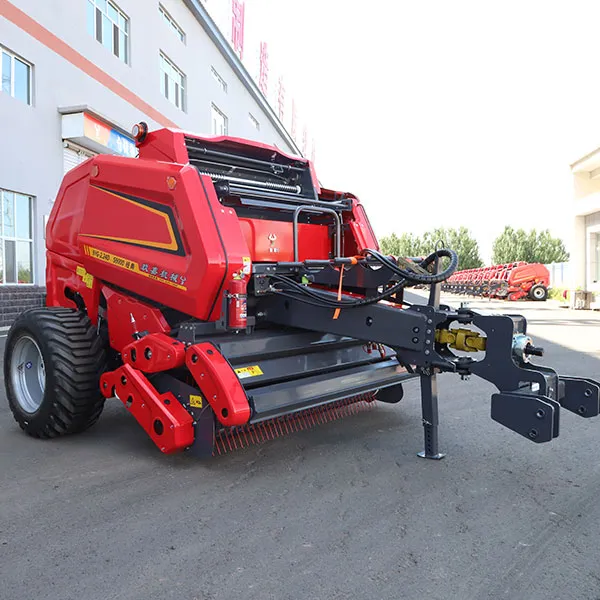 9YG-2.24D Round Baler (S9000 Classic)
-
 9YG-2.24D Round Baler (S9000)
-
 Baler for forming rectangular bales model 9YFQ-2.2D (cross type, for export to Russia)
-
 Trailed single-drum combine harvester 4DQ-5 for bean threshing
-
 9YG-1.25A Round Baler FASCAR
-
 9JYY-4.5 Roll pick-up-conveyor
Relatedsearch
Related Search- Kurgan and Kurgan region sale of agricultural machinery
- trailed double-bar mower
- Harvesting grass
- creation and production of highly efficient agricultural machinery
- tedder rake for mini tractor
- trailed quad bike mower
- large agricultural machinery
- baler with its own motor
- How much does a round baler cost?
- balers Tula region