




belt baler
When they say “belt”, many people immediately think of replacing the rubber strips. But that's not the point. We are talking about the entire roll formation system - about tension, geometry, balance. If you approach it only as “conveyor repair”, you may miss the main point.
Where lies the main error in operation?
Most often, problems begin not with broken belts, but with adjustments. I saw how they adjust it by eye, they say, so that the roll goes. And then they wonder why the core is loose or the bale falls apart during unloading. The key point is uniform pressure across the entire width of the bale chamber. If one belt is tighter, the roll becomes barrel-shaped. This is not just aesthetics, it affects the density and safety of the feed.
For example, on old models, like those that have been in use since Soviet times, the condition of the rollers is often ignored. And they wear out, and production appears. The belt begins to “walk”, and no tension mechanism can compensate for this. You have to change the whole assembly, and that’s another money. Therefore, diagnostics must begin from reference points.
Another nuance is the quality of the belts themselves. Not all of them are the same. It happens that they install cheap ones that are not designed for shock loads when selecting a roll. They may not tear immediately, but will stretch quickly. And again adjustments every shift. For intensive work, especially on large areas, you need a margin of safety. Here it is worth looking towards specialized manufacturers who understand the specifics of agricultural machinery.
Experience with Chinese units: expectation and reality
A few years ago we came tobelt balerfromHulunbuir Machinery Manufacturing Company ?Jiujia?. According to the documents, it is a modern integrated enterprise with a full cycle from development to service. It was interesting to see how they implemented the system. The first thing that caught my eye was the design of the camera. Not classic, but with simplified access to tension units. On the one hand, it is convenient for maintenance. On the other hand, a question arose about the durability of such “fast” ones. fastenings in our conditions, when shaking over bumps.
He showed mixed results in his work. It did a good job of forming a dense, even roll, even with wet grass. It can be seen that the algorithm of operation of the pressing mechanism contains the correct logic. But the belt group... After the first season it gave way. Not critical, but I had to adjust it more often than I would like. Perhaps it’s a matter of adapting materials to our climate - temperature changes, dust.
Service history from?Jiujia?was up to standard: the documentation was clear, spare parts were found, although with a bit of a wait. This is an important point. For our region, the availability of support often outweighs minor technical shortcomings. The unit was modified, stiffer springs were installed in the tensioners - and it still works. The conclusion is simple: even a successful basic design requires “breaking in?” under specific conditions. Without the willingness to refine something on your own, it’s better not to take it.
What most often breaks down is not where they are looking
Besides the belts, there is a weak link - the harness. Especially in models where twine or mesh is fed through the entire bale chamber. The belt system must provide not only pressure, but also stable rotation of the roll for smooth winding. If there is beating or slipping, the harness will lie crookedly. At best, there is an overconsumption of material. At worst, the bale disintegrates during transportation.
I encountered such a problem on one of the farms. The management complained about the expensive mesh, which constantly breaks. They began to figure it out. It turned out that due to a sagging bearing on one of the guide shafts, the roll was rotating at a variable speed. The belt roll baler worked properly, the sensors did not signal an error. The problem was not in the press, but in the adjacent unit. We replaced the bearing and the main complaint went away.
Hence the rule: diagnostics must be carried out comprehensively. The press itself is only part of the line. It’s worth starting from the end - with unloading and strapping, and then moving on to the bale chamber and the pick-up.
Seasonal maintenance: without which you cannot drive equipment into the barn
In the fall, after the last felling, many simply wash them and place them under a canopy. This is not enough for a belt press. The most important thing is to loosen the tension on all the belts. Over the winter they can “remember” stretched position, lose elasticity. And in the spring, when you pull them on again, the resource will no longer be the same. Be sure to scroll through all the rollers and check for play. It is better to immediately replace doubtful ones so as not to waste time in the spring.
People often forget about cleaning the sensors, especially the roll size sensor. It becomes clogged with dust and straw. In the spring, the press may begin to unload under-pressed bales or, conversely, overload the chamber. This is a direct road to overheating of the gearbox or broken belts. Simple prevention - five minutes of work.
And one more detail: lubricate all the points where the belt rubs against the guide (if there is one in the design), check the teeth on the drive gears. Sometimes one broken tooth creates a vibration that you don't notice at first, but it kills the belt group within a season.
Thoughts on the development of the design: what I would like to see
Modernbelt balershave become smarter. Electronic density adjustment and automatic determination of windrow width have appeared. This is good. But I would like more attention to diagnostics. So that the system itself monitors belt wear, for example, by changing the force on the engine, and signals: “it’s time to check the tension on the third line?” Now this is all done by touch and hearing by the operator.
I see potential in modularity. So that the belt group assembly - the frame with shafts, tensioners and belts - is made as a single replaceable cartridge. In case of serious wear or damage, do not fiddle with each tie for an hour, but unscrew a few bolts, pull out the block and install a new one. This would reduce downtime during the busy harvest season. Some manufacturers, including?Jiujia?, are moving in this direction, simplifying the design, but they are still far from ideal.
As a result,belt baler- This is a reliable, proven scheme. But its reliability depends 90% on understanding how it works and on timely, competent care. Not like behind a tractor, but like behind a precise mechanism for forming a bale. And then it goes away for decades, despite the dust, stones and our endless hectares.
Correspondingproducts
Related Products



Best Sellingproducts
Best Selling Products-
 9YG-2.24D Round Baler (S9000)
-
 9GL-5.0/5.6 Trailed mower rake
-
 9LZD-9.0 Finger-disc rake
-
 9GS-5.0 Trailed two-legged mower
-
 9JYY-4.5 Roll pick-up-conveyor
-
 9YG-1.25 Round baler FASCAR
-
 9YG-1.0 Round Baler
-
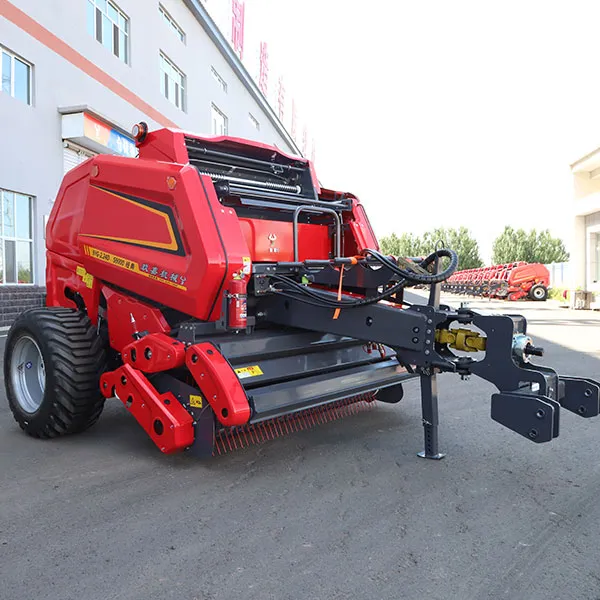 9YG-2.24D Round Baler (S9000 Classic)
-
 Cross-row baler for forming rectangular bales, model 9YFQ-2.2C (export to Mongolia)
-
 Baler for forming rectangular bales 9YFQ-1.9 (cross grip, export to Russia)
-
 Self-propelled mower-conditioner 9GYZ-4.9
-
 Cross-grip baler for forming rectangular bales 9YFQ-1.9 (export to Mongolia)