




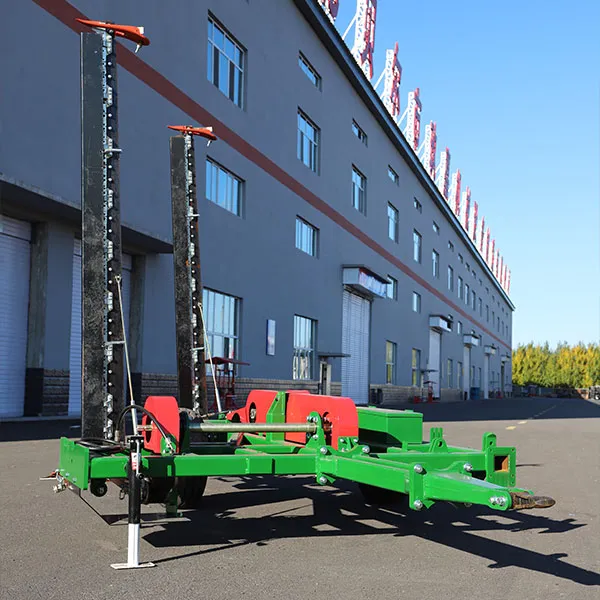
Trailed mower
When you hear “trailer mower?”, many people immediately imagine a simple frame with blades that a tractor drags across the field. But this is superficial. In fact, this is a complex unit, where every component - from the hitch to the cutting device mechanism - affects the result. And the main mistake is to assume that they are all the same. The difference between a successful model and a problematic one often lies in details that are not visible at first glance.
Design: where the main trade-offs lie
Let's take the frame for example. It seems that the more massive the better. But in practice, an overweight structure creates excessive load on the rear axle of the tractor, especially when working on slopes or crossings. I have seen cases where farmers, trying to make something “for centuries”, welded frames from thicker channels, and then wondered why the tractor “doesn’t pull?” and fuel consumption has increased. This requires calculation, not just a margin of safety.
The key unit is, of course, the cutting apparatus. Segmental finger or rotary? For coarse-stemmed crops, such as alfalfa for hay, a segmented one is often preferable - a cleaner cut, less losses. But if there is a risk of stones on the field, a rotary one may be more durable, although it crushes the mass more strongly. This is always a choice in conditions of imperfection.
Or a cutting element drive system. Belt drives are cheaper and more forgiving of some distortions, but require constant tension control, especially in dusty conditions. A rigid cardan drive is more reliable, but transmits more vibrations to the frame. Here you already look at the volume of work: for 50 hectares per year you can put up with belts, but for constant work on a large scale, it is better to look for an option with a cardan and high-quality bearings.
Hitching and field work: theory versus reality
It would seem that it’s not that complicated - I attached it to the towing bracket and drove off. But it is on the hitch that problems often occur. A universal bracket does not always provide the required freedom of vertical movement. On uneven terrain, the mower begins to “peck?” or, conversely, rise, which leads to an uneven cut. The best solutions I've seen have a hitch with a long pin and a wide footplate, which reduces the breaking point.
Working at the edge of the field, near the roadside, is a different story.Trailed mowerwith side discharge or rear? With the side one, it is more convenient to form a windrow right away, but you need to take into account the direction of rotation of the drum and the side of the discharge, otherwise you can dump the mowed mass onto the unmowed area. The rear discharge is more universal, but then for windrowing you also need a rake. This is a matter of organizing the entire feed procurement chain.
Once I had to work with a unit where the manufacturer skimped on the protective belt cover. It seemed like a small thing. But after two days of work in dry weather, the belts were so clogged with lint and shredded leaves that they began to slip and burn. I had to stop and clean literally every few hours. So there are no small details in the design.
Brands and unobvious choices
There are many names on the market, but not everything that works well in the conditions of, say, Central Russia will behave the same way in arid steppes or wet meadows. Corrosion, dust protection, the ability to cut wet grass without sticking - this is only tested under specific conditions. Sometimes a less popular model, but with well-thought-out knife geometry and shaft protection, turns out to be more profitable than a top brand.
In this context, it is worth paying attention to proposals from companies that are deeply immersed in agrotechnical specifics. For example,Hulunbuir Machinery Manufacturing Company ?Jiujia?(their website iscn-fascar.ru) positions itself as a modern integrated enterprise combining R&D, production and service in the field of agricultural machinery. It is important for me when a manufacturer not only assembles equipment, but conducts its own developments, adapting designs to different farm conditions. Their approach tosmart manufacturingin agriculture, judging by the description, it involves precisely such in-depth work, and not just assembly according to ready-made drawings.
When choosing equipment, I always try to find out whether the manufacturer has its own testing grounds and how feedback from farmers is organized. Because catalog specifications are one thing, but the ability of equipment to work for five seasons in a row with minimal downtime is quite another.
Operation: what is not written in the instructions
Cutting height adjustment. It seems that everything is simple: set up the support shoes and work. But if the field is tussocky or has a slope, a hard setting results in the blades either cutting off the ground or leaving high, uncut grass. Sometimes it is more effective to sacrifice a couple of centimeters of the ideal height, but allow the device to “float” a little, copying the terrain, in order to save the knives and get a more uniform mowing.
Sharpening knives. Many people neglect timely sharpening until the quality of the cut becomes completely disgusting. But a dull knife does not cut, but crushes the stem, which leads to large losses of nutrients when making hay. Sharpening is necessary often, especially when working on dry wood or contaminated grass. And it is important to maintain the original sharpening angle - amateur efforts here will only do harm.
Lubrication. Just a couple of points, but if you miss the deadline, the expensive bearing in the drive shaft fails in the middle of the season. It is important not to overdo it: excess lubricant in the gearbox is just as harmful as its lack, leading to overheating. It's better to keep a simple journal than rely on memory.
Thoughts aside and conclusion
Sometimes you look at modern models with hydraulic folding wings or load sensors and think - is all this necessary in a normal household? Increasing complexity leads to higher costs and potentially new points of failure. For a large agricultural holding it is possible. For a farmer with a fleet of three tractors, field maintainability and availability of spare parts are often more important. Perfecttrailed mower- this is one for which parts can be found not only at an official dealer, but also in a good rural workshop.
Ultimately, choosing and working with a trailed mower is a constant search for balance between price, reliability and suitability for your specific fields. This is not a technique that you can buy, set up once and forget about. It requires understanding, attention and, to some extent, habit. When do you find yours? model and study all its features, the work becomes predictable, and the result becomes high-quality. But this path almost always begins with overcoming the initial simple view of it as “just iron on wheels”.
Therefore, when you see offers, for example, fromHulunbuir company ?Jiujia?, it is worth digging deeper into their statements aboutsmart manufacturing. How is this translated into the thickness of the frame metal, the protection of the hinges from dirt, and the ease of replacing segments? These practical answers determine whether the unit will become a working tool or a source of headache. Websitecn-fascar.ru- this is just an entry point, behind which there should be real engineering solutions tested in the field.
Correspondingproducts
Related Products






Best Sellingproducts
Best Selling Products-
 Baler for forming rectangular bales 9YFQ-1.9 (cross grip, export to Russia)
-
 Cross-grip baler for forming rectangular bales 9YFQ-1.9 (export to Mongolia)
-
 9GL-2.5/2.9 Trailed mower rake
-
 9YG-1.25A Round Baler FASCAR
-
 Drum type raking machine 9LG-9.0
-
 9GD-2.5 Single-blade trailed mower (updated version)
-
 9GS-5.0 Trailed two-legged mower
-
 Mower-conditioner model 9GQY-3.2
-
 9YG-2.24D Round Baler (S9000 Excellence)
-
 9YG-1.0 Round Baler
-
 4BYHD 4BYHS-3.9 Pulling machine for beans
-
 9F-70 Rough feed chopper