




production of agricultural machinery
When they talk about the production of agricultural machinery, many immediately imagine workshops, machines, and welding. But that’s not the point. The point is to create a machine that will work in the field for more than one season, which will not have to be repaired in the middle of the harvest season because of some little thing like a failed hydraulic cylinder or a frame cracked from vibration. This is the main challenge. We are in ?Jiujia? We've been through this, more than once. It all started, like many others, with simple balers, but it quickly became clear: without our own developments, without an understanding of agronomy and real operating conditions, this is a road to nowhere. Simply copying someone else’s work is futile.
From drawing to field: where the main problems lie
The most painful stage is the transition from prototype to series. It would seem that everything has been calculated, the tests on the stand have been completed. But the very first batch of cars sent to customers in Kazakhstan made its presence felt. Not massively, but there have been complaints about the reliability of the auger in feed dispensers. On the stand it spun perfectly, but in reality, when working with wet silage, overloads arose that we had not foreseen. We had to urgently change the design of the drive and strengthen the shafts. This was a lesson: tests should be as close as possible to “combat” ones. conditions rather than ideal laboratory conditions.
Another point is the logistics of spare parts. We produce equipment in Hulunbuir, and our main markets are, of course, other regions. It is unacceptable for a client from the Novosibirsk region to wait two weeks for a gasket for the hydraulic system. We had to build a network of service centers with a minimum stock of the “hottest” ones. positions. It's expensive, but you can't live without it today. Our websitecn-fascar.ruhas become not just a business card, but a tool where dealers and end farmers can quickly find diagrams, technical documentation and fill out an application for the required part. This reduces tension.
And of course, the footage. Finding a good welder who welds a frame not just with an even seam, but with an understanding of future loads is a whole story. We spent a lot of time ensuring that key specialists from production traveled with service teams on field trips. See exactly where the very frame they were assembling burst. This is a better motivation for quality work than any instructions.
Integration of "smart" in traditional: our way to ?Jiujia?
Nowadays there is a lot of talk about precision farming and smart technology. Our position asmanufacturer of agricultural machinery— don’t hang up a bunch of sensors for the sake of marketing, but implement something that actually brings savings. For example, we have been experimenting for a long time with a system for automatically leveling the header on slopes for our combine harvesters. We didn’t buy a ready-made module, but developed our own system, which was simpler and repairable in the field. It didn’t work out right away, the first versions were capricious, but in the end a solution was born, which now comes as standard and is valued by farms in hilly areas.
Our enterprise is declared as integrated - from development to service. These are not empty words. Our designers sit in the same building with the warranty department. And when a complaint comes in about a new model of mineral fertilizer spreader, the engineer who designed it goes to investigate it personally. It can be unpleasant, but this is the only way to make truly reliablecars. Sometimes such feedback leads to improvements that were not initially even considered.
It was a similar story with the livestock sector. We made a feed chopper-mixer. It seemed nothing complicated. But it turns out that even mixing is critical, otherwise the cows will start to have problems. We had to involve a feeding technologist and conduct dozens of tests with different types of feed. Now the passport for this machine contains real, farm-tested recommendations on mixing times for silage, haylage, and additives. This is the very integration that gives the product an advantage.
Materials and cost: the eternal compromise
One of the main questions from clients: “Why is your equipment more expensive than some of its analogues?” You have to explain it with your fingers. Take, for example, a trailer wheel axle. You can use regular steel 3 and make it cheaper. But under the conditions of Russian roads and loads, it may not even reach half of the declared resource. We have switched to a more alloyed steel and use heat treatment. The part is 15% more expensive, but its service life increases significantly. For a farmer who considers not only the purchase price, but also the cost of ownership, this is an argument.
But there are pitfalls here too. One day, trying to keep up with the price, we simplified the design of mounting the cutting device on the mower. We saved a kilogram of metal and a couple of hours of assembly. The result is that during the second season, several cars developed backlashes in the most critical unit. We had to return the old, proven design and upgrade the already sold units for free. Reputation is more valuable. Now any simplification undergoes the most severe testing at the testing ground.
Nowadays there is a lot of noise around import substitution. For us this is not just a slogan. We have been working on the localization of components for a long time, especially hydraulics and bearing units. But it is important not just to replace, but to maintain or improve the parameters. The transition to domestic seals for hydraulic cylinders, for example, took almost a year: different brands of rubber were tested, checked for frost resistance and wear. We found an option that even surpassed the previously used imported one in terms of abrasive resistance. This is painstaking work, invisible from the outside, but it forms the basis of sustainableproduction of agricultural machinery.
A look into the future: what will be in demand tomorrow
Judging by the requests from our fields (literally and figuratively), the trend is towards universality and modularity. It is not profitable for farms to maintain a fleet of a dozen highly specialized machines. Rather, there will be a demand for basic chassis, to which you can quickly attach either a front loader, a broom, or a spreader. We are already moving in this direction, developing such a platform. The difficulty lies in the unification of control systems and hydraulic connectors, but the problem can be solved.
The second is service as a service. We are in ?Jiujia? We are gradually introducing a system where we offer a large client not just to sell a combine harvester, but to enter into an agreement for its full maintenance for its entire service life. We carry out scheduled maintenance on our own, monitor the wear of components, and prepare parts in advance. For the client - predictability of costs and lack of downtime. For us - long-term relationships and a deep understanding of how our equipment behaves in real life. This is invaluable information for designers.
And finally, ecology and resource conservation. It's not just ?green? PR We're talking about direct benefits. Our new developments in the line of machines for applying liquid organic fertilizers are aimed at minimizing nitrogen losses and precise dosing. This reduces the cost of production for the farmer and the burden on the environment. The demand for such solutions will only grow, and ourproductionshould be ready for this. This is no longer just iron, it is a complex symbiosis of mechanics, electronics and agronomy. And this, perhaps, is the modern challenge for our workshop.
Instead of an epilogue: just work
As a result, the production of agricultural machinery is not about loud statements. This is about daily work: accepting incoming metal, checking the quality of the weld, listening to a complaint from a mechanic from a remote farm, finalizing the 3D model of the assembly. It's a cycle that has no end. Success is when they don’t scold your equipment, but simply work on it for years, wearing out every last bolt. And when they come for the next car, choosing not by price, but by name. This is what we strive for at the Hulunbuir Jiujia Company. Slowly, with mistakes, but persistently.
Correspondingproducts
Related Products




Best Sellingproducts
Best Selling Products-
 Drum type raking machine 9LG-9.0
-
 9LH-12 Trailed cross rake
-
 9FZ-2.0 Finger-disc tedder
-
 9LZ-6.0 Finger-disc rake
-
 Cross-grip baler for forming rectangular bales 9YFQ-1.9 (export to Mongolia)
-
 9GL-5.0/5.6 Trailed mower rake
-
 Baler for forming rectangular bales 9YFQ-1.9 (cross grip, export to Russia)
-
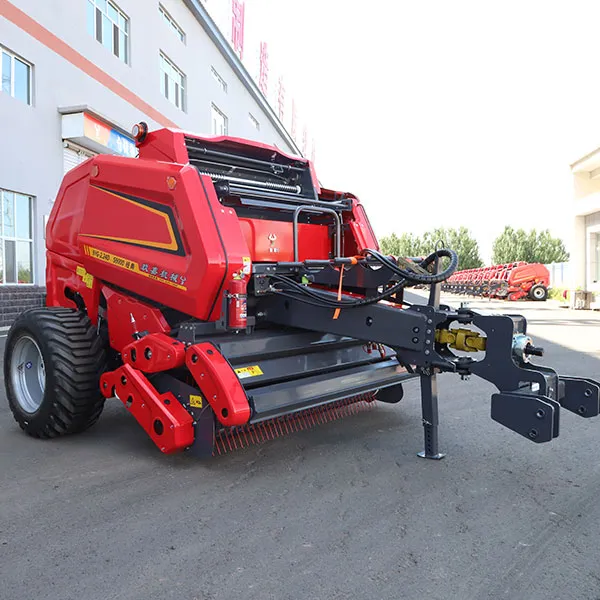 9YG-2.24D Round Baler (S9000 Classic)
-
 Baler for forming rectangular bales model 9YFQ-2.2D (cross type, for export to Russia)
-
 Cross-row baler for forming rectangular bales, model 9YFQ-2.2C (export to Mongolia)
-
 9GD-2.5 Single-blade trailed mower (updated version)
-
 9YG-1.0 Round Baler