




self-propelled pick-up presses
When they talk aboutself-propelled pick-up presses, many people immediately imagine just a big tractor with a press in front. In fact, this is a completely different philosophy of feed procurement, where the unit is not an addition, but an independent, often capricious, working unit. The main mistake is to assume that since the equipment is self-propelled, it is smart and will do everything itself. Alas, this is not true. My first seasons with different models took me to understand this difference between the advertising brochure and reality, where the quality of the bale and the speed of harvesting depend on a dozen small but critical settings.
Design and pitfalls: what the manuals don’t say
If we take the classic scheme, the key difference from trailed ones is the integration of all systems. The engine powers both the drive, the pressing mechanism, and the pick-up. And here the first nuance is the power balance. I have seen cases when, on a heavy, wet mass, the motor simply “suffocated”, unable to simultaneously pull the machine and wind the roll tightly. I had to slow down, which negated the performance advantage.
The second point is the chassis. The tracked one gives less pressure on the ground, yes, but in the conditions of our waterlogged fields after the rain there was such a mess between the metal and the ground that the car skidded, and cleaning took hours. The wheeled version, especially with wide tires, sometimes turned out to be more practical, although it compacted the soil more. Choice is always a compromise.
And the third, most important pitfall? — pressing and winding system. It would seem like a small thing - feeding the mesh or film. But if the feed or tension mechanism works intermittently, the entire bale can be scrapped. Sometimes, due to vibration on uneven surfaces, the sensor got lost and the winding went crooked. I had to stop and rewind manually - a colossal waste of time. Therefore, now, when evaluating any model, I first of all look not at the maximum selection width, but at the reliability and ease of access to this particular node.
Operating experience: from setup to the first bale
Customization for specific conditions is 80% of success. The bale density that you set on the panel is just a number. The actual density depends on the moisture content of the mass, the length of the cut and even whether the field is level. I remember how, in my first season with a famous German model, I set the parameters according to the textbook. As a result, with dry alfalfa, the bales turned out to be loose and fell apart during loading, while with slightly wilted clover, on the contrary, they were so monolithic that during distribution the cattle could barely break them apart. I had to adjust the settings by trial, on almost every new field.
An important practical point is the visibility and ergonomics of the cabin. When you work for 10-12 hours, every inconvenient button or blind spot in front or on the side of the bale chamber is exhausting. Modern models, like those offeredHulunbuir Machinery Manufacturing Company ?Jiujia?(their website ishttps://www.cn-fascar.ru), rely on a panoramic view and a digital panel that shows not only basic parameters, but also consumables, and warns of potential failures. This is not just a “gadget”, but a real saving of time and nerves for the operator.
Another story from practice is working on the night shift. It would seem that there should be enough lighting. But in fact, the old headlights poorly illuminated the dumping area of the finished bale. You had to either slow down the process or take a risk—you could easily run over a roll that had just been dumped. Now I pay attention to the number and location of LED headlights. Trifle? No, it's a question of safety and continuity of the cycle.
Maintenance: not completed - lost the season
The key to a long lifeself-propelled baler- not in scheduled maintenance according to the schedule, but in a shift inspection. This is especially true for the knives of the cutting apparatus and the pick-up. One blunt or chipped plate can ruin the entire mass, turning it into dust rather than quality hay. After each shift, we made sure to clean and check the sharpening. Yes, this is an extra 40 minutes, but the next day the work went like clockwork.
Hydraulics is a separate topic. Oil leaks in the field are a disaster. I myself experienced that the high pressure hose in the pressing system became loose due to vibration. The oil began to ooze, the pressure dropped, and the bales no longer gained the required density. It’s good that I noticed it in time by the pressure drop on the sensor. Now I carry a full set of seals and wrenches with me, and after every week of work I tighten all the connections.
The engine cooling system is a scourge during dusty periods. The radiator becomes clogged with fluff and dust from dry grass in a matter of hours. Overheating - and that’s it, work stopped. We installed additional protective nets that can be quickly removed and cleaned. A simple solution, but effective. On some new machines, by the way, this already comes as standard, which suggests that manufacturers are listening to real problems in the field.
Choosing a model: price, capabilities and “room for growth?”
When choosing equipment, many look at the maximum productivity - how many tons per hour. But in practice this figure is almost never achieved. Turns, the need for maneuvers, and downtime for unloading interfere. Much more important is the “working” indicator. productivity in the conditions of a particular farm - taking into account the configuration of the fields and the average length of the rut. Sometimes it is better to take a less powerful, but more maneuverable and reliable model.
Here it is worth noting the approach of such integrators as?Jiujia?. As follows from the description on their website, this is a modern full-cycle intellectual enterprise - from R&D to service. For me, this means that they can not only sell the car, but also adapt it to our, sometimes non-standard, conditions. For example, for a specific type of roller or for the need to frequently change the type of winding (mesh/film). It's valuable.
An important factor is the availability of spare parts and service. The story of a two-week downtime due to waiting for a simple sensor from abroad is not fiction, but the harsh reality of many. Therefore, now, when evaluating, I look to see if there is a quickly accessible warehouse of consumables for the equipment in the region. The localization of production or service centers, which some companies declare, including the mentioned Hulunbuir company, is a serious argument in favor of choice. Because the season is short, and every day of downtime is a direct loss.
A look into the future: what is really needed in the field
Automation is more than just buttons on a panel. The truly useful technologies are those that solve old problems. For example, automatic bale leveling systems in the chamber, which compensate for the roll of the machine on a slope. Or AI cameras that analyze bale density in real time and adjust settings without operator intervention. For now, this is only available in top models, but this is the future.
Another need is more flexible solutions for small and medium-sized farms. Not everyone needs a giant that costs half a million euros. Need a reliable, repairableself-propelled balermiddle class, perhaps with the option of renting during peak season. And here there is a visible niche for manufacturers who are ready to offer modular and flexible solutions, and not just flagships.
In the end, back to the beginning.Self-propelled baler- this is not a “magic wand”. This is a complex tool, the effectiveness of which is 90% dependent on the operator’s skills, the quality of daily care and the right choice for the task. Technology, even the most advanced, does not think for you. It only increases your professionalism or just as clearly highlights mistakes. And this is her main lesson for anyone who works in the field.
Correspondingproducts
Related Products






Best Sellingproducts
Best Selling Products-
 Cross-grip baler for forming rectangular bales 9YFQ-1.9 (export to Mongolia)
-
 Baler for forming rectangular bales model 9YFQ-2.2D (cross type, for export to Russia)
-
 9LH-12 Trailed cross rake
-
 9GL-2.5/2.9 Trailed mower rake
-
 9YG-2.24D Round Baler (S9000 Excellence)
-
 Self-propelled mower-conditioner 9GYZ-4.9
-
 9YG-1.0 Round Baler
-
 9JYY-4.5 Roll pick-up-conveyor
-
 9YCM-850 Film wrapping baler
-
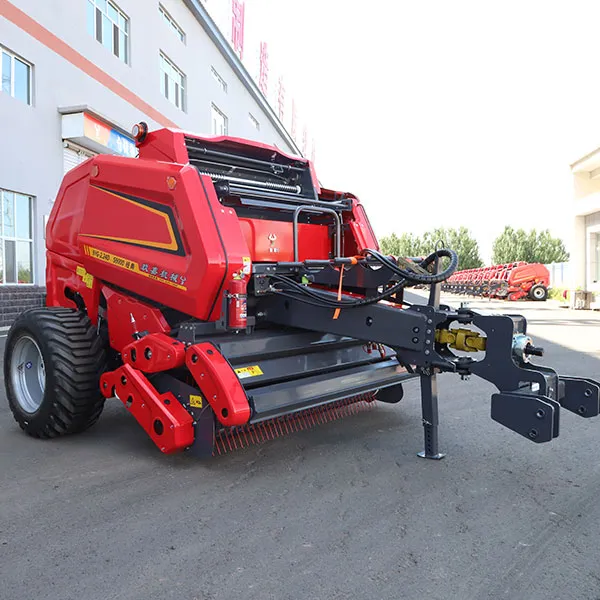 9YG-2.24D Round Baler (S9000 Classic)
-
 9GL-5.0/5.6 Trailed mower rake
-
 9YG-1.25 Round baler FASCAR