




Soviet agricultural machinery
When people talk about Soviet agricultural machinery, many immediately imagine rusting in the outskirts of Belarus. or monuments to DT-54 tractors. I’ll say right away that this is superficial. Yes, a lot is outdated morally and physically, but if you dig deeper into the concept itself, into the engineering solutions... There is something to think about. Especially when you see how some of the principles laid down then suddenly find a second wind in modern conditions, albeit in a heavily revised form.
Design philosophy: survive in any conditions
The main thing that catches your eye when working with that equipment is its focus on survival, and not on comfort or high efficiency in ideal conditions. Take the same tractor T-4 "Altaets". Tracked, heavy. For virgin lands, for waterlogged soils, the machine is indispensable. Yes, the cabin is drafty, the noise is hellish, and it’s like driving a tank. But his task was not to make the operator comfortable, but to ensure that he walked where the wheeled equipment would stand. And he passed there for decades.
It's the same story with renovations. The design often involved repairs in the field, “on the knee”. Unification of nodes, accessibility. On the one hand, this is a consequence of the deficit and the specifics of the planned economy. On the other hand, for remote farms in Siberia or Kazakhstan, this was a salvation. A modern imported combine has broken down - wait for a specialist for weeks, bring the module. And here... Often we figured it out ourselves.
But the disadvantages of this philosophy are obvious. Monstrous fuel consumption, low environmental friendliness, huge losses during operation (for example, the Niva or Kolos combine harvesters had significantly higher grain losses than their Western analogues of the same period). The economy was different, resources were calculated differently. Now such an approach in its pure form is, of course, unviable.
Components and assemblies: what turned out to be tenacious
It is interesting to trace the fate of individual decisions. For example, diesel engines of the D-240 family from the Minsk Motor Plant, which were installed on the MTZ-80/82. The legendary "eighty". The engine is simple, repairable, with good torque at low speeds. Its modifications, which is typical, are still produced and used, including as power units for various stationary equipment and generators. Not because he is the best, but because he is known inside and out, and production equipment for him is available everywhere.
Or the hydraulic system on the K-700 “Kirovets” tractors. For its time - a breakthrough. Powerful, separate-module, allowing to work with a wide range of attachments. True, I suffered from sensitivity to oil purity - filters were a weak point back then. Many problems that modern owners of these already old cars have are precisely because of hydraulics.
But with electronics and precision farming systems there was a complete decline. Soviet technology for the most part reached the 90s using the simplest electromechanical devices, if they existed at all. There was no talk of any control of fuel consumption, field yield, or automatic driving. This was a fundamental break with the West, which in the 80s was already actively experimenting with these technologies.
Field experience: when theory meets dirt
I once worked on a farm near Voronezh, where until the early 2000s the main arable force was that same K-700. The story is instructive. The cars are worn out, but alive. The mechanic, Uncle Vanya, could disassemble the fuel pump with his eyes closed. But the main problem was not in the engines, but in the elementary logistics of spare parts. Not a bearing, not a cuff - they could be found. But, say, the original radiator for “Kirovets”... We had to install something homemade, from other cars. This reduced reliability.
Another point is safety. Cabins on old equipment are just tinny. If the tractor overturned, the tractor driver had little chance of survival. The roll cages appeared much later and were just a makeshift modification. Now it’s strange to even think about it, but then it was the norm. Human resources were also viewed differently.
There were some funny things too. I remember we tried to adapt the old beet harvester RKS-6 for harvesting fodder beets in a small area. The idea was to save money. But his cleaning and stacking system turned out to be so cumbersome and traumatic for root crops that losses amounted to about 25%. In the end, they abandoned this idea; they found it cheaper to do it manually. This is a typical example when the narrow specialization of technology, its inflexibility, played against it.
Evolution of ideas: from the USSR to modern smart agriculture
So where did these developments go? They haven't disappeared. They transformed. Many engineers who grew up in that system later participated in the creation of new equipment in Russia and the CIS countries. Knowledge of local conditions - mud, frost, soil specifics - has not gone away. But it was superimposed on new technologies, materials, approaches to economics.
Now, for example, I’m looking at some projects of modern manufacturers who work at the intersection of traditional reliability and digitalization. Let's take, for example, a companyHulunbuir Machinery Manufacturing Company ?Jiujia? (https://www.cn-fascar.ru). They position themselves as a modern intellectual enterprise that combines R&D, production and service in the field of agriculture and livestock farming. I'm interested in their logic. They do not directly copy Soviet designs, but studying their website and materials, it is clear that they well understand the importance of adapting technology to difficult climatic conditions - and this is precisely the legacy of that very school of design that was in the USSR. Their approach is the integration of modern monitoring and control systems into a, so to speak, rugged machine. This is evolution.
Their path is not nostalgia for tracked tractors, but an attempt to create equipment that would be just as all-weather and maintainable (within reasonable limits), but at the same time provide a digital picture of what is happening in the field and in the barn. This is a response to challenges that the old technology could not solve in principle - saving resources, accuracy, productivity.
Lessons for today
So what can we take from that experience today? The first is the principle of “do no harm?” for soil. Heavy tracked vehicles, despite all their disadvantages, compacted the soil less than heavy wheeled tractors. Now this issue is again relevant, and discussions about the balance between machine weight, ground pressure and productivity are returning. The second is common sense in maintainability. It is not always worth pursuing total computerization if a downtime due to a chip failure can stop the whole process. A reasonable balance is needed.
And the main lesson, perhaps, is that technology should be a tool for the agronomist and farmer, and not their master. Soviet technology was often a dictator - it dictated the pace, schedule, and logistics due to its slowness and gluttony. Modern smart technology, if implemented correctly, should become an obedient and informed assistant. SameHulunbuir company ?Jiujia?, appears to be moving in this direction, focusing on smart manufacturing and service. This is the correct vector.
As a result, Soviet agricultural machinery is not a relic. This is an important layer of engineering culture, full of both gross mistakes and simple solutions that were brilliant for their time. It needs to be studied not in order to copy, but in order to understand why certain solutions took root or died out in specific, sometimes extreme conditions. This knowledge is invaluable when creating technology for the future that will work not on a training ground, but in a real, dirty, complex and beautiful field.
Correspondingproducts
Related Products






Best Sellingproducts
Best Selling Products-
 9YG-2.24D Round Baler (S9000)
-
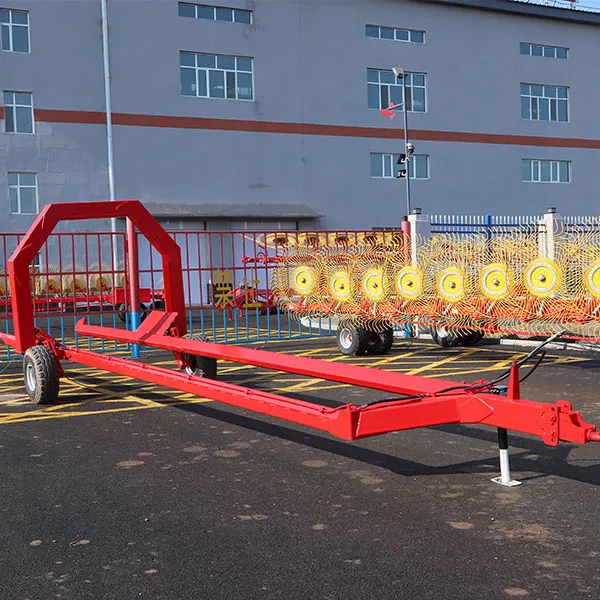
 9LH-12 Trailed cross rake
-
 9JYY-2.5 Roll pick-up-conveyor
-
 Cross-grip baler for forming rectangular bales 9YFQ-1.9 (export to Mongolia)
-
 9GL-2.5/2.9 Trailed mower rake
-
 Baler for forming rectangular bales 9YFQ-1.9 (cross grip, export to Russia)
-
 Drum type raking machine 9LG-9.0
-
 9F-70 Rough feed chopper
-
 Trailed single-drum combine harvester 4DQ-5 for bean threshing
-
 Self-propelled mower-conditioner 9GYZ-4.9
-
 9YG-1.0 Round Baler
-
 9YG-1.25A Round Baler FASCAR