




in which cities are agricultural machinery produced?
When asked which cities produce agricultural machinery, many immediately remember Rostov-on-Don, Chelyabinsk, maybe Rubtsovsk. But the real picture, of course, is more complex and sometimes more unexpected. It is often overlooked that manufacturing is not only about giant conveyors, but also highly specialized enterprises that can be located in cities not always associated with mechanical engineering. And another important point: now under ?production? Anything can be hidden - from a full cycle to assembly from ready-made units, which greatly changes the geography.
Classic industrial centers: what remains of the giants
Let's take Rostov-on-Don, for example. ?Rostselmash? - this is, one might say, a brand locomotive. But if you dig deeper, not all production is concentrated in Rostov itself. Some components, such as headers or transmission parts, may come from related factories in other regions or even from abroad. This is a general trend: the main plant is in a large city, and the network of suppliers is scattered throughout the country. In Chelyabinsk the situation is similar - a tractor plant, but many spare parts for the sameagricultural machinerydone in neighboring areas.
It is interesting to observe the evolution of these centers. Previously, the plant was a city-forming plant and did almost everything itself. Now the economy dictates different rules. It is often easier and cheaper to purchase a ready-made hydraulic unit in China or Belarus than to set up its production from scratch at your own site. This also affects the qualifications of workers at the plant itself - there are fewer generalists who understand the machine inside and out, and more assembly line operators.
I had experience in supplying bearings for one such plant in the Volga region. I arrived and thought we’d discuss the technical specifications and approvals. And the purchasing department was mainly interested in price and deadlines; technical documentation was studied superficially. This is about the depth of production. Sometimes in the car’s passport they write “made in the city of N,” but in fact this is the final assembly. This is neither good nor bad, just a reality worth being aware of.
Unobvious players and specialized clusters
But what’s really interesting is the emergence of industries in seemingly unconventional places. Take, for example, livestock-raising regions. Where dairy or beef cattle breeding is developed, there is naturally a demand for equipment for feed procurement, feed distribution, and manure removal. And sometimes local entrepreneurs or even large agricultural holdings organize their own, albeit small, assembly or adaptation workshops.
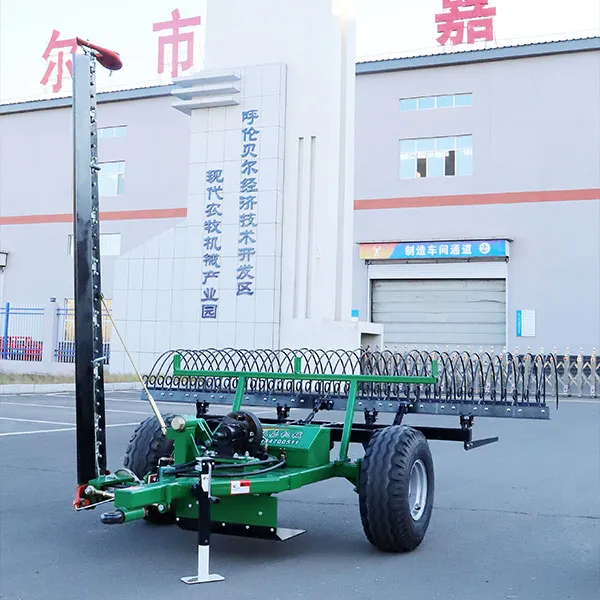
Here we can mention an example likeHulunbuir Machinery Manufacturing Company ?Jiujia?. Their website (https://www.cn-fascar.ru) positions them as a modern, integrated smart manufacturing enterprise for agriculture and livestock. What does this mean in practice? Often such companies, especially those cooperating with Chinese partners, work according to a model: a basic platform or components are brought in, and then modified, “sharpened”? for specific local conditions - different soils, different climates, specific agricultural technologies.
Such production can hardly be called a city in the classical sense. Often this is an industrial zone on the outskirts or even in the suburbs. But this is where solutions to specific problems are born. I saw how they modified the baler to work in the high humidity conditions in the north - they added reinforced augers and a different piping system. This is the same “integrated enterprise” that combines on-demand development, assembly and service. It is important that they do not just sell, but accompany the equipment, which is sometimes more important for a farmer than the brand.
Localization problems and ?screwdriver? assembly
This is perhaps the most painful topic in conversations with colleagues. Many new industries, especially those that have appeared in the last decade, are assembly sites. The city may report on a new production plantagricultural machinery, but in fact there are processes going on there that are more like a construction set: containers with units arrived, they were connected, painted, and a sign was screwed on. The localization depth is minimal.
On the one hand, this gives quick results and allows us to saturate the market with affordable equipment. On the other hand, it is killing domestic cooperation and the engineering school. I remember trying to find in Russia a manufacturer of high-quality gearboxes to drive a fan for a combine harvester. It turned out that it was easier and more reliable to order in Germany than to set up production here, because the necessary machines and specialists were no longer available.
Another nuance is the build quality. In a large historical plant there is a culture, a technological discipline that is passed on from master to apprentice. On the new "screwdriver" The lines are often staffed by people who came in from the street yesterday. The result is predictable: backlash, leaks, electrical problems. Then all this is attributed to “harsh Russian conditions”, although the root of the problem is in the organization of the process.
The role of logistics and raw materials
The choice of city for production is often dictated not so much by historical prerequisites as by cold logistics calculations. Where is it cheaper to deliver metal? Where is closer to the main consumer - the grain region? Where is the available capacity and workforce? Sometimes production appears where a Soviet factory has closed, leaving workshops and a core staff of engineers and workers.
For example, in some cities of Central Russia the production of mounted and trailed equipment is now actively developing. Why? Because nearby is the Black Earth Region, a powerful agricultural region. There is no need to transport a heavy harrow or seeder across the country; it can be assembled almost on the spot. This saves huge amounts of money. And such cities are gradually becoming new centers, albeit for a segment of not all equipment, but part of it.
Raw materials are a different story. The production of steel frames and frames gravitates towards metallurgical centers. But for the manufacture of cabins with modern plastic cladding, a different type of supplier is needed. Therefore, more and more often we see dispersed production: the frame is made in one city, the cabin in another, and the final assembly in a third, closer to test sites and dealers. And in this sense, the question is: in which city is it produced? becomes incorrect. It is more correct to ask about the production chain.
A look into the future: what will happen to the geography of production
I think the trend towards dispersal and specialization will continue. Large, complete factories in megacities will increasingly shift to the role of final integrators and development centers. And the physical production of parts and assemblies will shift to regions with lower cost of resources, to industrial parks and special economic zones.
Enterprises like the one mentioned will begin to play a special roleHulunbuir company ?Jiujia?, which focus on comprehensive solutions for a specific sub-industry - in their case, livestock. Their strength lies in their narrow specialization and deep understanding of the needs of the end user. They don’t need to be in the capital or a million-plus city. Their plant can be successful in any city, the main thing is that there is strong agricultural science and experienced agronomists nearby with whom you can conduct a dialogue.
Robotization and digitalization are also inevitable. This could lead to a new concentration, but this time around competence centers in IT and electronics. A city that has a strong technical university dedicated to robotics has every chance of becoming a new center of attraction for the production of intelligent technology.agricultural machinery. This is no longer about metalworking, but about software and sensors.
As a result, the map of agricultural machinery production is becoming more and more colorful and dynamic. The old centers will not go away, but their share will change. New points on the map will appear, connected not with the past, but with the future of the industry - digital, precision farming, robotization. And answering the question “in which cities are they produced?”, in ten years, perhaps, we will name completely different names.
Correspondingproducts
Related Products



Best Sellingproducts
Best Selling Products-
 Mower-conditioner model 9GQY-3.2
-
 Self-propelled mower-conditioner 9GYZ-4.9
-
 Trailed single-drum combine harvester 4DQ-5 for bean threshing
-
 9YG-2.24D Round Baler (S9000)
-
 9YG-1.25 Round Baler
-
 Baler for forming rectangular bales 9YFQ-1.9 (cross grip, export to Russia)
-
 Drum type raking machine 9LG-9.0
-
 Cross-grip baler for forming rectangular bales 9YFQ-1.9 (export to Mongolia)
-
 9LZY-9.0 Finger-disc rake
-
 9GD-2.5 Single-blade trailed mower (updated version)
-
 Cross-row baler for forming rectangular bales, model 9YFQ-2.2C (export to Mongolia)
-
 9GL-5.0/5.6 Trailed mower rake