




production of agricultural machinery
When they talk aboutproduction of agricultural machinery, many immediately imagine metal welding and a conveyor. But this is just the tip. The real difficulty begins when you need this equipment to actually work in the field - in mud, in dust, at minus thirty and at plus forty. This is where the difference between simply “produced” is visible. and “designed for business”. I went through this myself when ten years ago we tried to adapt a common tractor module for heavy soils in the Altai Territory - it worked, but the service life of the units was half the calculated one. We had to reconsider everything: from the steel grade to the frame geometry. This is the very “kitchen” that is rarely written about in brochures.
From the drawing to the first furrow: where the pitfalls lie
Take, for example, the process of developing a plow. It would seem that nothing new can be invented. But this is where many manufacturers stumble on seemingly trifles. The plowshare material is a different story. If you take one that is too hard, it will hold an edge, but may crack from impact on rocky soil. Too soft and it will quickly become dull. At one time we tried several options until we settled on a certain brand of wear-resistant steel with the addition of manganese. But this is not a guarantee either. The hardening technology is also important - if you overheat it, it will become brittle.
What about the assembly? You can do everything perfectly according to GOST, but if, when assembling the fastening unit, you do not take into account possible vibration loads that are not recorded by static tests, backlash will appear after a season of operation. We had a case with a cultivator - everything was calculated, but during field tests a nut on one of the levers began to unscrew. Trifle? And idle equipment on hundreds of hectares is a huge loss for the farm. I had to modify it for a self-locking thread and install an additional lock. Such improvements?as a result? - normal practice if the company is really responsible for the product.
This is why I respect companies that don’t just follow a plan, but have their own full cycle from idea to testing. For example, I see a websiteHulunbuir Machinery Manufacturing Company ?Jiujia? (https://www.cn-fascar.ru). Their description states that this is a modern integrated enterprise combining R&D, production and service. This is the key point. If R&D is under the same roof as the shop floor, engineers can come in at any time, look at the process and immediately make adjustments. This is incomparably more efficient than when the design bureau is located a thousand kilometers from the plant.
What is intelligent manufacturing really about?
Nowadays it is fashionable to say “intelligent manufacturing”. In contextmanufacturing of agricultural machinerythis often comes down to robotic welders and an automated painting line. Yes, this is important for quality and repeatability. But for me, intelligence in manufacturing starts somewhere else - with a system that allows you to track every detail. Let's say a complaint comes from a customer regarding a specific serial number of a baler. Is it possible to quickly understand what batch of bearings was in this assembly, who was the operator during the assembly, and under what parameters this frame was welded? If yes, this is the basis for real quality control and quick problem solving.
Implementing such systems is a painful process. It requires a restructuring of the thinking of all personnel - from the worker to the shop manager. I remember how we introduced digital maps for assembly. People resisted - “they collected it somehow before?” But when, six months later, it was possible to localize the cause of the system defect within an hour (it turned out to be a substandard batch of hydraulic hoses from one supplier), everyone saw the direct meaning in this. This is not ?big data? for a report, but a real tool.
Returning to the example of Jiujia, their emphasis on smart manufacturing in agriculture and livestock farming suggests such an integrated approach. It is important that they also cover livestock farming - this is a different specificity, different machines (feed dispensers, milking systems), but the principle is the same: the equipment must work in an aggressive environment (humidity, ammonia) and be convenient for daily maintenance. If their engineers and technologists understand these nuances from the inside, and do not simply copy other people's samples, it is worth a lot.
Service as a continuation of production
This is perhaps the most vexing issue in the industry. You can make a good car, but if it breaks down - and in agriculture everything breaks down, the only question is when - the client must get help quickly. Not in two weeks, but preferably tomorrow. This is where spare parts logistics become critical. Many of our failures at the beginning of our journey were connected precisely with this: we made a unique unit, optimized it, but did not establish a system for supplying service centers with these units. As a result, customers waited months for repairs.
Now we do things differently. When designing a new model, we immediately lay down the so-called “repair portfolio”. — a list of the most likely to fail parts that should be in the regional warehouse in the required quantity. This requires in-depth analysis of breakdowns on previous models and prediction. Ideal when the manufacturer is the sameHulunbuir Machinery Manufacturing Company ?Jiujia?, combines production, sales and service. This means that feedback from the client to the designers follows a short path, and the next batches of equipment will take these field comments into account.
I always give the example of hydraulics. On paper, the calculation of pressure and pump performance may be ideal. But in the field, when the filter gradually becomes clogged with straw and dust, the behavior of the system changes. If service engineers regularly report that on certain models, customers most often complain about the slow operation of hydraulic cylinders under such conditions, designers can modify the filtration system or select a pump with a different performance margin. Without a close connection between production and service, such targeted work is impossible.
Adaptation vs. Copying: the path to a sustainable product
Our market has long been dominated by the approach of simply copying proven Western designs. This gave quick results, but had a ceiling. Soils, climate, agricultural technologies, even the mentality of machine operators - everything is different. Equipment that works ideally in the Canadian prairies can choke in the black soil of the Kuban or in the waterlogged fields of the Non-Black Earth Region.
Therefore, now the vector is shifting towards adaptation and independent development. It's more complicated and more expensive. It requires not only engineers, but also agronomists on staff, its own testing grounds, where you can “race”? equipment in different conditions all year round. This is what separates temporary workers from those who plan to stay in the industry for a long time. When you see that a company positions itself as an integrated enterprise with a full cycle, you hope that they are investing in this deep adaptation to real conditions.
For example, whenmanufacturing equipmentTo prepare forage, it is necessary to take into account not only the yield, but also the moisture content of the mass, the length of the stem, and the weediness of the field. The parameters of a baler or mower taken from a European manufacturer’s catalog may not provide the required quality of silage or haylage in our conditions. It is necessary to change cutting angles, roller settings, and pressing pressure. This is painstaking work, the result of which is visible only after a season, or even several seasons of operation. This cannot be done without our own serious R&D.
Looking Ahead: What Will Matter Tomorrow
If we put aside the marketing noise about “digitalization”, then the main trend that I see is not just “smart”? technology, but technology that becomes part of a single agro-technological chain. The combine or the tractor are no longer isolated units. Data from their sensors (yield, humidity, soil condition) directly affects work planning, logistics, and fertilization.
For the manufacturer this means that whenproduction of agricultural machineryIt is necessary, already at the design stage, to establish compatibility with common precision farming systems, to provide places for installing additional sensors, to standardize connectors and data transfer protocols. This is a new level of difficulty. And companies that are already building their production as an integrated and research platform, like the one we were talking about (cn-fascar.ru), are in a more advantageous position. They have a process for creating ?iron? and its ?digital? filling can go in parallel, in one control loop.
Ultimately, it all comes down to one thing: whether the technology will help the farmer get a larger and better harvest at lower costs. All these complex words - intelligent production, integration, service - make sense only when at the end of this cycle there is a satisfied client, whose technology did not fail at the most crucial moment. And for this it is necessary that the one who makes it deeply understands why and under what conditions it will be used. Experience, mistakes, constant improvements - this is the very “practical knowledge” that not a single most advanced machine can replace.
Correspondingproducts
Related Products




Best Sellingproducts
Best Selling Products-
 9GL-5.0/5.6 Trailed mower rake
-
 9YG-1.25 Round Baler
-
 4BYHD 4BYHS-3.9 Pulling machine for beans
-
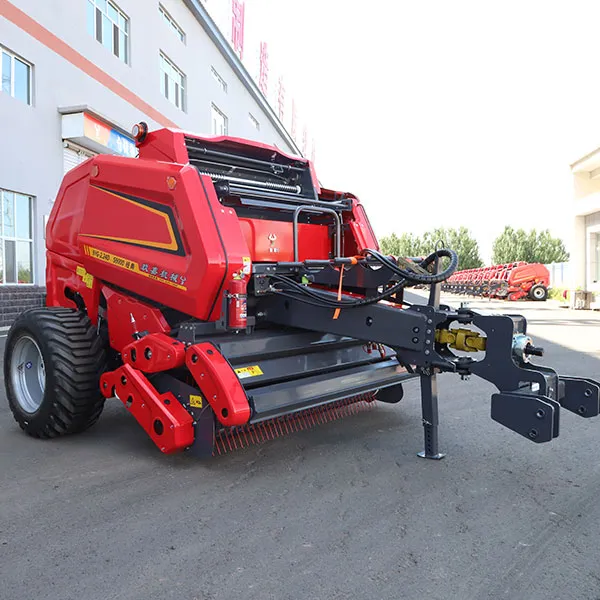 9YG-2.24D Round Baler (S9000 Classic)
-
 9JYY-2.5 Roll pick-up-conveyor
-
 9JYY-4.5 Roll pick-up-conveyor
-
 9GL-2.5/2.9 Trailed mower rake
-
 9LH-12 Trailed cross rake
-
 9YG-1.25 Round baler FASCAR
-
 9YG-2.24D Round Baler (S9000)
-
 Self-propelled mower-conditioner 9GYZ-4.9
-
 Mower-conditioner model 9GQY-3.2