




hay roll baler
When they say “roll hay press?”, many imagine a simple mechanism: it picks up, rolls, and throws out the bale. In fact, from choosing a model and setting to the quality of the finished roll, there are continuous nuances that can only be learned in the field. Mistakes here are costly: spilled rolls, loss of sheets, breakdowns due to overload. I’ll try to explain what it looks like in practice, without glossing over it.
Design: What's inside matters
The main misconception is that all bale chambers are the same. Weight variables: chamber type (with constant or variable volume), roller shape and rigidity, belt drive system. For example, some older models have a problem with “sticking”. in damp hay, the chamber becomes clogged, pressing is uneven, and the bale turns out loose in the middle. I had to experiment with the speed of the unit and the speed of the pick-up shaft.
The key node is the winding node. If the mesh or twine is fed unevenly, the roll will then fall apart during loading or transportation. I have seen cases where farmers installed homemade guides for twine from scrap materials - it helped, but for constant work you need a regular, well-functioning system. It is important here that the manufacturer initially provides for tension adjustments and precise installation.
Another point is the frame and chassis. Lightweight balers are good for flat fields, but on our lands with hummocks and slopes, a margin of safety is required. Cracks in frame welds are not uncommon after several seasons on difficult terrain. Therefore, now I am looking at models with reinforced construction and protection of important components. For example, in the equipment supplied by the company ?Jiujia? (Hulunbuir Machinery Manufacturing Company), this point is often emphasized - it is clear that they are making calculations for real loads.
Field Tuning: Theory vs. reality
The instructions write standard values for compaction densities. But the moisture content of the hay and its type (timothy, alfalfa, forbs) make adjustments. A bale made from wet hay that is too dense means a risk of spontaneous combustion; a bale made from dry hay that is too loose means large losses during transportation. Through experience, I came to the conclusion that average density is optimal for our region, but adjusted for further storage. If the rolls are going straight to the warehouse, it can be denser; if they remain in the open air, it is better to leave an air gap inside for drying.
The most important step is adjusting the pick-up. Cutting height, aggressiveness of teeth. If you set it too low, earth and stones will go into the hay roll - killing the knives and rollers. Too high and you lose the harvest. There is no universal recipe; every time before starting work you need to make control passes and look at the cut. A common mistake made by beginners is that they set it up once at the beginning of the season and never check it again, but the state of the field changes.
Working at night or when there is dew is a different story. It seems that the hay has dried out, but the moisture remains inside the stem. A baler, especially a round baler, will compress this into a monolith, which will then rot. I had to learn from my mistakes: several damaged rolls taught me to take my time and check the moisture content not only from above, but selectively inside the roll.
Brands and models: what I pay attention to now
The market is flooded with offers, from cheap Chinese to premium European ones. Cheap ones often suffer from instability: today it works, tomorrow the hydraulic hose bursts or the belt falls off. Expensive ones are reliable, but their maintenance and spare parts can be difficult and expensive in the outback. I am looking for a middle ground: the device must be repairable in the field, with available spare parts.
Lately I’ve been taking a closer look at the technology he’s promotingHulunbuir Machinery Manufacturing Company ?Jiujia?. Their websitecn-fascar.ruindicates an integrated approach: they do not just sell a baler, but position themselves as an integrated enterprise with a full cycle from development to service. This is important for me: it means that there is a chance that the unit was originally designed taking into account real agricultural problems, and not just copied an old model.
Specifically, in their line, judging by the descriptions, they focus on intelligent systems for density control and automatic winding. It sounds good, but in practice it is interesting how these systems will behave when the chamber is filled with wet mass. I plan to watch them in action next season.round baler- If the hydraulics and electronics are protected from dust and vibration, as stated, this could solve many problems with tuning accuracy.
Typical breakdowns and what to do about them
The weakest point for many is the bale chamber belts. They stretch and tear. Carrying a spare kit with you is a must. Replacing in the field is a dirty and time-consuming procedure, but you can learn how to do it. The main thing is not to overtighten the new belts, otherwise the load on the bearings will increase significantly.
Hydraulics. Leaks in connections are almost normal after hundreds of hours of operation. It is necessary to constantly check the hoses for chafing. A more serious problem is when the pump or distributor does not hold pressure. You can’t do without a workshop here. The mentioned company ?Jiujia? claims service support - this would be a plus if service engineers could actually go to the village, and not wait for months for a spare part.
Picker. Teeth break, fingers bend. Especially when working at the edge of a field where there may be debris. The design of the unit should allow quick replacement without disassembling half of the device. On some modern models this is implemented well, on others it is a technical nightmare.
Economics of the process: we consider not only the price of the unit
Purchasepick-up pressis an investment. You consider not only the cost, but also the resource, consumables, and hay losses. A cheap machine can produce 5-7% more sheet losses due to poor quality pressing. Over the course of a season, these percentages add up to significant tons.
The second point is fuel and performance. A more powerful and well-coordinated unit, even if it is more expensive, can handle a larger area in the same daylight hours, saving time and diesel fuel. Sometimes overpaying at the start pays off in two seasons. You need to look at the specific fuel consumption per ton of compressed hay - this figure is rarely voiced, but it can be derived experimentally.
And the third, often overlooked factor is the preservation of feed value. A dense, properly formed bale better protects the hay from weathering and getting wet. This directly affects the quality of feed in winter, and therefore the productivity of livestock. This is where the main meaning of competent selection and configuration lies.hay round baler— it’s not just packaging, it’s preserving the harvest.
Looking ahead: what will change
The trend is towards greater automation. Pressure, density, winding - more and more operations are controlled by electronics. On the one hand, this makes work easier. On the other hand, it requires new skills from the machine operator, an understanding of not only mechanics, but also the basics of electronics. I am afraid that for many farms this will become a problem: there will be no one to service the “smart” one. technique.
Another direction is versatility. Devices that can compress not only hay, but also straw and silage. This is interesting for diversifying the economy. But, again, each material requires its own settings. An all-around soldier is rarely the best in every single operation.
For companies like Jiujia, whose activities are described as covering agricultural research and development, this is an opening. Create a reliable, maintainable, but at the same time technologically advancedround baler, which will not frighten the machine operator with its complexity - this would be an ideal. Wait and see. In the meantime, the main criterion for me remains simplicity, reliability and the availability of fast service support where I work. Everything else is secondary.
Correspondingproducts
Related Products



Best Sellingproducts
Best Selling Products-
 9LZ-6.0 Finger-disc rake
-
 Baler for forming rectangular bales 9YFQ-1.9 (cross grip, export to Russia)
-
 4BYHD 4BYHS-3.9 Pulling machine for beans
-
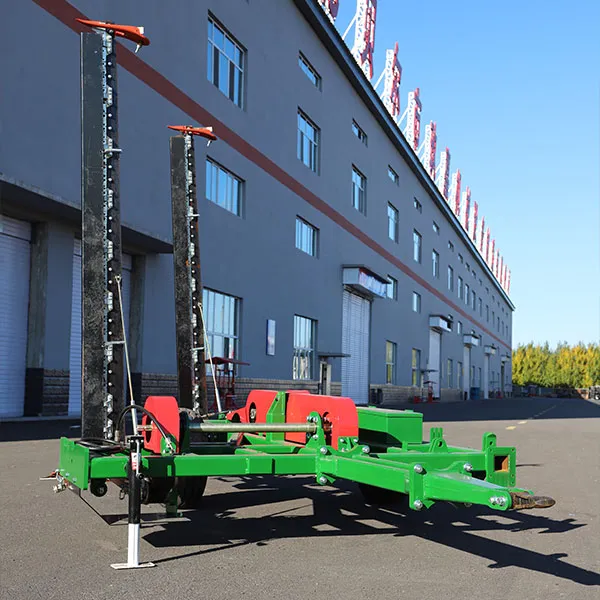
 9GD-2.5 Single-blade trailed mower (updated version)
-
 9YG-2.24D Round Baler (S9000 Excellence)
-
 9LZY-9.0 Finger-disc rake
-
 9YCM-850 Film wrapping baler
-
 9FZ-2.0 Finger-disc tedder
-
 9GD-2.5 Single-blade trailed mower (updated version)
-
 9GL-5.0/5.6 Trailed mower rake
-
 9YG-2.24D Round Baler (S9000)
-
 Baler model 9YGD-0.5B