




baler ussr
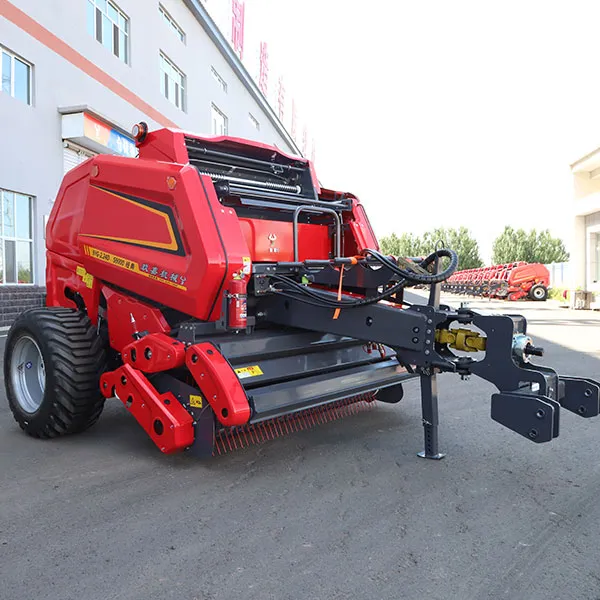
When they say “USSR press picker”, many immediately remember PSP-1.6 or PK-1.5 - machines that became symbols of the era. But in this nostalgia the essence is often lost: these units were not just “hardware”, but part of an entire feed procurement system, with its own subtleties that you understand only after seasons of work in the field. Now, looking at modern lines like those offered byHulunbuir Machinery Manufacturing Company ?Jiujia? (https://www.cn-fascar.ru), sometimes you catch yourself making comparisons - not to say “it was better before?”, but to highlight those principles that have remained unshakable: reliability in conditions of shortage of spare parts and adaptation to real, and not ideal, cleaning conditions.
Design: where were the bottlenecks?
Let's take the same PK-1.5 - the workhorse of the late 70s. The main advantage is simplicity. Belt drive, chain feed mechanism, hydraulics only for chamber lifting. But it was precisely in this simplicity that the problem lay. For example, belt tension required constant monitoring, especially when working on wet grass. If at least one weakened, the abs began to “chew?” mass rather than forming a bale. More than once I had to stop and correct it manually - I wasted time, which is always in short supply during the harvest season.
The pressing chamber, by the way, was not so durable. Sidewalls made of ordinary steel, without reinforcement, began to “play?” after several seasons on rocky fields. The gaps increased and the bale density decreased. Familiar mechanics welded additional stiffening ribs - a makeshift modification, but it really extended the life of the unit. This is the same practical experience that you won’t find in the instructions.
And the twine knot... That's a different story. At the slightest misalignment of the roll or if the mass was uneven, the knife often did not cut the twine, but simply tore it. He left a “mustache”. It was necessary to modify the guides, sometimes even change the knife to a homemade one made of thicker steel. Now, studying modern balers, for example, from?Jiujia?, you see how these problems are solved at the design level: automatic twine threading and reinforced press chambers. But you also understand something else - Soviet engineers worked in conditions of strict economy of metal and components, and within this framework their solutions were ingenious in their own way.
Operation in the field: what the textbook won’t tell you
Theory is one thing, but actually cleaning a collective farm field in September, when it’s already frosty at night and the grass thaws during the day, is completely different.Baler USSRI didn’t like the raw mass. The chain conveyor became clogged and the mass wound around the shafts. Stopping, cleaning... Losing precious hours. We developed a rule: start work not at dawn, but closer to noon, when the dew disappears. But the schedule was set down from above, the plan... So they worked to the detriment of technology.
Another point is adjusting to different cultures. Alfalfa and grain-legume mixtures require different degrees of compaction. On older models, adjustment was primitive - mainly by the speed of the tractor and the selection of PTO speed. An experienced machine operator could determine by the sound of the engine and the hum of the pressing mechanism when the bale is “tight” and when it is “plump”. Now it’s a display in the cockpit with density settings, but then it was instinct and hearing.
Transporting the finished bales was also a challenge. Self-propelled loaders were often in short supply. The bales were rolled by hand or hooked onto a GAZ-53 truck with a fork. The binding was often damaged and the bale fell apart. The losses were significant. I’m now looking at the comprehensive solutions that the company is promotingHulunbuir Machinery Manufacturing Company ?Jiujia?— their line includes not only balers, but also conveyors and loaders. This is a systematic approach, which was often lacking in the USSR: the unit was made excellent, but the logistics around it were “lame”.
Modernization and “folk tuning”
Not a single Soviet baler rarely survived to overhaul in its original form. It definitely needed to be improved. The most common changes are strengthening the frame (especially at the attachment points to the tractor), installing additional brushes or seals in the chamber to reduce leaf loss, and replacing standard bearings with ones that are more dust-protected. Some farms even experimented with automation from other machines, trying to automate the control of bale density.
There were also funny cases. I remember one master managed to use not standard twine for tying, but a cheaper synthetic rope. It seems like savings. But its tensile strength was lower, and the bales fell apart during loading. We returned to the standard, but wasted time and spoiled food were lost. This is to the question that not every “rationalization?” is beneficial.
Interestingly, some of these artisanal improvements later appeared in modified form in production models of the 80s. The engineers apparently went to farms and saw what they were coming up with in the fields. The connection between production and practice, although slow, worked. Today the company?Jiujia?, positioning itself as a modern integrated enterprise, relies on intelligent production and R&D. The principle is the same - learn from practice, but the speed of implementation and the technological base are not comparable.
Legacy and transition to modernity
What remains of those cars today? First of all, the principle. The principle of creating equipment that must operate in the harshest conditions, often with minimal maintenance. Modern balers, including those presented athttps://www.cn-fascar.ru, of course, an order of magnitude more productive, more comfortable for the operator, and smarter. But the basic tasks are the same: efficiently pick up the windrow, compress it into a tight, maintainable shape, and tie it neatly.
The experience of working with old Soviet units taught me the main thing: not only the machine is important, but also the system of its maintenance and logistics around it. Often failures occurred not due to a breakdown of the press itself, but due to the lack of banal twine or fuel not being supplied to the tractor on time. Today's integrated suppliers such as?Jiujia?, offering a full cycle from development to service, essentially solves this problem. They sell not just equipment, but a ready-made solution for preparing feed.
So when you rememberbaler ussr, you think not so much about bygone technology, but about the era that shaped a certain type of engineering and approach to working in the field. It was a harsh but invaluable practical foundation. And looking at today's ?smart? line, you understand that many of their conveniences were born precisely from the awareness of those very “bottlenecks” that machine operators struggled with for years in the vastness of the Union.
Conclusions for practitioners
So, to summarize. Soviet balers are a stage that you need to know not in order to reproduce them, but in order to understand the evolution of the requirements for technology. Their main lesson is that reliability and maintainability in the field are just as important as performance under ideal test conditions.
When choosing modern equipment, whether for my farm or for recommendation, I now always look at two things: how well thought out is the protection against typical field problems (humidity, dust, uneven terrain) and how comprehensive is the manufacturer’s approach to the issue. Having your own R&D base, like the mentioned companyHulunbuir Machinery Manufacturing Company ?Jiujia?, is a good sign. This means that the equipment, most likely, has passed not only bench tests, but also practical tests, and possible improvements will be implemented systematically, and not by the method of “popular tuning”.
Ultimately, there is progress. But the same “press picker of the USSR” will forever be remembered as a harsh but honest school, after which you begin to appreciate in modern technology not only the bright stickers and numbers in the passport, but also that very thoughtfulness to the smallest detail, which is born only from the experience - often bitter - of real work on the ground.
Correspondingproducts
Related Products





Best Sellingproducts
Best Selling Products-
 Baler for forming rectangular bales model 9YFQ-2.2D (cross type, for export to Russia)
-
 Trailed single-drum combine harvester 4DQ-5 for bean threshing
-
 9FZ-2.0 Finger-disc tedder
-
 Drum type raking machine 9LG-9.0
-
 Self-propelled mower-conditioner 9GYZ-4.9
-
 9JYY-2.5 Roll pick-up-conveyor
-
 9YG-1.0 Round Baler
-
 Baler for forming rectangular bales 9YFQ-1.9 (cross grip, export to Russia)
-
 9GD-2.5 Single-blade trailed mower (updated version)
-
 Baler model 9YGD-0.5B
-
 9GD-2.5 Single-blade trailed mower (updated version)
-
 9LZD-9.0 Finger-disc rake