




metal press picker
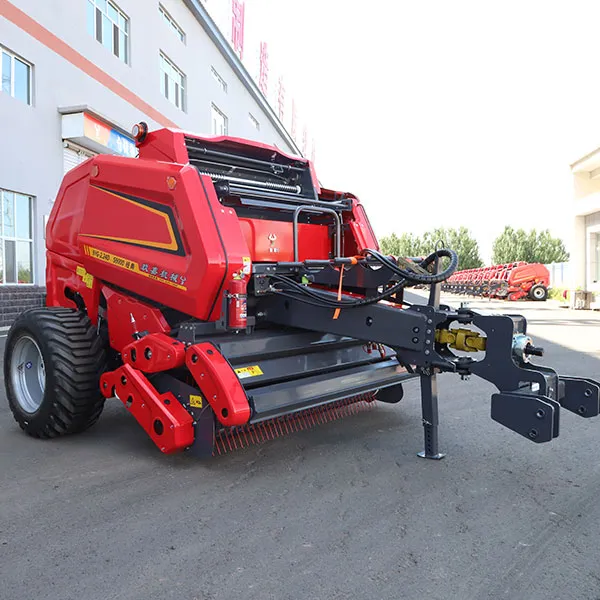
Here is a term that misleads many people - “metal press picker”. One immediately imagines something monstrous at a metallurgical plant. But in practice, especially on small farms or at collection points, it is often a question of adapting a conventional agricultural square baler to work with scrap metal. And this is not always a good idea.
From hay to tin: the limits of the possible
I'll start with the main thing: a standard baler, whether rotary or piston, is designed for the density and resistance of the plant mass. Springs, gears, belts - all of this has a safety margin, but it is not unlimited. Trying to stuff scraps of sheet metal, wire, or worse, small steel parts into the chamber is an almost guaranteed recipe for failure. The most common outcome is deformation of the fingers, bending of the pressing bar, or, at best, breakage of the drive belt.
Why then do they do this? The answer is simple - savings. A specialized press for scrap metal costs serious money, and an old Claas? or ?John Deere? already on the farm. I saw how on one of the farms near Chita they were trying to press tin cans and scraps of roofing iron. We got “bales”, but at what cost... The inside of the bale chamber was covered in scratches and dents, the feed mechanism was groaning so much that it seemed like it was about to shatter. Productivity was scanty, and wear and tear was colossal.
There is a nuance with the type of metal. Soft aluminum or copper scrap, thin tin - the unit can handle them if you do it very carefully and in doses, mixing, for example, with dense straw. But steel, even thin, is already too much. It does not compress like plant mass, but springs and creates critical stress points in the machine components.
Chinese solutions: universality or compromise?
Here it is worth mentioning companies that see this niche and are trying to offer more suitable options. Take, for example,Hulunbuir ?Jiujia Machinery Manufacturing Company. On their websitecn-fascar.ruposition themselves as a modern integrated enterprise for the agro-industrial complex. Studying their catalog, you can notice an interesting trend: they often offer enhanced modifications of their equipment.
Specifically on the topicmetal press pickerthey, strictly speaking, do not have a separate model. But in a dialogue with their technologists (I had to talk a couple of years ago on another issue), the idea slipped through that some lines of balers, especially for forming large bales, are designed taking into account the possibility of processing not only straw, but also other, more rigid materials of plant origin - for example, corn stalks or cane. This is closer to our topic: reinforced frames, more powerful hydraulic systems.
However, it is important to understand: even a reinforced agricultural machine is not a metal press. The Jiujia company, like others, primarily solves the problems of agriculture. Their equipment may be more durable, but using it for constant work with a crowbar means ignoring its intended purpose. It's like trying to chop wood with a kitchen hatchet: maybe it will work, but not for long.
Practical observations and “crutches”
From my own experience I have come across handicraft modifications. In order to somehow protect the mechanism, craftsmen install additional protective plates in the pressing chamber, replace standard knives with homemade ones made of harder steel, and install high-strength safety shear bolts. Sometimes it helps. More often than not, it simply delays the moment of serious breakdown.
An acquaintance who accepts non-ferrous scrap adapted an old rotary pick-up specifically for aluminum shavings and thin foil. The key was to reduce the drive speed and install a magnetic separator at the inlet to prevent stray steel chips from getting inside. He still works, but he admits that he is looking for a used specialized press, because the current solution is a constant headache with adjustments and the risk of sudden downtime.
Another point is safety. When pressing metal, there is always a risk of sharp chips or wire flying out of the chamber. Standard agricultural implements are not designed for this. It is necessary to weld additional protective covers, which impairs visibility and complicates maintenance.
When is it still possible? Narrow scenarios
So is there a situation where the bunch is ?baler metal? has the right to life? I think so, but these are very specific conditions. Firstly, it must be exceptionally light, soft and clean (without any hard steel impurities) scrap. Secondly, we are talking about occasional, not regular work. Thirdly, the unit must be initially powerful and simple in design - the less electronics and complex kinematics, the better.
For example, for pressing large volumes of empty aluminum containers (cans) before delivery. But even here the efficiency will be lower than that of a specialized baling press. The bale will be less dense, the cycle will be longer.
Therefore, if we are talking about a serious volume or heterogeneous scrap metal, all these experiments with agricultural machinery are a false economy. The cost of one major overhaul of the baler after such violence will easily cover all the benefits from the scrap delivered. It’s better to immediately look for options with a real metal press, even a used one. Or consider the services of third-party companies that have such equipment.
Conclusions and final thoughts
As a result, the termmetal press picker- this most often does not mean an ideal solution, but a forced practice bordering on operating equipment to the limit. Companies like?Jiujia?, by making reliable equipment for agriculture, can indirectly provide a stronger platform for such experiments, but they do not advertise or guarantee them.
If you need a solution for a small business or farm where there is a periodic need to dispose of metal waste, you may want to look towards small-sized hydraulic balers. Yes, it's different money. But this is another level of reliability, safety and, ultimately, profitability.
And an adapted agricultural press is always a palliative. It can work, but it requires constant attention, preparedness for breakdowns and a deep understanding of how the machine works from the inside. Without this, you will only end up with damaged equipment and wasted time.
Correspondingproducts
Related Products



Best Sellingproducts
Best Selling Products-
 Self-propelled mower-conditioner 9GYZ-4.9
-
 9YCM-850 Film wrapping baler
-
 9LZY-9.0 Finger-disc rake
-
 Baler model 9YGD-0.5B
-
 9LH-12 Trailed cross rake
-
 9YG-1.25 Round Baler
-
 Cross-row baler for forming rectangular bales, model 9YFQ-2.2C (export to Mongolia)
-
 Baler for forming rectangular bales model 9YFQ-2.2D (cross type, for export to Russia)
-
 Mower-conditioner model 9GQY-3.2
-
 9GL-2.5/2.9 Trailed mower rake
-
 9GD-2.5 Single-blade trailed mower (updated version)
-
 9YG-1.25A Round Baler FASCAR