




baler with bale wrapper
When they talk about a baler with a roll wrapper, many people immediately think about film and the finished roll. But the point is not in the machine itself, but in what happens to the feed inside this roll. A common mistake is to chase the speed of winding or the cheapness of the film, forgetting about the main thing: the quality of pressing and tightness. If the hay or straw is not compacted tightly, or the winding lies with gaps, the whole point is lost - the feed spoils. I went through this myself when, in pursuit of volume, I overlooked the settings of the pressing chamber on one of the old units. The result is mold along the edges of the roll and dissatisfied customers.
From pressing to wrapping: where the problems lie
Let's start with the basics - the bale chamber. In modern balers, especially from the same Chinese manufacturers like the Hulunbuir company ?Jiujia? (websitecn-fascar.ruI see in dealer catalogs), now they often install adjustable chambers with hydraulics. But adjustment is not “set it and forget it”. For each type of mass - aged grass, wet hay, straw - you need to select the pressure. If it’s not enough, the roll is loose and will “breathe”. and warm up even under the film. If there is a lot, the tightening belts may break or the load on the wrapper will increase. I usually make a test roll on a new field first, then cut it and look at the structure. Only then do I go to full load.
The wrapper itself. It would seem like a simple unit: film, feed mechanism, roll rotation. But there are two critical points here: film tension and overlap of turns. Weak tension - the film will sag, condensation will appear and air will enter. Too strong and it will break at the slightest tension, especially at the corners of the roll. On one of the pressesbaler with bale wrapperfrom the Jiujia, which we tested a couple of seasons ago, there was a problem with the spring tensioner - it got tired. after 200-250 rolls, the tension dropped. I had to install an additional brush-clamp for the film, a homemade one. The manufacturer, by the way, later modified this unit in new batches.
And the third point that is often overlooked is the starting film grip. Especially in windy weather. If the gripping mechanism is unreliable, the first turns will lie crookedly and the entire roll may be damaged. I have seen how operators stick the beginning of the film with tape to the roll - this is a crutch that indicates a problem in the design. A normal unit must have either a pressure roller with teeth or a vacuum suction cup. At the samepick-up pressfrom the mentioned company the system had a roller, but it had to be regularly cleaned of adhering plant mucus, otherwise it would slip.
Humidity and film: subtleties that are not written in the instructions
Manufacturers write: work at mass humidity up to 18-20%. But in reality, especially in our region with morning dew, you often take the mass on the verge of 22-23%. And here the solution is not in the baler, but in the choice of film. A standard 5-layer 750 mm film may not stretch; you need a more elastic one, with a reinforced inner layer. We tried several brands, and eventually settled on the one that has micro-perforations (not to be confused with holes!). It allows you to “breathe” a little. condensate without breaking the seal. But such film is more expensive and must be ordered in advance.
An important nuance is the number of winding layers. Everyone recommends 6-8 layers. But I came to the conclusion that for heavy silage 8 is better, and for dry straw 6 is enough, but with a mandatory overlap of 50-55%. If there is less overlap, the seam will be vulnerable. By the way, some cheap wrappers have a film width of only 500 mm, and in order to achieve normal overlap, you have to make more turns, overusing the film by 15-20%. This is the same saving that leads to losses.
And one more thing about film - color. Black, white, green... It's not for beauty. Black is better for outdoor storage - it heats up less in the sun. White - for control: it is better to see under it if the film is sagging or torn. For critical batches of feed (alfalfa, clover) we use white, even if it is more expensive. And we store the rolls in the shade, if possible.
Integration into the farm: not only buy, but also service
When you lookbaler with bale wrapperAs part of the technological chain, the question of logistics arises. The film-wrapped roll is not the final product. It needs to be transported, stored, and sometimes fed through a feed dispenser. The dimensions and weight of the roll must match your technique. We had a case: we bought a powerful press that made rolls 1.4 meters wide and weighing about 900 kg. But the old loader could not lift them onto a high stack. We had to buy additional equipment, which negated all the benefits from the press’s performance.
Therefore, now, when I look at proposals, for example, from the Hulunbuir Machinery Manufacturing Company ?Jiujia? (and they position themselves as a modern integrated enterprise for intelligent production for agriculture), I pay attention not only to the characteristics of the press, but also to whether they have compatible loaders or conveyors in their line. An integrated approach is the right thing to do. Their websitecn-fascar.rushows that they rely on complete solutions rather than piecemeal technology.
Service. The wrapper is a delicate device. Film cutting knives, bearings in rollers, sensors - all this requires cleaning and lubrication every day of work. It’s better to spend 20 minutes in the evening than to stand idle for half a day in the middle of mowing. I have introduced a rule: the operator does not turn off the unit until he cleans the film guides and checks the stock in the cassette. It's a small thing, but it saves you from downtime.
The price of the issue: when savings lead to losses
The market is flooded with offers, especially in the middle and low price segment. The temptation to buy cheaper is great. But here it is not the cost of the machine that needs to be considered, but the cost of the finished bale of preserved feed. A cheap baler may have a weak winding unit that tears the film or winds crookedly. As a result, some of the rolls go to waste. Or the service life of the main components (for example, springs in the pressing chamber) is designed for 2-3 seasons, after which expensive repairs are required.
I'm looking at the same Chinese manufacturers. Previously, there was a reputation of “cheap, but short-lived?”. Now, looking at companies like Jiujia, I see that they are adopting technologies and using higher quality components - Italian hydraulic cylinders, German electronics. The price is rising, but so is the reliability. For a large farm, where every day of downtime means thousands of lost profits, it is better to pay extra for reliability. For small businesses, perhaps a cheaper option, but with an understanding of the risks.
Personal experience: we rented one budget baler with a wrapper for the season. The performance was good, but towards the end of the season problems began with the film feeding mechanism - apparently, wear of the plastic gears. And most importantly, there was no service support; we waited a month for spare parts. Since then, I have been working only with those suppliers who have a spare parts warehouse in the region or, at a minimum, clear delivery times. This is critical.
A look ahead: what else do you need from this technology?
Modernbaler with bale wrapper— it’s no longer just hardware with a motor. Telematics are increasingly being integrated: roll weight sensors, film counter, GPS tracker. This is useful for accounting and planning. But, in my opinion, the most necessary thing is a system for automatically adjusting the film tension depending on the humidity of the mass and wind speed. So far I have only seen this on top European models, but I think it will soon appear on Asian manufacturers.
Another trend is versatility. One unit that can press and wrap with film, or maybe with mesh or twine. This is convenient for farms with different types of feed. I heard that some models are from ?Jiujia? have this option. It will be necessary to study this issue in more detail, perhaps for the next update of the equipment fleet.
In the end, back to the beginning. The key to a wrapping baler is not the bright paint or the number of functions on the control panel. This is the reliability of the pressing unit and the accuracy of the wrapper in field conditions, when there is dust, vibration and haste. And the opportunity to quickly receive spare parts and service. Everything else is secondary. Technology should work, not create problems. And the choice must be made based on this simple principle, and not just on the numbers in the price list.
Correspondingproducts
Related Products





Best Sellingproducts
Best Selling Products-
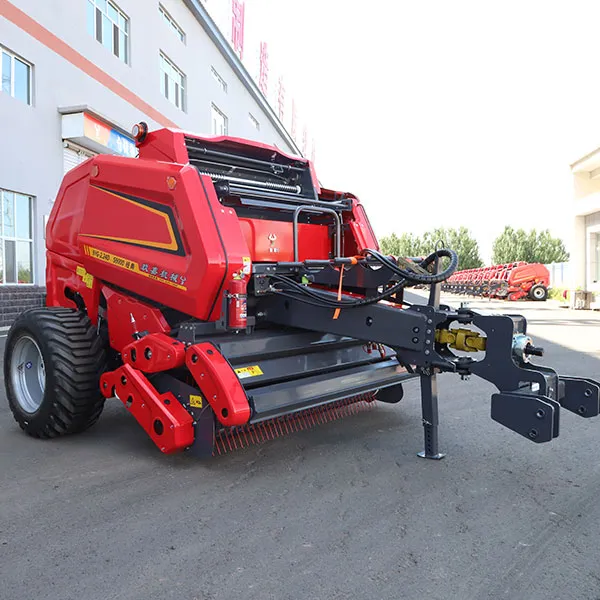 9YG-2.24D Round Baler (S9000 Classic)
-
 9LZD-9.0 Finger-disc rake
-
 9JYY-4.5 Roll pick-up-conveyor
-
 9YG-2.24D Round Baler (S9000 Excellence)
-
 9GD-2.5 Single-blade trailed mower (updated version)
-
 Drum type raking machine 9LG-9.0
-
 Cross-row baler for forming rectangular bales, model 9YFQ-2.2C (export to Mongolia)
-
 Trailed single-drum combine harvester 4DQ-5 for bean threshing
-
 9FZ-2.0 Finger-disc tedder
-
 9GS-5.0 Trailed two-legged mower
-
 Cross-grip baler for forming rectangular bales 9YFQ-1.9 (export to Mongolia)
-
 9YG-1.25A Round Baler FASCAR