




caeb baler for walk-behind tractor
When you hear aboutcaeb baler for walk-behind tractor, the first thing that comes to mind is an attempt to make almost a mini-tractor out of a light cultivator. Many people think that they stuck such a unit in the back, and the work began. In reality, everything depends on a lot of nuances: from the actual power take-off (PTO) power of the walk-behind tractor to the type and moisture content of the hay. I often see how people take the first press they come across, without looking at compatibility, and then they wonder why the walk-behind tractor stalls every second bale or the pressing is loose and the bale falls apart. Let's figure it out without water.
What CAEB really is and what walk-behind tractors it should be associated with
The CAEB designation is usually the model or series of the baler. You shouldn’t look for some magical secret in it, it’s just a factory index. More important are its technical parameters: working width, required power, type of pressing mechanism (most often piston), weight of the unit itself. For a walk-behind tractor, it is the mass that is critical. If the press weighs under 200 kg, then even a heavy diesel walk-behind tractor will lift up the front end, controllability will become zero, not to mention the load on the frame and gearbox.
From practice, for normal operation with a baler of this class, you need a walk-behind tractor with a weight of 250-300 kg in running order, preferably with water cooling and a full-fledged power take-off shaft, and not a belt drive. Heavy models like “Bison” are suitable. or “Belarus-09N?”, but they also have their problems. Light petrol "motoblocks" - no, it’s just a torment for yourself and your equipment.
It is worth mentioning here that some manufacturers, likeHulunbuir Machinery Manufacturing Company ?Jiujia?, offer comprehensive solutions. On their websitecn-fascar.ruit can be seen that they position themselves as an integrated enterprise engaged in the development and production of equipment for agriculture and livestock farming. This hints that they may offer more balanced “walk-behind tractor-hitch” combinations, where the parameters have already been calculated. But in any case, this does not eliminate the need to personally check compatibility using passports.
Key nodes and where the dog buries itself
The heart of any baler is the bale chamber and the binding unit. Models for walk-behind tractors, including CAEB, often have a chamber with a variable cross-section. This is when the density of the bale is adjusted not only by the tension of the twine, but also by using interchangeable strips. It sounds good, but in practice these slats tend to become clogged with plant debris, especially if the hay is with sow thistle or is leafy. You have to constantly stop and clean, otherwise the bale goes like an accordion.
The second diseased unit is the twine feed mechanism. Cheap models are often equipped with the simplest reels, which either twist the string or, on the contrary, pull it weakly. As a result, the bale either falls apart when dumped, or you can’t cut it later - it’s so tight. Through experience, I came to the conclusion that it is better to immediately replace the standard coils with more reliable ones, with bearings and a clear tension lock. Yes, these are additional expenses, but they save nerves and time in the midst of preparation.
And the third point is the coupling. The standard hitch that comes with the kit is often just a pin and two eyes. It will do for a static load, but the baler constantly wobbles during operation and creates variable lateral loads. Over time, holes in such couplings become broken and play appears, which affects the entire drive shaft. I always recommend either strengthening the standard hitch with additional ties, or immediately installing a more massive one, with fastening at several points. This is not a whim, but a matter of preserving the power take-off shaft of a walk-behind tractor, the repair of which costs a pretty penny.
Operational errors that could have been avoided
The most common mistake is working in dew or immediately after rain. The slightly damp hay seems to compress. In fact, moisture acts as an abrasive and catalyst for corrosion inside the pressing chamber. The piston begins to move tighter, the load on the baler gearbox and on the PTO of the walk-behind tractor increases. I have seen cases where, after such a season, deep scuffs appeared on the piston and chamber walls, and the press was simply sent to scrap. The ideal humidity for pressing is no higher than 18%. You can check it in the old-fashioned way: twist a bundle of stems - if it does not unwind and break immediately, but straightens out slowly, the humidity is still high.
The second mistake is ignoring adjustments. Many people, having connected the press, work all season on the same settings. But hay is different: thin-stemmed clover and coarse alfalfa require different pressing forces and torque for tying. For coarse hay, you need to increase the piston pressure (if there is an adjustment) and check that the twine cutter is sharp. Otherwise, he doesn’t cut, but crumples the string, and the knot floats.
And thirdly, saving on twine. They buy the cheapest polypropylene, which comes in different thicknesses and slipperiness in one batch. As a result, the knotter sensor does not work correctly; bales either have a double tie or a single tie that barely holds on. It is better to find a trusted supplier and take twine stated specifically for automatic balers. It is more expensive, but its consumption is stable, and it breaks less often in the camera.
Case study and why an integrated approach is important
I had experience setting up a baler, similar to CAEB, on a heavy walk-behind tractor for one small farm. The press was new, but the bales came out loose, with concave sides. They began to figure it out. It turned out that the problem was not in the press, but in the pick-up stacker that came with the kit. Its teeth were too sparse and long; they did not pick up the mass evenly, but raked it in lumps. The hay entered the bale chamber in portions, and not in a continuous flow, so the piston could not create uniform pressure.
I had to modify the stacker itself: shorten some of the teeth, add guide plates. After that the process went like clockwork. This case shows well thatcaeb baler for walk-behind tractor- this is not an independent unit, but part of the system. And if one element of this system works poorly, then it is pointless to expect a good result from the entire complex. That is why the approach declared by the company ?Jiujia? — integrated solutions from development to maintenance? - has practical meaning. When the entire chain (walk-behind tractor, hitch, pick-up, press) is designed and selected as a whole, the chances of success are much greater.
By the way, on their resourcecn-fascar.ruYou can find not just a product catalog, but also technical documentation with fairly detailed diagrams and recommendations for aggregation. For a person who wants to figure it out himself, and not just buy a “black box”, this is valuable. Although, of course, no documentation can replace live experience and understanding of the physics of the process.
Final thoughts: is the game worth the candle?
So is it worth getting involved with a walk-behind tractor baler? The answer is ambiguous. If you have 5-10 hectares of hayfields with relatively flat terrain, and you have a powerful, heavy walk-behind tractor, then yes, this can be economically justified. You get a mobile and relatively inexpensive (compared to a mini-tractor) system for preparing bales. But you need to be prepared for constant fuss with settings, maintenance and minor repairs.
If the area is larger, or the terrain is difficult, or hay has to be harvested in a short time between rains, then a walk-behind tractor with a press is not the best choice. Productivity will be low and the risk of breakdowns will be high. Here you need to look towards self-propelled or tractor solutions. The CAEB baler and others like it are a tool for very specific conditions and a handy owner who is not afraid to tinker with iron.
Ultimately, it all comes down to a sober assessment of your needs, the equipment you already have, and your skills. Don’t believe advertising pictures where a light walk-behind tractor is carrying a huge bale. Study the passport data, look for reviews from real users (users, not dealers), and be prepared for the fact that ideal equipment does not exist. There is one that you can make work effectively in your specific conditions. And this, perhaps, is the whole essence of working with any agricultural machinery, be it a simple hitch or a complexbaler.
Correspondingproducts
Related Products






Best Sellingproducts
Best Selling Products-
 9GL-5.0/5.6 Trailed mower rake
-
 9YG-1.25A Round Baler FASCAR
-
 Cross-row baler for forming rectangular bales, model 9YFQ-2.2C (export to Mongolia)
-
 9GD-2.5 Single-blade trailed mower (updated version)
-
 4BYHD 4BYHS-3.9 Pulling machine for beans
-
 9YCM-850 Film wrapping baler
-
 9JYY-4.5 Roll pick-up-conveyor
-
 9LZ-6.0 Finger-disc rake
-
 Drum type raking machine 9LG-9.0
-
 9GL-2.5/2.9 Trailed mower rake
-
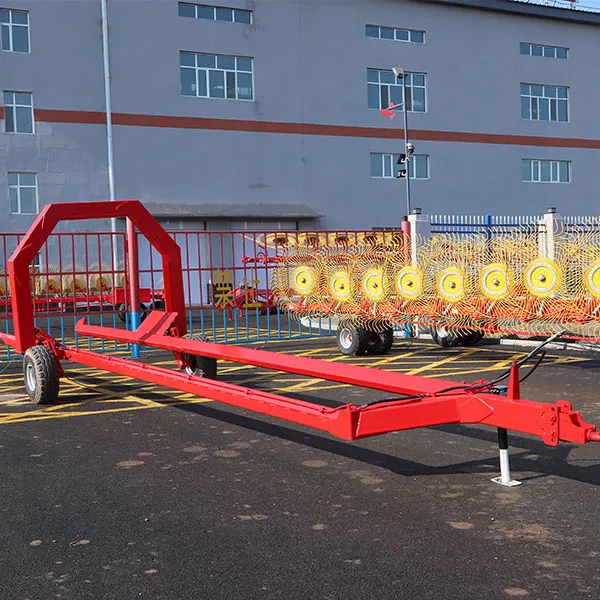 9JYY-2.5 Roll pick-up-conveyor
-
 9LH-12 Trailed cross rake