




homemade pick-up press
When you hear abouthomemade pick-up press, you immediately imagine a bunch of scrap metal in the barn and hope to save money. Many people think that the main thing is to weld the frame and attach the shaft, and the rest “somehow?” This is where the problems begin, which during the season result not in saved money, but in lost hay and time. I did it myself, remodeled it, and saw how my neighbors’ houses were falling apart. The main mistake is underestimating the loads, especially on the pressing unit and feed mechanism. Not to mention adjusting the bale density.
Why homemade is not just welding
I'll start with the basics: the frame. It seems that take a thicker channel and you’ll be fine. But if you don’t take into account the point of application of force from the plunger, even a powerful frame will lead over time. My first option has failed. after two seasons, it was necessary to strengthen it with gussets and change the hydraulic cylinder mounting scheme. This is not to mention that the hydraulic cylinder itself is a different story. Putting anything at random means either weak compression or the risk of rupture of the hoses under peak load. We need a calculation, at least an approximate one, in terms of force and stroke.
The second point is the bale chamber and bale formation. Smooth walls guarantee that the hay will turn and not be compressed. We need guides and ribs, but designed so as not to create excessive friction. Many people copy the shape of factory ones, but do not take into account the quality of the metal. A thin sheet will lead, gaps will appear - and that’s it, the density of the bale will “float” in the corners. I had to experiment with thickness and additional ties.
And the third, most insidious, is the feed unit and needle mechanism. Here precision is everything. If the needle pitch is too frequent, the spring is weak, the twine will break. Too sparse and the bale falls apart. I made a variant with a chain drive from the power take-off shaft, but under variable load (hay of different humidity and density enters) the chain either stretched or sagged. I switched to a gear drive with a rigid shaft, but this required reworking the entire feed window frame. There are a lot of mistakes at this stage.
Hydraulics and drive: where you can’t save money
The hydraulic system is the heartpick-up press. At first I thought I could use a pump from a decommissioned combine harvester. It worked, but the efficiency was low, the tractor was choking. in dense areas. I had to select a pump based on performance and pressure, taking into account the volume of the cylinder. A distributor is better with fixed positions, otherwise adjusting the density in the field turns into torture. A pressure gauge on the line is a must, without it you are blind.
PTO drive - it would seem simple. But if you don’t calculate the speed and don’t install a safety clutch (at least the simplest one, a shear pin), you can ruin both the gearbox and the mechanism itself if it jams. I had a case when a stone got into the feed mechanism - it’s good that the pin worked and did not break the shaft. The clutch was then replaced with a more reliable friction clutch from old equipment.
Tank, filters, oil cooling—the little things that “burn?” I installed the tank without partitions, and when moving, the oil was agitated and foaming—the system was unstable. I had to redo it. A coarse filter in front of the pump is a must, otherwise any debris from the tank will damage the pump. In the summer, in the heat, without a cooling radiator, the oil overheated and the pressure dropped. I decided to install a small car radiator in the air flow.
Experience and ready-made solutions: when to look towards manufacturers
After several years of fiddling with homemade products, I began to take a closer look at factory designs. Not to buy right away, but to understand the logic. Accidentally came across the siteHulunbuir Machinery Manufacturing Company ?Jiujia? (https://www.cn-fascar.ru). The company positions itself as a modern integrated enterprise for intelligent production in the field of agriculture and livestock farming. While studying their baler models, I noticed several details that I had missed.
For example, in their bale chamber they use not just a set of ribs, but a certain profile that directs the mass in a spiral - this reduces the load on the plunger and gives a more uniform bale. Or a tying unit - there is a backup mechanism for controlling the tension of the twine, which almost eliminates breaks. In my homemade products, I did not provide for this, at most - adjusting the spring tension on the go, which is inconvenient.
This is not an advertisement, but a statement. When you dohomemade baler, you often focus on the main node, and such “little things” How the lubrication system of the needle drum, protective guards on the chains or the precise balancing of the rotating masses go by the wayside. And then they are the ones who determine whether the unit will work for three seasons or will fall apart after the first cleaning. From manufacturers like ?Jiujia? this has been worked out, even if their technology is not always available to small farmers.
Field tests and improvements
The first trip to the field is always stressful. My firstbalerI made bales, but they were loose, the corners were falling in. The reason is insufficient pressure at the end of the plunger stroke and early operation of the piping unit. I had to adjust the hydraulic distributor and modify the cam mechanism, which gave the command for piping. Made it adjustable, with the possibility of phase shift.
The second problem is clogging of the feed window when working with wet hay. The conveyor belt (installed from an old combine) began to slip. Increasing the angle of inclination of the bottom of the feed chamber and installing additional shaking bars on the chain helped. But this added load to the drive. I had to install a more powerful gearbox. The circle is closed - the modification of one system entails the modification of another.
The third is transportation and unloading of the bale. The homemade ejection mechanism often broke down. I made the simplest one, with a hydraulic cylinder that tilts the entire rear wall. It works, but requires care - if the bale is not formed tightly, it may fall apart when unloading. I saw others have an option with a rotating camera - interesting, but difficult to implement for a homemade assembly.
Conclusions for those who still decide
Is it even worth taking on?homemade pick-up press? If you have access to a good metal supply, a lathe, a welding machine and, most importantly, experience in repairing agricultural machinery - yes. But get ready for the fact that this is not a one-month project. There may be savings compared to a new unit, but it will be consumed by time and materials for alterations.
If you need results here and now, it may be better to look for a used factory one in good condition or consider the available new options. Alternatively, look at offers from companies that specialize in this, for example, the sameHulunbuir company ?Jiujia?. Their website (https://www.cn-fascar.ru) makes it clear that they are deep in the topic, combining development, production and service. Even if you don't buy it, you can get ideas for the design.
As a result, my homemade unit works. But when I remember how many hours it took to fit, weld and set up, I think - wouldn’t it have been easier to initially invest in something ready-made? However, for a household where every ruble counts and there are hands that can repair and improve, homemade work is a challenge and, to some extent, pride. The main thing is not to repeat the mistakes of others, or better yet, your own too. Start with calculations, not welding. And be sure to provide for the possibility of modifications - during operation you will definitely want to improve something.
Correspondingproducts
Related Products






Best Sellingproducts
Best Selling Products-
 9LZY-9.0 Finger-disc rake
-
 9LZ-6.0 Finger-disc rake
-
 9YG-2.24D Round Baler (S9000 Excellence)
-
 Mower-conditioner model 9GQY-3.2
-
 9YG-2.24D Round Baler (S9000 Classic)
-
 Baler for forming rectangular bales 9YFQ-1.9 (cross grip, export to Russia)
-
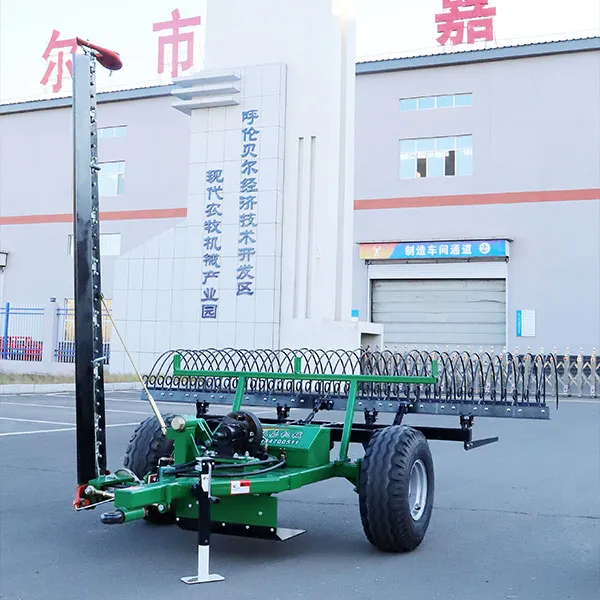 9GL-2.5/2.9 Trailed mower rake
-
 9F-70 Rough feed chopper
-
 9YG-1.25 Round Baler
-
 9GD-2.5 Single-blade trailed mower (updated version)
-
 Baler model 9YGD-0.5B
-
 9GS-5.0 Trailed two-legged mower