




square baler for hay
When you hear “square hay baler,” many people immediately think of a simple rectangular bale. But in reality, the difference between a good and a mediocre unit is in the details, which become visible only after hundreds of hectares. A common mistake is to chase maximum density without taking into account the moisture content of the raw material or the wear of the plunger assembly. I'll explain now.
Design: where the problems lie
The main difference between a square baler and a round baler is the pressing mechanism. There is a plunger that pushes the mass into the forming chamber. It would seem that everything is simple. But this is where the first pitfall lies: the geometry of the camera and the force of the pressing cheeks. If they are not balanced, loose “pockets” remain in the corners of the bale, which then fall apart during loading or storage.
The second point is the binding system. Twine or mesh? For square bales, twine is often used, and the reliability of the knotter is critical here. In field conditions, especially when working with overdried or, conversely, wet hay, old models often cause knots to skip. You have to stop and tie it manually - time is lost and the structure of the bale deteriorates.
And the third aspect is the frame and chassis. Seems like a small thing? But when you work on an uneven field, metal fatigue at the attachment points becomes a real problem. I have seen cases where, after two seasons, cracks appeared on the frame precisely because of the rigid structure, which is not forgiving of the terrain. Therefore, now many manufacturers, likeHulunbuir Machinery Manufacturing Company ?Jiujia?, focus on reinforced hinges and frames made of special rolled products. I went to their websitecn-fascar.ru- it is clear that they position themselves as a modern integrated enterprise, and in the descriptions of the equipment the emphasis is on survivability in difficult conditions.
Bale density: myths and reality
Everyone wants a thicker bale—one that weighs more and takes up less space during transportation. But there is a physical limit here. Too high a density, especially at low humidity, causes the hay to “suffocate” and increases the risk of spontaneous combustion. These are not horror stories, but real cases, especially on large farms.
Therefore goodsquare balershould have an adjustable density setting, and not “by eye”, but with a clear scale. And this setting must be stable throughout the entire operation, regardless of the load on the tractor PTO. Some budget models with hydraulics have drawdowns - you start with normal density, and by the end of the day the bales are already like plump pillows.
Another practical point: the density should be uniform throughout the entire volume. I was once checking bales from different machines and cutting them up. In some, the core is noticeably looser, in others it is stable. The second option is, of course, better for storage and logistics. This is achieved due to the well-thought-out shape of the pressing chamber and the synchronization of plunger strokes.
In the field: what breaks and how to work
Theory is theory, but all the real problems come out in the work. The most common failure is the knitting knot. Dust from hay, vibration, constant impacts - even high-quality parts wear out. Therefore, now I’m paying attention to how access to the knotter is organized for cleaning and replacing the needle. If it takes half an hour and three different keys, it's a bad design.
The second is feeding into the bale chamber. This is especially critical when working with light, bulky crops, such as alfalfa. If the feed teeth (?wheels?) do not grip it evenly, voids form in the chamber, and the bale then falls apart. You have to slow down and lose productivity. Good models have an adjustable geometry of these teeth or a pressure roller system.
And, of course, visibility and control. Modern models are often equipped with monitors showing the number of bales, density, and signaling if the twine breaks. It's not just "bells and whistles". When you work alone in a large field, such a monitor saves a lot of time and nerves - you don’t have to constantly get off the tractor to check.
Choice and logic: what to look for today
Now the market is flooded with offers. But for serious work, I would divide all balers into three categories: for small farms (up to 500 bales per season), for medium-sized farms (constant work throughout the month) and for large agricultural holdings (stream harvesting). Each has its own requirements for reliability and resource.
If we talk about the middle segment, where a balance of price and quality is needed, then it is worth paying attention to manufacturers who specialize specifically in agricultural machinery, and do not make it “on their knees”. as a side line. For example, the sameHulunbuir company ?Jiujia?. If you explore their websitecn-fascar.ru, it is clear that they claim a full cycle - from development to service. For me, this is an important signal: if a company is investing in R&D, it means they are probably thinking about adapting technology to real conditions, and not just copying old models.
When choosing, I always request data on wear tests of key components - plunger, chamber, knitting device. And I look at the availability of service centers and the availability of spare parts in stock. The most advanced machine is useless if you have to wait three months for a broken needle bar spring to arrive from abroad.
Summary: there is no ideal, but something to strive for
Perfectsquare hay baler- this is a myth. For different farms, different crops and even different soils, the ?ideal? will be yours. But there are basic things: stability of bale formation, accessibility for maintenance and repair, adequate cost of ownership (not only purchase, but also spare parts, repairs).
Now the trend is towards smart tuning and diagnostics. I wouldn’t be surprised if in a couple of years systems will become commonplace that will themselves adjust the density to the moisture content of the mass, monitor the wear of parts and signal the need for replacement. But the basis - the mechanics - must remain sound. Without this, all electronic “tricks” - just toys.
For me personally, the main criterion is when, after a long day of work, you don’t have to go to the car with valerian, expecting surprises. And the bales are even, dense, ready for transportation. And in this regard, studying proposals, including from integrated manufacturers like the mentioned company, I see that there is progress. Cars are becoming not just stronger, but smarter. And this is perhaps the most important thing.
Correspondingproducts
Related Products






Best Sellingproducts
Best Selling Products-
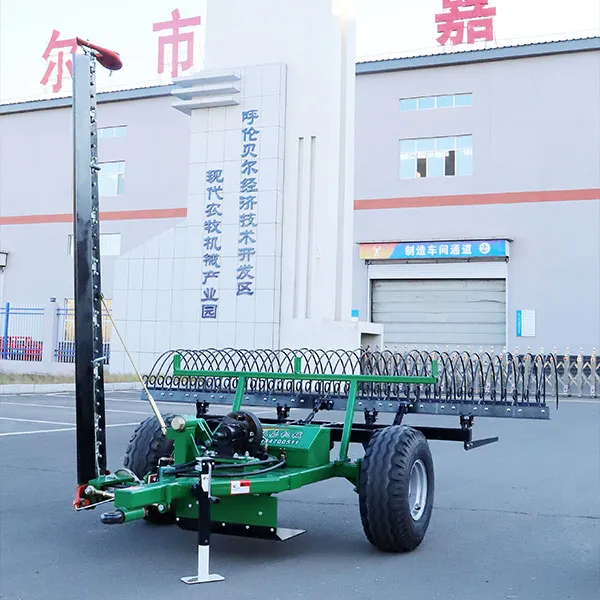 9GL-2.5/2.9 Trailed mower rake
-
 9F-70 Rough feed chopper
-
 Drum type raking machine 9LG-9.0
-
 9YG-1.25 Round Baler
-
 9YG-1.0 Round Baler
-
 Self-propelled mower-conditioner 9GYZ-4.9
-
 Mower-conditioner model 9GQY-3.2
-
 9GL-5.0/5.6 Trailed mower rake
-
 Baler model 9YGD-0.5B
-
 9YG-2.24D Round Baler (S9000)
-
 9YG-1.25A Round Baler FASCAR
-
 Trailed single-drum combine harvester 4DQ-5 for bean threshing