




sale of agricultural machinery
When they talk aboutsales of agricultural machinery, many immediately present the warehouse, catalogs and discounts. But in reality, if you are into this, you understand - it’s more about how to fit iron into a specific field, into a specific work cycle and into the heads of machine operators. A common mistake is to think that the main thing is to “get in?” tractor. No, the main thing is that in three years he plows the same way as on the first day, and the client does not curse you every sowing season.
From warehouse to field: where logistics breaks down
Here, for example, is the story of the supply of seeders. Winter, we agreed, shipped from the factory warehouse. Everything is orderly. And in the spring I got a call: “Didn’t you preserve the bearings there?” There has been moisture in the port over the winter, is it humming now? And formally, it’s not our fault; we shipped it in good condition. But in fact, the client’s problem has become ours. Implementation is responsibility for the entire journey, and not until the moment of payment. We had to urgently organize a service team to transport the units. A loss, of course. But now we specify storage conditions in transit warehouses in contracts - a trifle, but it saves the day.
Or another point - equipment. We delivered a baler to a client, and he asks: “Where are the hydraulic hoses?” Were they in the specifications? Let's see - it's really an option. But the plant was not in stock at that moment; it was shipped on a basic basis. We thought we'd come to an agreement. We didn't agree. I had to remove it from another machine so as not to disrupt the feed stock. The conclusion is simple: if something is not available, it is better to immediately say honestly and reschedule rather than create an emergency situation. Trust is more valuable.
Now, by the way, many dealers are guilty of delivering equipment “as is”, straight from the factory, without pre-sale preparation. Like, the client will figure it out himself. This is a dead end. For example, we even test and adjust simple fertilizer spreaders on our site. Yes, it's time and money. But when a farmer receives equipment that works right away, this is the best advertisement. This is especially important for complex units, such as intelligent precision seeders.
Service as part of the sale, not an “add-on”
This is where many companies stumble. They create a sales department and a service department, which are at war with each other. Sales people promise “mountains of gold”, but the service then cannot provide this. At one time we also had such a gap. Until they began to include the senior mechanic in negotiations at key stages. He sits, listens to the needs of the farm, and can immediately say: “For such an area and such soils, this model of forage harvester will constantly clog, it’s better to look at the one with a different type of knives?”
A striking case was with the supply to one large farm in the Black Earth Region. Ordered from us through the websiteHulunbuir Machinery Manufacturing Company ?Jiujia?several pieces of equipment for livestock farms - in particular, feed dispensers. The company positions itself as a modern integrated enterprise, and these are not just words. Their engineers sent not just passports, but a whole questionnaire on operating conditions: what type of feed, the width of the passages in the barns, even the height of the ceilings. Thanks to this, we were able to offer a modification - a shortened boom. Without such an in-depth approach, the technology simply would not have developed in the stalls.
And after the sale the story continues. Spare parts are a separate pain. Keeping everything in your warehouse is unrealistic. But we and ?Jiujia? We have built a scheme: for the most popular items we always have stock in the regional warehouse, and for rare requests we have direct expedited delivery from the factory. Transparency is key. The client in his personal account sees not just the “ordered” status, but the actual tracking of the cargo from China. This removes 80% of nervous calls.
Price, cost and value: how to explain the difference to a farmer
The most difficult conversation is about money. When there are cheap analogues on the market, it is difficult to convince a person to pay 20-30% more. Here you can’t just poke at the characteristics table. We need examples from life. Once we arrived at a farm where inexpensive domestic cultivators had been working for five years. The owner complained about fuel consumption and processing time. We brought in one of our units for demonstration, which essentially does the same job. They didn’t talk about the steel grade or innovation. They simply said: “Let’s measure how many hectares it will cover at one gas station and in what time?” The difference was clear.Sales of agricultural machinerythen it took place not because we had a good conversation, but because the technology spoke for itself.
But there are pitfalls here too. Sometimes equipment is objectively more expensive due to imported components or complex logistics, as is the case with the sameHulunbuir company ?Jiujia?. Their equipment for livestock farming - automatic drinkers, ventilation systems - is often a one-piece product for a project. You need to explain the price through the economics of the entire cycle: how much you will save on labor costs, on veterinary medicine, on the safety of livestock. This is no longer a conversation about the price of a tractor, this is a consultation on the efficiency of a business process.
It happened that our calculations turned out to be too optimistic. We supplied, for example, a drip irrigation system for vegetable farming. We calculated water savings and increased productivity. But they did not take into account that local personnel were not ready to service such a complex system - filters became clogged, controllers malfunctioned. We had to organize a two-week training on site for an agronomist and a mechanic. In fact, they created a new expense item for the client - a specialist’s salary. Lesson: when selling complex equipment, you need to immediately ?sell? and training, include it in the package price. Otherwise, implementation will turn into a headache for everyone.
Working with information: websites, catalogs and live communication
Nowadays everyone is looking for equipment on the Internet. But the sitecn-fascar.ru- this is not just a showcase. For us, as partners, this is a tool. When a client comes with a question, we often open the website and together look not only at the dimensions, but also at sections with technical documentation, 3D models of components, and recommendations for running. This creates the feeling that behind the technology there is not an abstract factory, but a team that thinks about its operation. For the client, this is an important signal of reliability.
However, no website can replace a trip to the fields. We have a rule: once a season, our sales managers are required to spend at least a day with the service team, or better yet, go to clients for harvesting or sowing. This is the only way you understand that the catalog says “hopper capacity is 5 tons,” but in practice it is difficult to clean it from the remains of wet corn, or that access to the radiator to clean it from fluff requires almost disassembling half the cabin. We then pass these observations back to the manufacturer, to the same Jiujia. Sometimes this results in minor modifications for the next batches - a reinforced bracket, an additional inspection cover. This is the very integration that is stated in their status as an integrated enterprise.
And more about information. We used to make beautiful PowerPoint presentations. Stopped. Now most often the exchange occurs through instant messengers - a photo of a specific breakdown, a voice message describing the problem, a screenshot from the sensor. It's unstructured, but fast and to the point. Our task is to learn to work in such a rhythm. Sometimes the response to the client is not an official letter, but a photo of a similar unit with the caption “look, there should be a seal here, check?”.
Results that don’t exist: a process instead of a point
So, to summarize... It’s impossible to summarize.Sales of agricultural machinery- this is not a linear process of “order-delivery-payment”. This is a cyclical story. The season has just closed, and we already need to prepare for the next thing: analyze which equipment is worn out, who should be offered what to update the fleet, what new state regulations on ecology or safety will affect demand.
Cooperation with such manufacturers asHulunbuir company ?Jiujia?, which combine R&D, production and service, slightly changes the role of the dealer. We become not just a reseller, but a link in this chain that brings real experience from the fields to the designers. This is perhaps the most valuable.
Therefore, the plans are not so much to “increase sales volumes by 15%,” but to introduce a clearer system for collecting feedback from mechanics and add all these minor improvements that we see in the field to the database. So that the next tractor or spreader that comes to our warehouse will be a little more adapted to our realities. This is probably the point - implementation as a continuous improvement, and not as an act of buying and selling. Everything else is just paper and numbers in a report.
Correspondingproducts
Related Products





Best Sellingproducts
Best Selling Products-
 9YG-2.24D Round Baler (S9000 Classic)
-
 4BYHD 4BYHS-3.9 Pulling machine for beans
-
 Self-propelled mower-conditioner 9GYZ-4.9
-
 9JYY-2.5 Roll pick-up-conveyor
-
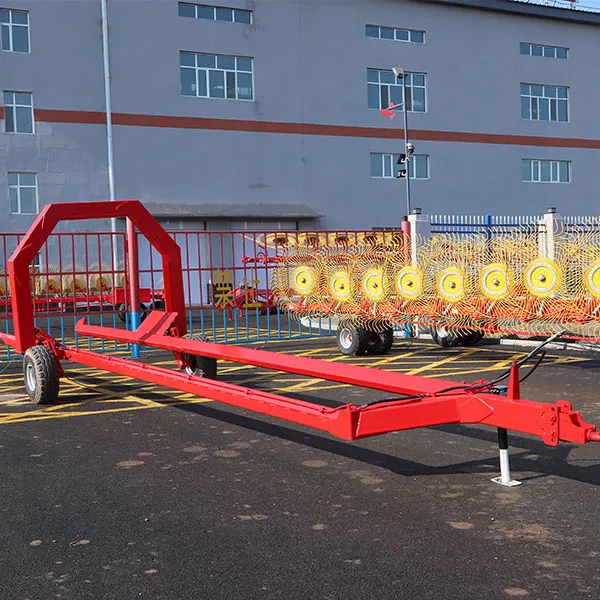
 9LZD-9.0 Finger-disc rake
-
 Baler for forming rectangular bales model 9YFQ-2.2D (cross type, for export to Russia)
-
 Mower-conditioner model 9GQY-3.2
-
 9YG-1.25 Round baler FASCAR
-
 Drum type raking machine 9LG-9.0
-
 9YG-2.24D Round Baler (S9000 Excellence)
-
 9GL-2.5/2.9 Trailed mower rake
-
 9YG-1.25A Round Baler FASCAR