




self-propelled mini baler
This is what people often argue about in the fields: is a self-propelled mini baler necessary at all, or is it a toy? Many people think that since it is “mini”, then its tasks are childish. But in fact, this is often the only way out for farming on difficult terrain or for working in cramped conditions in gardens, vineyards, and row spacing. The main thing is not the size, but the correct concept of the unit.
The “mini” concept: not only about sizes
When we say "mini", we are not just talking about a small car. This is a whole philosophy of approach to the procurement of feed in limited or hard-to-reach areas. Classic trailed balers require a powerful tractor and room to maneuver. But what to do if the area is hilly, with plantings, or you need to remove grass along the edges of the fields, where large equipment cannot reach?
This is where the self-propelled mini baler reveals its potential. It is mobile, has its own chassis, often on tracks or all-wheel drive. This is not an attachment, but an independent unit. Key -self-propelled mini balermust retain all the key functions of the “big brother”: swath picking, baling, tying and bale ejection. Just on a smaller scale and with more flexibility.
I remember a case when one farm in the Leningrad region tried to use a converted mini-loader with a mounted press. The idea seemed logical: there is maneuverability. But they did not take into account the synchronization of the operation of the units and sufficient pressing force. As a result, the bales turned out to be loose and fell apart during transportation. We realized that what was needed was a solid, balanced unit, designed as a single whole, and not a “constructor”. This is an important lesson.
Selection criteria: what to look for after the price
Price, of course, is the first thing people ask. But immediately after this there should be a question about the type of bale chamber. There are fixed and variable cameras. Mini presses often use a fixed one; it is simpler and cheaper. But for working with different crops (tender meadow grass and coarse sunflower for silage), it is better to look towards machines with adjustable pressing force and the ability to change the bale density.
The second point is the type of chassis. The tracks provide excellent traction and low ground pressure, ideal for wet areas. But they are more difficult to maintain and more expensive. Wheeled versions, especially those with all-wheel drive and adjustable ground clearance, can be optimal for most tasks. You need to evaluate your specific conditions. I saw how a machine on tracks worked calmly on a slope where the wheel was already slipping.
The third, and often overlooked, criterion is the strapping system. Mini presses usually use mesh or twine. Mesh is more expensive, but is often preferable for silage. It is important to check the reliability of the harness - this is the "Achilles heel" many budget models. The mechanism should work smoothly even in dusty conditions. It is better to see it once in work than to read it ten times in the specification.
Practice and pitfalls: from personal experience
Working with different equipment, I came to the conclusion that for a small farm or even a peasant farm (peasant farm) an investment inself-propelled mini balercan pay for itself faster than renting large equipment or maintaining a tractor with a trailed implement. But there are nuances.
For example, productivity. Don't expect any records from the mini press. Its strength lies in its accuracy and accessibility. It can work where other equipment cannot, collecting the same amount of feed that would otherwise be lost. This is not mass harvesting, this is targeted, effective cleaning. It is important to correctly assess your tonnage needs.
Another stumbling block is service and spare parts. When buying an exotic or less common model, you may be faced with months of waiting for a simple bearing. Therefore, I always pay attention to the presence of a manufacturer’s representative office in the region or country, which provides spare parts logistics. This is critical for smooth operation during the season.
By the way, about the manufacturers. Interesting integrators are appearing on the market who do not just sell equipment, but offer comprehensive solutions. Take, for example,Hulunbuir ?Jiujia Machinery Manufacturing Company. If you go to their websitehttps://www.cn-fascar.ru, it is clear that they position themselves as a modern intellectual enterprise combining R&D, production and service in the field of agriculture and livestock farming. For me, such complexity is a plus. This means that there is a chance that the equipment was initially designed taking into account real agrotechnological problems, and was not simply copied from someone else’s model. Their approach to "smart manufacturing" may mean more thoughtful design decisions, although, of course, you need to “feel” iron live.
Application scenarios: where it is truly indispensable
Besides the obvious scenarios in gardens and hills, there are others. For example, working in organic farming in small fields separated by hedges. Or preparing feed for stables, where the quality and cleanliness of the bale is important. The mini-press can accurately collect windrows without picking up soil and stones, which is critical for animal health.
Another interesting case is the cleaning of areas along roads and reclamation canals. Large contractors with large equipment often don’t go there, and manual work is expensive. A small self-propelled unit can solve this problem by simultaneously preparing roughage.
It is also worth considering it as a second unit in a large farm. Not for the main areas, but for “finishing”? edges of fields, areas around power line supports, for cleaning after the main forces - where using a large line is uneconomical. This increases the overall percentage of harvested mass used.
Looking Ahead and Final Thoughts
The trend towards robotization and precision farming will not bypass this segment either. I think in the future there will be completely autonomousself-propelled mini baler, working according to given field maps. But today's choice should be based on purely practical things.
So, I will say this: this is not a universal car for everyone. This is a specialized tool for specific conditions. Its purchase should be a conscious decision based on a clear understanding of your objectives, terrain and scale. If these conditions coincide, then such a unit removes a huge layer of problems, providing flexibility and preservation of feed mass where previously it simply disappeared.
When choosing, I advise you not to limit yourself to catalogs. Look for reviews, if possible, go and look at a working machine in conditions close to yours. And be sure to analyze the logistics of the service and the availability of spare parts. As in the case of the same ?Jiujia? — their status as an integrated enterprise with a full cycle is encouraging, but you need to check in dialogue with them: how quickly they can deliver a repair kit, whether they have engineers for commissioning. Everyone’s equipment breaks down in the field, the question is how quickly it will be repaired. Here, in fact, is the whole main breakdown of this interesting, niche, but extremely useful class of machines.
Correspondingproducts
Related Products







Best Sellingproducts
Best Selling Products-
 Baler for forming rectangular bales model 9YFQ-2.2D (cross type, for export to Russia)
-
 9YG-1.25 Round Baler
-
 9F-70 Rough feed chopper
-
 9YG-2.24D Round Baler (S9000 Excellence)
-
 9LH-12 Trailed cross rake
-
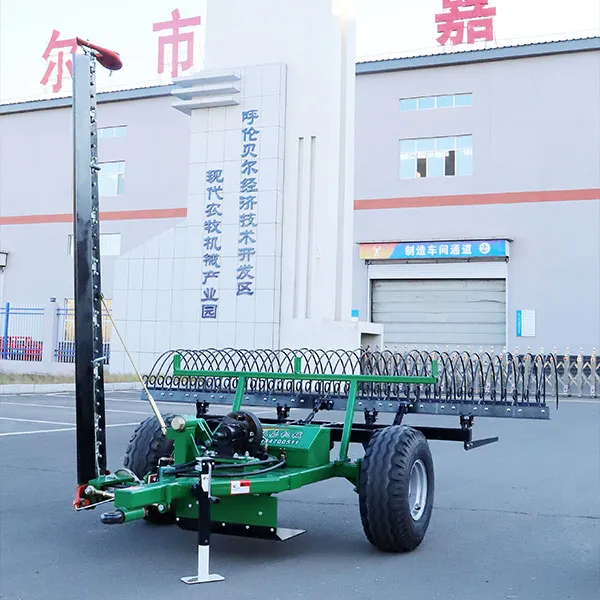 9GL-2.5/2.9 Trailed mower rake
-
 4BYHD 4BYHS-3.9 Pulling machine for beans
-
 9FZ-2.0 Finger-disc tedder
-
 Cross-grip baler for forming rectangular bales 9YFQ-1.9 (export to Mongolia)
-
 9GD-2.5 Single-blade trailed mower (updated version)
-
 Baler for forming rectangular bales 9YFQ-1.9 (cross grip, export to Russia)
-
 Cross-row baler for forming rectangular bales, model 9YFQ-2.2C (export to Mongolia)