Buy roller baler 2026: price from the manufacturer
2026-08-18
Buy a roller baler 2026: direct supplies from the manufacturer
If you are planningbuy a roller press pick-upIn 2026, the key success factor is not only the basic cost of the equipment, but also its ability to provide high bale densities with minimal operating costs. Roller machines, unlike their chain-slat counterparts, use a system of smooth or grooved shafts to form the bale core, which is critical for wet silage and straw with high residual moisture. Buying directly from the manufacturer allows you to avoid dealer markups, get a factory warranty on hydraulic systems and access to original spare parts without lengthy logistics delays.
Modern 2026 models integrate real-time density monitoring sensors and automatic lubrication systems, which reduces the risk of equipment downtime during the peak of the harvesting campaign. When choosing equipment, it is necessary to take into account not only the working width, but also the type of forming chamber, shaft diameter and compatibility with the tractors in your fleet. Our company offers an engineering approach to the selection of equipment: we analyze your agronomic conditions, type of crop and required productivity to offer a solution that will pay for itself in one or two seasons. Request a quote now to lock in your manufacturer's price before seasonal increases.
Why is it worth buying a roller press pick-up directly from Jiujia factory?
The agricultural machinery market in 2026 is characterized by high price volatility and extended delivery times for imported components. Under these conditions, the solutionbuy a roller press pick-upfrom the direct manufacturer becomes a strategic advantage for agribusiness. A direct contract excludes intermediary margin, which can range from 15% to 30% of the final cost of the machine. However, saving on the purchase price is just the tip of the iceberg.
The main value of working with the manufacturer is technical support and adaptation of equipment to the specific needs of the farm. Factory engineers have a deep understanding of the hydraulics and mechanics of their machines. If you have a problem adjusting roller pressure or need to upgrade your pick-up for a specific crop (such as alfalfa or corn silage), the manufacturer can make design changes or provide customized recommendations that a typical dealer cannot.
In addition, purchasing “from the factory” guarantees transparency of the origin of components. In 2026, issues of sanctions restrictions and supply chains are acute. The manufacturer clearly documents the origin of each component: from SKF/FAG bearings to hydraulic hoses, providing complete packages of documents for customs clearance and EAC certification. This reduces the risk of downtime due to lack of spare parts and ensures the legal purity of the transaction.
About the manufacturer: Hulunbuir company "Jiujia"
Reliability of supplies and quality of equipment directly depend on the capacity and reputation of the manufacturer. Hulunbuir Machinery Equipment Manufacturing Company"Jiujia"(Jiujia) is a modern integrated intelligent manufacturing enterprise located in the National Modern Agricultural Machinery Industrial Park (Hulunbuir City). Founded in 2021, the company has quickly risen to the top position, becoming China's No. 1 in round baler sales in 2023-2024.
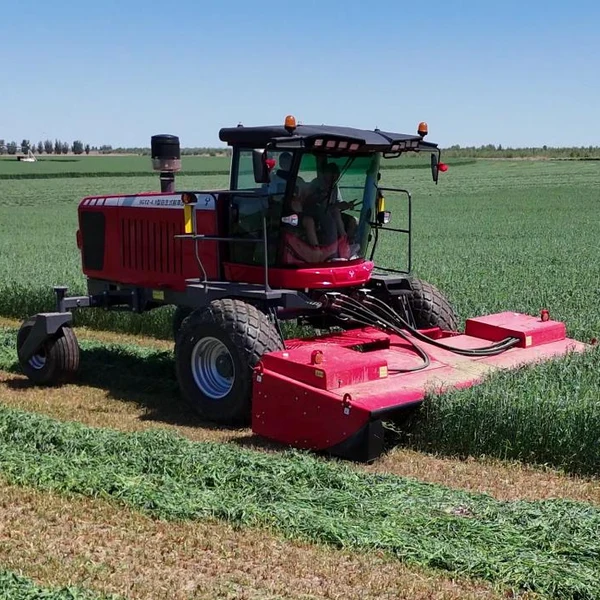
The Jiujia production base occupies more than 32,000 square meters and is equipped with advanced equipment: CNC laser machines, automated welding systems and electrostatic spraying lines. Two specialized production lines provide an annual output of up to 4,000 units of equipment, including mower rakes and round balers. Its own testing laboratory and almost one hundred technological patents allow the company to produce products certified according to the ISO 9001 standard and adapted to the harsh climatic conditions of Russia and Mongolia.
Jiujia has the status of a national high-tech enterprise and a AAA credit rating. The presence of a subsidiary in Mongolia and experience of successful export to the Russian Federation make Jiujia a reliable partner for Russian farmers, providing direct supplies without unnecessary intermediaries.
Advantages of direct integration into the Jiujia production cycle
- Custom configuration:The ability to choose the type of strapping (mesh, twine, film) and the width of the chamber to suit your needs, thanks to the flexibility of the plant’s production lines.
- Priority service:Direct line of communication with the Jiujia design bureau to resolve complex technical issues.
- Staff training:Factory specialists conduct on-site training for machine operators on the features of operating the roller system.
- Liquidity guarantee:Certified equipment of the Jiujia brand (trademarks Yingjiamen, FASCAR, etc.) with a complete service history are easier to sell on the secondary market.
Technical features of roller balers 2026 model year
The technological leap in forage harvester design by 2026 has shifted the focus from simple mechanical reliability to intelligent control of the baling process. When you decidebuy a roller press pick-up, you are investing in a complex cyber-physical system. The main difference between the roller design is the method of roll formation. Instead of chains or belts, which can slip on wet material, it uses knurled or smooth steel shafts that rotate at a controlled speed.
The shaft system creates constant pressure on the mass along the entire perimeter of the chamber, starting from the very first turn. This makes it possible to achieve bale densities of up to 220–250 kg/m³ for straw and up to 600–700 kg/m³ for haylage, which is critical for quality fermentation. The 2026 models produced at Jiujia-level factories feature the following innovations:
- Adaptive hydraulics:The system automatically adjusts the pressure in the shaft tension cylinders depending on the moisture content of the mass and the speed of the tractor. Moisture sensors installed on the pick-up transmit data to the on-board computer, which optimizes the compression ratio.
- Reinforced frame design:The use of high-strength steels of the S700MC grade made it possible to reduce the weight of the machine by 8% while increasing the service life of the frame by 30%. This reduces the load on the tractor and saves fuel.
- Intelligent harness:New net and twine binding mechanisms are equipped with electric drives with tension control. This prevents the wrapping material from breaking when the bale leaves the chamber and prevents the bale from “unraveling” during transportation.
- ISOBUS compatibility:Full integration with tractor terminals from John Deere, Claas, Case IH and other brands via the ISOBUS UT protocol. The operator controls all functions of the press from a monitor in the cab, without being distracted by physical levers.
An important aspect is the cutting system. Modern roller presses are equipped with knife blocks with the ability to quickly change the number of cuts (from 13 to 25 cuts per meter). The hydraulic blade drive allows you to turn cutting on and off directly from the cab, which is convenient when switching from one type of crop to another.
Comparison of roller and chain balers: an engineering analysis
The choice of press type often causes discussions among agronomists and machine operators. To make an informed decision when you wantbuy a roller press pick-up, it is necessary to objectively compare it with traditional chain-slat analogues. Below is a detailed comparison chart based on field testing during the 2025 season.
| Parameter | Roller baler | Chain (belt) baler |
|---|---|---|
| Formation principle | Shaft pressure from center to periphery | Friction of chains/belts against ground |
| Bale density | High and uniform (up to 700 kg/m³) | Medium, depends on humidity (up to 500 kg/m³) |
| Working with wet mass | Excellent (shafts do not slip) | Poor (risk of slippage and unevenness) |
| Bale shape | Perfectly cylindrical, rigid | Often "cone-shaped" or soft in the center |
| Service | Shaft bearings, hydraulics | Replacement of chains, sprockets, bars |
| Ownership price (5 years) | Lower (fewer wearing parts) | Above (regular replacement of chains and belts) |
| Required tractor power | From 80 hp | From 60 hp |
Engineering conclusion:If your farm specializes in the production of silage, wet hay, or operates in regions with a short window of dry weather, roller technology has no alternative. Chain presses can only be justified for dry straw on small farms with a limited initial purchase budget. However, given the service life of a roller press (10+ years versus 5-7 years for heavily used chain presses), the total cost of ownership of a roller press is lower.
How to choose a roller baler: key criteria
The process of selecting equipment should be based on accurate calculations, and not on marketing brochures. Beforebuy a roller press pick-up, conduct an audit of your current capabilities and needs. Here is a step-by-step selection algorithm developed by our technical specialists.
1. Compatibility with tractor fleet
Roller presses require significant power to rotate the shafts, especially when the bale begins to form. Check the passport data of your tractors:
- Minimum power:For chambers with a volume of 1.2–1.5 m³, a tractor of 80–90 hp is required.
- Hydraulic system:Make sure the tractor has hydraulic outlets with sufficient oil flow (minimum 40-50 l/min) to drive the pick-up and wrapping mechanism. Having a closed hydraulic center is preferable for correct ISOBUS operation.
- Weight:Consider overhead load. A fully loaded press can weigh up to 3-4 tons. The tractor must have adequate rear linkage capacity and ballast weights.
2. Chamber volume and bale size
Standard bale diameters are 1.2 m, 1.35 m and 1.5 m. Widths vary from 1.2 to 1.5 m.
- Small bales (1.2 m):Convenient for transportation and storage, dry faster, less risk of internal heating. Ideal for small farms.
- Large bales (1.5 m):They provide the highest productivity (up to 40-50 bales per hour), but require powerful loaders for processing and large storage areas.
3. Type of harness
Modern presses allow you to combine types of binding. The mesh provides quick fixation of the shape (2-3 turns), the twine provides additional strength to the edges, and the film is necessary for the preservation of silage wrapping. If you plan to harvest silage, make sure the model you choose supports or integrates a film wrapper.
4. Quality of steel and components
Pay attention to the thickness of the shaft walls and the quality of the bearings. In 2026, the quality standard is bearings with reinforced seals that protect against dust and moisture. The frame must be welded from a profile pipe with an anti-corrosion coating. Cheap analogues often skimp on the thickness of the metal, which leads to deformation of the camera after 2-3 seasons of intensive work. Jiujia products undergo strict quality control at all stages, from laser cutting to final assembly, which guarantees the durability of the structure.
Economic justification and payback calculation
Buying equipment is an investment. Let's calculate the approximate economics of using a roller baler using the example of an average farm with 500 head of cattle.
Let's say you need to prepare 2000 tons of haylage. Using a roller press with a density of 650 kg/m³ and a bale weight of 600 kg, you will need approximately 3,300 bales. High density means:
- Space saving:The storage will hold 20-25% more feed compared to loose bales.
- Loss reduction:A dense bale ferments better and nutrient losses are reduced by 5-7%, which is equivalent to hundreds of tons of stored feed.
- Logistics:Fewer transport trips due to the compactness of the cargo.
Ownership costs include depreciation, fuel, maintenance and operator salaries. Due to the high reliability of roller systems, repair costs are usually 30% lower than their chain counterparts. With proper operation, the payback period for the equipment is 1.5–2 seasons. With rising feed prices and the need for quality feed preservation, investing in a reliable baler is one of the fastest ways to increase the profitability of your dairy or beef production.
Logistics, delivery and service support in 2026
When purchasing large agricultural machinery, logistics plays a decisive role. The Jiujia company organizes the delivery of roller balers throughout the Russian Federation and the CIS countries, using its own trawl fleet and partner logistics networks. Thanks to the right to independently carry out import-export operations, we undertake all customs procedures.
Delivery stages:
- Pre-sale preparation:Each press undergoes a test run at the Jiujia factory site. The pressure in the hydraulic system, the operation of the knives, the tension of the shaft drive chains and electronics are checked.
- Packing:Components susceptible to corrosion are preserved. Electronic components are packaged in moisture-proof containers.
- Customs clearance:We provide the client with a full package of documents (road accident, invoice, EAC certificates), ensuring the legal purity of the transaction.
- Commissioning works:Our engineer goes to the farm to configure the press for a specific tractor and train operators.
Service support is provided according to the “one window” principle. We have created a warehouse stock of critical spare parts (bearings, belts, knives, sensors) in regional hubs. This allows the necessary parts to be delivered within 24-48 hours, minimizing equipment downtime during the hot season.
Typical operating mistakes and how to avoid them
Even the most reliable equipment can be damaged by improper use. Based on an analysis of service calls for 2024-2025, we have identified the main mistakes that operators make:
- Ignoring lubrication:The rollers work under enormous load. Failure to lubricate bearings on a daily basis leads to them seizing and costly repairs. Use only recommended lithium greases.
- Incorrect pressure setting:Too much pressure on wet grass can cause sap to be squeezed out and loss of nutritional value. Too low and the bale will collapse. Adjust the pressure according to the humidity sensor readings.
- Working on uneven ground:Driving with the pick-up raised over bumps creates shock loads on the frame and shafts. Always lower the pick-up before driving and avoid sudden maneuvers.
- Neglecting cleaning:The accumulation of dirt and plant debris around the shafts and sensors distorts readings and accelerates wear. Clean the press after every shift.
Frequently asked questions (FAQ)
What is the real productivity of a roller baler?
Productivity depends on crop yield, tractor speed and density settings. On average, modern 2026 models provide productivity from 25 to 45 bales per hour with a yield of 4-5 t/ha. On light crops (straw), the speed can reach 50-60 bales per hour.
Is it possible to upgrade an old press to 2026 standards?
Partially yes. You can install new humidity sensors, update the control unit and replace the strapping mechanism. However, replacing the forming chamber and shafts is not economically feasible. If your abs are older than 7-8 years, better valuebuy a roller press pick-upa new design rather than investing in a major overhaul of an outdated model.
What warranty period does the manufacturer provide?
The standard warranty for the machine is 12 months or 1000 operating hours. For the main supporting structures (frame, shafts), the warranty can be extended to 2-3 years, subject to annual maintenance by authorized specialists.
Is the roller press suitable for working with straw?
Yes, roller presses do a great job with straw. Thanks to high pressure, they form very dense and compact bales that are easy to transport and store. However, less pressure can be used for straw than for haylage to save tractor energy.
Do I need a special tractor for ISOBUS control?
For full functionality, a tractor with an ISOBUS Class 3 terminal is desirable. However, all our presses are equipped with an autonomous control unit with a display, which allows you to operate the machine regardless of the tractor’s equipment, using standard hydraulic and electrical outputs.
Conclusion and call to action
The choice of forage harvesting equipment is fundamental to the efficiency of your livestock business. In 2026, roller baling technology has reached maturity, offering unrivaled quality in feed preservation. Decidingbuy a roller press pick-upfrom the Jiujia plant, you get not just metal and hydraulics, but a ready-made technological solution, confirmed by engineering calculations and field tests of the market leader.
We don’t just sell equipment - we help you optimize your harvesting processes, reduce the cost of feed unit and increase the productivity of your herd. Don't leave your decision until the last minute before the season. Prices for metal and components tend to rise, and production times may increase due to high demand.
Ready to improve your feed harvesting efficiency?
Contact our technical consultants today to:
- Get an individual payback calculation for your farm.
- Book a production queue for delivery in 2026.
- Request detailed technical specifications and video of equipment operation.
Click the button below to request a consultation or download a full catalog of models with prices.