Agricultural harvesting equipment 2026: prices from the manufacturer
2026-09-05
- Agricultural harvesting equipment 2026: prices from the manufacturer and market analysis
- Classification and types of modern harvesting equipment
- Where agricultural harvesting equipment is used: use scenarios
- Key Specifications: What to Look for in 2026
- How to choose agricultural harvesting equipment: step-by-step algorithm
- Manufacturer as a guarantor of quality: the example of the Jiujia company
- Price Range and Cost Factors in 2026
- Comparison of models: an engineering view
- Logistics, export and service
- Typical mistakes when purchasing and using
- FAQ: Frequently asked questions
- Conclusion and purchasing recommendations
Agricultural harvesting equipment 2026: prices from the manufacturer and market analysis
Agricultural harvesting equipmentin 2026, it is a high-tech complex of machines that ensure mechanized harvesting of grain, oilseeds and feed crops with minimal crop losses. For agricultural holdings and farms, the key selection factors remain not only basic productivity (ha/hour), but also energy efficiency, compliance with Stage V / Euro 5 environmental standards, as well as availability of service. Direct deliveriesagricultural harvesting equipmentfrom the manufacturer can reduce capital costs by 15–20% by eliminating dealer markups and optimizing supply chains.
In the current economic conditions, the purchase of combines and harvesters requires a thorough feasibility study. The market has shifted towards modular solutions, where one basic machine can be combined with various types of headers (grain, corn, rapeseed) and adapters for harvesting soybeans or sunflowers. This reduces the need for a fleet of various specialized equipment. In this review, we will look in detail at how the price ofagricultural harvesting equipment, what technical parameters are critical for different soil and climatic zones and how to avoid hidden costs during operation.
Classification and types of modern harvesting equipment
The choice of equipment begins with an understanding of the agrotechnical requirements of a particular farm. There is no universal solution: what is effective on the black soil of the Kuban may be unsuitable for light sandy soils or the humid climate of the North-West. Modernagricultural harvesting equipmentis divided into several key classes based on the principle of threshing and the type of stroke.
Combine harvesters: drum and rotary
Traditional drum harvesters remain top sellers due to their versatility and lower repair costs. They provide gentle threshing, which is critical for seed material. However, their efficiency drops when the grain moisture is high or the field is heavily clogged.
Rotary models, on the contrary, demonstrate high productivity over large areas (from 500 hectares per farm). Centrifugal force allows for better separation of grain from straw, even in difficult conditions. But it is worth taking into account increased fuel consumption and higher requirements for the quality of field preparation (leveling).
Specialized equipment
- Corn harvesters:Equipped with specialized cob-cleaning devices. In 2026, the trend was to reduce grain crushing due to changes in the geometry of the shafts.
- Forage harvesters:The key parameter is the cutting length and the quality of flattening. Modern models allow you to change the cutting length “on the fly” through the control terminal.
- Cotton and beet harvesting machines:Highly specialized equipment where minimizing impurities (leaves, dirt) in the bunker is important.
When creating a park, it is important to maintain a balance. Excessive power leads to equipment downtime and engine underload, which is harmful to DPF particulate filters. Insufficient capacity leads to crop losses due to the inability to harvest the crop within the optimal agricultural time frame (the harvest window is often only 7–10 days).
Where agricultural harvesting equipment is used: use scenarios
Efficiency of investments inagricultural harvesting equipmentdirectly depends on operating conditions. An engineering approach requires taking into account not only the type of crop, but also the topography, moisture and soil structure.
Scenario 1: Large agricultural holdings (Steppe zone)
Conditions:Flat terrain, large fields (contour from 100 hectares), low air humidity.
Requirements:Maximum harvesting speed, large hopper volume (from 10–12 m³) to minimize unloading time. Heavy 8-class combines with a header working width of 9–12 meters are cost-effective here.
Economy:High intensity of use (up to 2000 engine hours per season) allows you to quickly pay for expensive equipment due to economies of scale.
Scenario 2: Medium-sized farms (Forest-steppe and Non-Black Earth region)
Conditions:Rough terrain, small fields, high probability of precipitation during harvesting.
Requirements:Maneuverability, four-wheel drive (4WD), automatic leveling of the threshing apparatus. Preference is given to universal models of grades 5–6.
Engineering advice:In humid conditions, an active separation system is critical. Conventional sieves can become clogged, so it is worth considering models with additional rotary separators.
Scenario 3: Harvesting oilseeds (Rapeseed, Sunflower)
A standard header is not suitable for these crops. Special equipment is required with an extended table and shear plates to prevent seed spillage. Losses due to incorrect settings can reach 15–20%, which eats up the entire margin of the culture.
Key Specifications: What to Look for in 2026
When evaluating specificationsagricultural harvesting equipmentMarketing numbers are often misleading. The focus should be on real operating parameters that affect the final cost per ton of harvested grain.
| Parameter | Impact on efficiency | Recommended value (2026) |
|---|---|---|
| Hopper volume | Frequency of unloading stops | 8–12 m³ for medium, 14+ m³ for heavy classes |
| Upload speed | Combine downtime | At least 100–120 l/sec |
| Engine type | Fuel consumption, environmental friendliness | Stage V / Euro 5 with AdBlue system |
| Straw walker area | Separation quality | From 6 m² for 5th grade |
| Monitoring system | Control of losses and yields | Availability of loss sensors and GPS mapping |
Important nuance:Engine power should not be the only criterion. More important is the torque at low speeds, which ensures stable operation of the threshing drum when the load changes (for example, when entering a windrow).
How to choose agricultural harvesting equipment: step-by-step algorithm
The procurement process must be systematic. An error in choosing the class of equipment can cost an enterprise millions of rubles due to a shortage of crops or excessive costs for fuels and lubricants.
- Field audit:Determine the average contour area, terrain slope, and soil type. For slopes greater than 8–10 degrees, a self-leveling system for the thresher is required.
- Bandwidth calculation:Use the formula:Cleaning area / Number of days of favorable weather / Number of working hours per day. This will give the required productivity in ha/hour.
- Selection of headers:The header determines the quality of the cut. Standard grain harvesters are suitable for wheat and barley. Soybeans require low-cut headers with feed belts. A universal header is often a compromise and increases losses by 3–5%.
- Service network analysis:Availability of spare parts within a radius of 100–150 km from the place of operation. During the season, idle equipment for 2 days waiting for a filter or belt can lead to a loss of 5-10% of the harvest due to overstaying.
- Test drive:Mandatory stage. Request a demo on a field similar to yours in terms of moisture and weeds.
Buyingagricultural harvesting equipmentdirectly from the manufacturer, you get the opportunity for customization: installation of reinforced tires, additional counterweights or specific hydraulic settings for your tasks.
Manufacturer as a guarantor of quality: the example of the Jiujia company
Choosing a reliable partner is as important as choosing the machine itself. A striking example of a modern approach to the production of agricultural machinery is the Hulunbuir Machinery Manufacturing Company"Jiujia". Founded in 2021, this integrated enterprise is located in the National Modern Agricultural Machinery Industrial Park (Hulunbuir) and combines the functions of R&D, serial production and service.
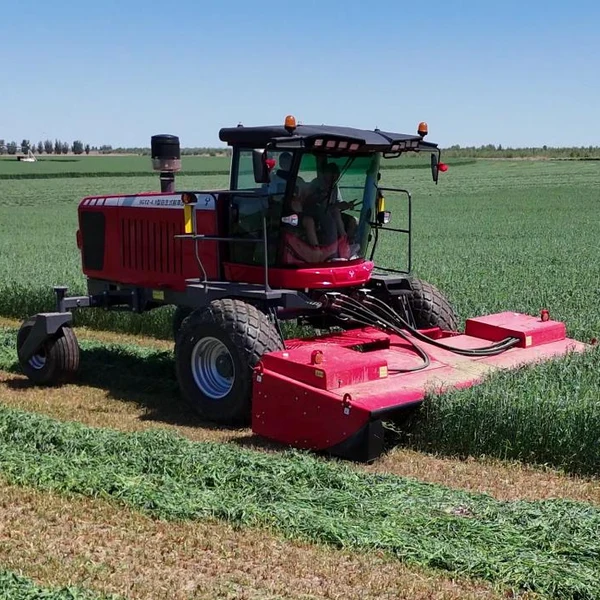
The company specializes in the development of forage and harvesting equipment using advanced computer modeling (CAD) methods. The Jiujia production base, with an area of more than 32,000 m², is equipped with CNC laser machines, automated welding systems and electrostatic spraying lines. Two specialized lines provide an annual production capacity of up to 4,000 units of equipment, including round balers and mower rakes.
The company's products, such as the 9YG and 9YCM series round balers, 9GL mower rakes and 9LZ tine rakes, are adapted to difficult climatic conditions. With its own testing laboratory and nearly a hundred technological patents, Jiujia guarantees the reliability of its equipment. In 2023-2024, the company ranked first in China in terms of round baler sales, and its equipment has been successfully exported to Russia and Mongolia, confirming compliance with international quality standards ISO 9001.
Price Range and Cost Factors in 2026
Pricing in the agricultural machinery market in 2026 has stabilized after periods of high volatility, but remains dependent on exchange rates, the cost of metal and electronic components. Purchaseagricultural harvesting equipmentis a long-term investment where the initial price is only 60-70% of the total cost of ownership (TCO).
What affects the cost?
- Performance class:The difference in price between 5th and 8th grade can reach 2–3 times.
- Equipment:Autopilot systems, all-round cameras, humidity and loss sensors increase the cost by 15–25%, but pay for themselves in 2–3 seasons due to fuel savings and reduced grain losses.
- Logistics:Delivery of oversized cargo from the factory to the buyer. Direct contracts with the manufacturer, such as cooperation with Jiujia, often include preferential delivery terms or reimbursement of transport costs due to optimized supply chains.
- Customs duties and recycling fees:Relevant for imported equipment. Localized production or direct deliveries from manufacturers with a developed distribution network allow you to avoid unnecessary markups.
Approximate prices (indicative)
Cost varies depending on configuration. Below are the average market ranges for new cars:
- Light class (3–4 t/hour):Budget segment for small farms. Price from 12–15 million rubles.
- Middle class (5–6 t/hour):The most popular segment. Optimal price/performance ratio. Price 18–25 million rubles.
- Heavy class (8–10+ t/hour):For large agricultural holdings. Price from 35 million rubles. and higher.
Note:The exact cost of a specific modification, taking into account volume discounts and leasing conditions, must be requested individually. Prices on the website are indicative and may vary depending on exchange rates and the cost of components.
Comparison of models: an engineering view
To help you get your bearings, let’s compare two conventional approaches to choosing equipment: “Budget Basic” and “Technological Premium”. This is not a comparison of brands, but a comparison of equipment philosophy.
| Criterion | Basic equipment | Premium package (Smart Farming) |
|---|---|---|
| Engine control | Mechanical pedal, manual gas | Electronic control, auto power mode |
| Setting up the thresher | Manual adjustment of sieves and fan from the cab | Automatic adjustment for crop type (One-Touch) |
| Monitoring | Basic display (rpm, temperature) | Color terminal with yield maps and telemetry |
| Operator comfort | Air conditioning, simple chair suspension | Climate control, air seat, sound insulation |
| Impact on the result | Higher dependence on the skills of the combine operator | Consistent cleaning quality by any operator |
Recommendation:If you have a high staff turnover or seasonal operators, investments in automation (premium equipment) will pay off faster by reducing the human factor. An experienced machine operator on a basic model can show no worse results, but the price of his labor will increase.
Logistics, export and service
Upon purchaseagricultural harvesting equipmentFrom the manufacturer, the issue of post-sales support is critical. The technology is complex, and idle time in the midst of the harvest is unacceptable.
Supply logistics
We organize delivery of equipment by road or rail to any point in the Russian Federation and CIS countries. Machines are transported partially disassembled (removed headers, wheels) to comply with dimensional restrictions, or under their own power over short distances. Full pre-sale preparation (PPP) is carried out either at the factory or at a regional center before delivery to the client.
Service and spare parts
The manufacturer guarantees the availability of a spare parts warehouse program. In 2026, online parts ordering systems with status tracking were introduced. For large quantities of equipment, it is possible to place a mobile spare parts warehouse directly at the customer’s premises for the cleaning period.
Staff training
The transfer of equipment includes instruction for mechanics and operators. Incorrect drum clearance or fan speed settings are a major cause of grain loss. We provide video courses and field engineers to set up the first batch of equipment for the season.
Typical mistakes when purchasing and using
An analysis of calls to service centers reveals a number of recurring problems related not to the quality of equipment, but to errors in operation and selection.
- Ignoring field preparation:Leveling the field surface before harvesting allows you to reduce the speed of the combine without losing productivity, since the header moves evenly. Unevenness causes the ears to be cut too high or grab the ground.
- Savings on headers:An attempt to harvest rapeseed or soybeans with a standard grain harvester leads to losses of up to 20%. A specialized attachment pays for itself in one season over large areas.
- Incorrect maintenance:Using inappropriate oils in hydraulics or ignoring regulations for replacing air filters in dusty conditions. This leads to failure of expensive hydraulic cylinders and pumps.
- Lack of diagnostics before the season:Checking belt tension, bearings and electronics should be done in the winter, not on the morning of the first day of harvest.
FAQ: Frequently asked questions
What warranty is provided for agricultural harvesting equipment?
The standard manufacturer's warranty is 12 months or 1000 hours (whichever comes first). If all maintenance regulations are followed and original spare parts are used, the warranty can be extended to 2–3 years. The warranty does not cover consumables (belts, knives, filters) or damage caused by improper use.
Is it possible to buy on lease or on credit?
Yes, we work with leading leasing companies and banks specializing in the agricultural sector. Programs with state support (interest rate subsidies) are possible, which significantly reduces the financial burden on the farm. Managers will help prepare a package of documents for participation in government park renewal programs.
What maintenance is required in the first year?
The first maintenance (break-in) is carried out after 50–100 operating hours. It includes changing the oil in the engine, transmission, hydraulics, replacing filters and checking fasteners. Subsequent maintenance is carried out every 250–500 operating hours, depending on the intensity of the load. Strict adherence to the maintenance schedule is a condition for maintaining the warranty.
Is your equipment suitable for working on slopes?
Yes, many models can be equipped with active leveling systems for the threshing apparatus (up to 15–18 degrees of transverse and longitudinal slope). This allows the equipment to be used effectively in mountainous and foothill regions, while maintaining the quality of grain threshing and cleaning.
Are there problems with electronics parts?
In 2026, we localized the production of most electronic control units and sensors. The electronics inventory program is maintained at 95% availability. In case of complex breakdowns, a program for exchanging units is provided (trade-in of a faulty unit for a restored one), which reduces downtime to a minimum.
Conclusion and purchasing recommendations
Choiceagricultural harvesting equipmentin 2026 - this is a strategic decision that determines the profitability of the entire agricultural cycle. The market offers reliable, technologically advanced machines that can compete with world leaders in terms of price-quality-service. Direct cooperation with the manufacturer gives you pricing transparency, flexibility in configuration and confidence in technical support.
Don't go for maximum power unless your fields are ready to handle it. It is better to take a car of a slightly smaller class, but richly equipped with loss control and operator comfort systems. This will preserve the harvest and the health of your employees.
Are you ready to update your park?
Receive an individual commercial offer with a payback calculation for your farm. Our engineers will help you choose the optimal configuration of the combine and headers for your crops and budget.
Request a price list and engineer consultation
Or check outcomplete catalog of agricultural machineryon our website.