Creation and production of highly efficient agricultural machinery 2026 – China factory
2026-08-09
- Creation and production of highly efficient agricultural machinery: Realities of 2026
- The evolution of Chinese agricultural machinery: From assembly to engineering
- Technical parameters: What to look for when assessing effectiveness
- The process of creating equipment: How quality is controlled at the factory
- Logistics and customs clearance: Hidden costs
- Comparison: Chinese factories vs European brands vs used market
- Frequently Asked Questions
- Conclusion: Procurement Strategy 2026
Creation and production of highly efficient agricultural machinery: Realities of 2026
The agro-industrial complex market will undergo a structural transformation in 2026. Global food shortages, tightening environmental regulations and a critical shortage of skilled operators are forcing farms to reconsider approaches to mechanization.Development and production of highly efficient agricultural machineryis no longer the task of exclusively European or American engineering firms. Chinese production clusters have made a qualitative leap, moving from simple copying to independent development of components and assemblies that meet ISO and GOST standards.
In our practice of working with farmers from Russia, Kazakhstan and the CIS countries, we observe a clear trend: buyers are increasingly paying attention to Chinese factories not because of low prices, but because of the “functionality/cost of ownership” ratio. If five years ago the Chinese tractor was perceived as a temporary solution, then in 2026 it is a full-fledged alternative to second-tier brands, and in some niches, to market leaders.
This article was written by engineers who are directly involved in the process of plant audits, quality control and adaptation of equipment to harsh operating conditions. We will not use marketing slogans. Instead, we will look at the technical aspects of production, the real risks of importing and specific steps to choosing a reliable partner in China.
The evolution of Chinese agricultural machinery: From assembly to engineering
To understand why the design and production of high-performance agricultural machinery in China has reached new heights, it is necessary to look at changes in the component supply chain. Until 2023, most Chinese factories depended on imported hydraulic systems and transmissions. Today the situation has changed.
Key manufacturers such as Weichai, Yuchai and local hydraulic brands have begun to produce components certified to international standards. This allowed Chinese assembly plants to control the entire production cycle. We've seen test data where modern Chinese 4-6 liter diesel engines achieve 8-12% lower fuel consumption than their decade-old counterparts, while maintaining torque in the 1400-1600 rpm zone.
However, it is important to distinguish between the concepts of “factory” and “trading company”. Thousands of enterprises are concentrated in the provinces of Shandong, Henan and Jiangsu. Only about 15% of them have their own design bureaus and foundries. The rest are engaged in final assembly from purchased kits (CKD). For the buyer, this is a critical difference. Our own production allows us to make changes to the design for specific client tasks, for example, strengthening the combine frame for working on rocky soils or changing the hydraulic configuration for specific mounted implements.
A striking example of such a technological transition is the company"Jiujia", located in the National Industrial Park of Hulunbuir City. Founded in 2021, the company has quickly evolved from a simple assembly plant into an integrated smart manufacturing center. With a production area of over 32,000 m² and a staff of 180 specialists, Jiujia demonstrates what a modern Chinese factory should look like in 2026.
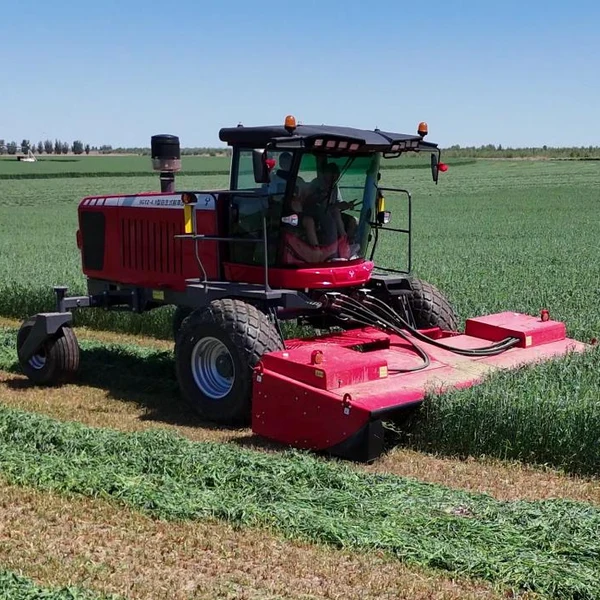
Unlike many competitors, Jiujia relies on its own R&D and the presence of almost a hundred technological patents. The company specializes in sophisticated forage equipment: round balers, mower rakes and lifting machines. For example, their flagship models, such as the 9YG-1.0 round baler and 9GQY-3.2 mower-conditioner, are designed using computer-aided modeling (CAD), allowing the assembly geometry to be pre-adapted to the loads found in Russian and Mongolian fields. The result was the company's leadership in round baler sales in China in 2023–2024 and successful exports to Russia.
Such enterprises set a new standard: the presence of ISO 9001:2015 and ISO 14001 certificates becomes the basis, but the decisive factor for the Russian and EAEU markets is compliance with the technical regulations of the Customs Union. The presence of a valid EAC certificate from manufacturing plants such as Jiujia indicates that the enterprise has already been audited by independent experts and its documentation has been brought into compliance with safety requirements.
Practical advice:Request from the supplier not just a scan of the certificate, but the declaration number in the FSA (Federal Accreditation Service) register. It will take 5 minutes, but will eliminate 90% of intermediaries.
Technical parameters: What to look for when assessing effectiveness
The efficiency of agricultural machinery is measured not by engine horsepower, but by the area processed per unit of time and resource consumption per hectare. When analyzing what Chinese factories offer in 2026, we recommend focusing on four key areas.
1. Transmission and chassis
Most budget models use manual transmissions or simple hydrostatic transmissions. However, highly efficient operation requires continuously variable transmissions (CVT) or powershift. Chinese manufacturers have begun to actively introduce their own CVT developments, which were previously a monopoly of Western brands. The advantage of such a transmission is the ability to maintain optimal engine speed regardless of speed, which saves up to 15% of fuel.
Pay attention to the material of the tracks or tires. For heavy equipment, the composition of the rubber mixture is critical. Cheap analogues quickly lose elasticity at temperatures below -20°C, which leads to microcracks and tears. Request data sheets for the tire material indicating the operating temperature range.
2. Hydraulic system
Hydraulics are the “muscles” of modern agricultural machinery. Two parameters are important here: pressure and oil purity. The standard operating pressure in modern systems is 20–25 MPa. If a plant offers a 16 MPa system, this is technology from last decade and will not provide the required lifting speed for heavy implements.
We have come across cases where Chinese factories skimped on fine filters. The result is failure of hydraulic pumps after 200–300 operating hours. The specification must indicate the presence of filters with a cleaning class of at least 10 microns, as well as oil contamination sensors. This is not an option, but a necessity.
3. Electronics and precision agriculture
In 2026, equipment without the ability to integrate with GPS/GNSS and telemetry systems is considered uncompetitive. Chinese factories are massively installing controllers compatible with ISOBUS protocols. This allows you to connect third-party autopilot navigation systems.
Check the availability of the CAN bus. It provides data exchange between the engine, transmission and attachments. The lack of a CAN bus means you won't be able to automatically adjust plowing depth or seed rate based on ground speed.
4. Cabin and ergonomics
The shortage of operators forces farm owners to fight for the comfort of their employees. Modern Chinese cabins are equipped with climate control air conditioning, pneumatic seats and noise insulation of 70–75 dB. It is important to check the cab's ROPS/FOPS certification for rollover and falling object protection. This is a legal requirement in many countries, including Russia.
| Parameter | Budget segment (China) | High performance segment (China 2026) | European premium |
|---|---|---|---|
| Transmission type | Mechanics / Simple hydrostatics | CVT / Powershift (in-house development) | CVT (ZF, Dana) |
| Hydraulic pressure | 16–18 MPa | 20–25 MPa | 22–28 MPa |
| Electronics | Basic instrument panel | Color terminal, ISOBUS, CAN-bus | Full integration, autopilot |
| Fuel consumption (tractor 150 hp) | 12–14 l/h | 9–11 l/h | 8.5–10.5 l/h |
| Warranty for main components | 1 year or 1000 hours | 2 years or 2000 hours | 3–5 years |
The choice between segments depends on the intensity of the load. For seasonal work with low intensity, a budget option may be justified. But for round-the-clock operation during the harvest period, only highly efficient equipment pays for itself by reducing downtime.
The process of creating equipment: How quality is controlled at the factory
Many buyers mistakenly believe that quality control occurs only at the output of finished products. In realitycreation and production of highly efficient agricultural machineryincludes a multi-level system of checks at each stage. We have visited more than 20 factories in Shandong Province and can highlight the best practices that distinguish reliable manufacturers.
- Incoming control of components.Every engine, axle and hydraulic pump is tested before entering the assembly line. Leading factories have their own stands for testing engines under load. If the engine does not reach rated power or has increased vibration, it is rejected. Request reports on incoming inspection of the batch you are purchasing.
- Control of welds.The frame and attachments are subject to high dynamic loads. The use of robotic welding ensures consistent seam quality. However, human supervision is required. We have seen cases where cheap factories missed microcracks in the attachment areas. Reliable manufacturers, such as Jiujia, use automated welding systems and ultrasonic flaw detection of critical components, which minimizes the risk of structural failure.
- Assembling and pulling connections.Each bolted connection must be tightened with a torque wrench and the tightening torque must be recorded. This prevents self-unscrewing due to vibration. At high-quality factories, each completed stage of assembly is marked with the color of a marker.
- Cold and hot tests.After assembly, the equipment undergoes a “run-in” test. Cold tests check the operation of electronics and hydraulics without starting the engine. Hot tests involve running the engine under load on a bench for 2–4 hours. The temperatures of the oil, antifreeze and the tightness of all systems are checked.
- Field tests.Before serial production of a new model, the plant is required to conduct field tests in different soil and climatic conditions. For equipment supplied to Russia, tests at low temperatures are critical. Check to see if the factory conducted winter tests on a specific model.
One of our clients was faced with the problem of rapid wear of constant velocity joints (CV joints) on Chinese loaders. The investigation revealed that the plant used a lubricant that was not designed for extremely low temperatures. After changing the lubricant specification to a frost-resistant one, the problem was solved. This case shows the importance of adapting equipment to the region of operation. Companies such as Jiujia, which has experience exporting to Mongolia and Russia, initially take into account the climatic characteristics of these regions in their design, using materials that are resistant to temperature changes.
Logistics and customs clearance: Hidden costs
The FOB (Free On Board) price that you see in the factory price list is only 60–70% of the final cost of the equipment in your field. The remaining costs are formed by logistics and customs. In 2026, logistics routes from China have stabilized but require careful planning.
Main delivery options:
- Railroad delivery.Optimal balance of price and term for Russia and Central Asia. Delivery time is 15–25 days. Proper preparation of equipment is required: draining technical fluids (or replacing them with non-hazardous analogues for transportation), dismantling protruding parts.
- Sea delivery.The cheapest option, but the period increases to 40–60 days. Suitable for large quantities. The risk of corrosion damage due to salt air is higher, so enhanced anti-corrosion treatment is required before shipping.
- Automobile delivery.Fast (7–12 days), but expensive. Used for urgent deliveries of spare parts or single samples.
Customs clearance includes payment of duties (usually 5–15% depending on the HS code), VAT (20% in the Russian Federation) and recycling fees. The recycling fee continues to rise in 2026, making the import of cheap equipment less profitable. However, for highly efficient equipment with a long service life, this tax is amortized more quickly.
An important point: obtaining a TR CU certificate of conformity. Without this document, you will not be able to register the equipment with Gostekhnadzor and legally operate it. The manufacturing plant must provide a full package of technical documentation in Russian, including an instruction manual and a product passport. Factories often offer assistance with certification through their partners in Russia. This is a convenient service, but make sure that the certificate will be issued specifically to your company.
Comparison: Chinese factories vs European brands vs used market
When making a purchasing decision, a dilemma often arises: buy a new Chinese tractor, a used European one, or save up for a new premium brand. Let's compare these options objectively, based on the economics of the enterprise.
| Criterion | New technology from China (2026) | Used equipment from Europe (5–7 years) | New equipment from the EU/USA |
|---|---|---|---|
| Purchase cost | Low / Medium | Medium/High | Very high |
| Technical condition | Perfect (guaranteed) | Unpredictable (risk of breakdowns) | Perfect |
| Availability of spare parts | High (warehouses in the Russian Federation are growing) | Low (discontinued models) | Medium (sanctions restrictions) |
| Manufacturability | Modern (ISOBUS, GPS) | Outdated (no precision agriculture) | Frontline |
| Risk of downtime | Low (first 3 years) | High (wear of components) | Low |
| Liquidity on resale | Average (market growing) | Stable | High |
Our recommendation is based on farm size. For small and medium-sized farms (up to 1000 hectares), new Chinese technology is the most rational choice. You get a guarantee, modern technology and predictable maintenance costs. Purchasing used equipment from Europe in 2026 is associated with high risks: spare parts are becoming scarce, and the cost of repairs may exceed the cost of the tractor itself.
For large agricultural holdings (more than 5,000 hectares), a combination is advisable: the fleet of main equipment is formed from reliable Chinese brands of the middle and high segment, and for complex operations, flagship models are used, if budget and logistics allow.
Frequently Asked Questions
What is the minimum order quantity (MOQ) of Chinese factories?
For standard models of tractors and combines, most factories are ready to ship even 1 unit. However, the price for a single copy will be 5–10% higher due to the cost of individual packaging and paperwork. For special equipment or customized solutions, the MOQ can be 3–5 pieces. We recommend teaming up with neighboring farms to form a container or wagon lot in order to reduce logistics costs per unit of equipment.
How is warranty service provided?
In 2026, the guarantee scheme was completed. Large Chinese manufacturers with representative offices in the Russian Federation and the CIS (for example, through subsidiaries or official dealers, as Jiujia does through its export channels) provide prompt service. Warranty cases are covered by replacement of components. It is important to agree in advance on the list of warranty parts and the order in which they will be supplied. Typically, the plant sends a set of critical spare parts along with the first batch of equipment. The response time for complaints from responsible factories is no more than 48 hours. Be sure to include penalties in the contract for failure to meet delivery deadlines for spare parts.
Are Chinese engines suitable for Russian fuel?
Modern Chinese-made diesel engines that comply with Euro-4 and Euro-5 standards are adapted to the fuel quality common in Eurasia. However, they are sensitive to sulfur and water content. We strongly recommend using additional fuel separator filters when refueling. This is a cheap solution that extends the life of injectors and injection pumps significantly. If you work in remote areas with unstable diesel quality, choose engines with a mechanical injection pump; they are less demanding, although less economical.
Is it possible to visit the factory before purchasing?
Yes, and we strongly advise you to do so. A personal visit allows you to assess the real production capacity, production culture and seriousness of management. Many factories organize a tour for potential buyers. If a visit is not possible, request a video conference with a live camera on the shop floor. Pay attention to component inventory and assembly line activity.
Conclusion: Procurement Strategy 2026
The development and production of high-efficiency agricultural machinery in China has reached maturity. The market is no longer a wild west with unpredictable quality. Today it is a source of technologically advanced, reliable and economically sound solutions for agribusiness. The key to success is not in finding the lowest price, but in choosing the right manufacturing partner who shares your quality requirements and is willing to take responsibility for their product.
Investments in new equipment should pay off through increased productivity and reduced operating costs. Chinese mills of 2026, such as Jiujia, which offer a wide range of forage equipment with proven quality and adaptation to local conditions, offer this balance. Don't be afraid to ask tough technical questions, demand proof of standards, and check the vendor's reputation.
If you're planning a fleet upgrade this season, start by auditing your current needs and comparing them with the technical capabilities of the models on offer. We are ready to help you understand the specifications and choose equipment that will work for your harvest and not need to be repaired.
Find out more about agricultural machinery models
Contact us today to receive a personal quote and advice on equipment selection.