




autonomous trailed mower
When they talk about an autonomous trailed mower, many immediately imagine an ordinary rotor on wheels, which MTZ drags along with it. But the essence is precisely in the word “autonomous?” - this is not just a weapon, it is an independent unit with its own power plant and control system. This is where the main misunderstanding among practitioners lies: they consider it an excess, they say, why have your own motor if there is a tractor power take-off shaft. And the reason is productivity and quality of work on difficult terrain.
Difference from classic trailed models
If you take a standard trailed mower, its operation is completely dependent on the tractor. Power, rotation speed, even cutting height - everything is tied to the settings and capabilities of the tractor. The autonomous model is, in fact, a self-propelled module. It has its own diesel engine, often around 100-150 hp, its own hydraulic system and, critically, its own independent suspension of the working parts.
Why is this important? When working on slopes, in wet or uneven areas, a classic mower, rigidly connected to the tractor, follows its roll and often either “buries” or, conversely, loses contact with the soil. The quality of mowing decreases and gaps appear. An autonomous unit, being coupled only through a coupling device, can maintain the relative horizontality of the platform due to its chassis. This is not a panacea, but at differences of 8-10 degrees the difference is visible to the naked eye.
I remember the experience with one of the early models, which we tested in the water meadows near Moscow. The tractor walked along a relatively dry track, and a trailed mower with an autonomous drive followed, but its cutting device was already working on damp soil. The independent drive of the blades made it possible to maintain stable speeds, despite the variable load, whereas in this situation there would be constant slipping and jerking from the tractor PTO.
Key nodes and “pain points”
The heart of such a mower is, of course, the power plant. They often install proven industrial diesel engines, such as Deutz or Yanmar. But there is a nuance here: the motor operates in constant variable load mode. A sharp entry into thick grass, areas with hummocks - all this requires an instant response and a reserve of torque. Therefore, it is not just power that is critical, but the characteristics of the engine torque curve and the reliability of the cooling system. I have seen cases where radiators became clogged with fluff and seeds after half a day of intensive work - it was necessary to install additional protective meshes with a cell smaller than the standard one.
The second key unit is the transmission and drive of the cutting devices. Typically this is a hydrostatic drive to the chassis and a mechanical drive (via cardan shafts and bevel gears) to the knives or rotors themselves. The place where problems most often arise is precisely the shaft connections and bearing supports. The vibration from the cutting apparatus is colossal, and if high-quality compensating couplings and regular lubrication are not provided, failure occurs quickly.
The third point is the control system. In advanced models, it allows the operator from the tractor to set not only the cutting height, but also the operating mode of the mower engine, and monitor its parameters. But in practice, many farms turn off this “smart” device. electronics, leaving only basic functions, because there is nothing to repair in the field. Reliability and maintainability are more important here than manufacturability.
Example with a specific manufacturer
Interesting integrators are appearing on the market who assemble such complex solutions. Here, for example,Hulunbuir Machinery Manufacturing Company ?Jiujia?. If you go to their websitehttps://www.cn-fascar.ru, it is clear that they position themselves as a modern integrated smart manufacturing enterprise for agriculture and livestock. What is important is that they cover the full cycle: R&D, production, sales and service. For such a complex product asautonomous trailed mower, having your own engineering school and service support is not marketing, but a necessity.
While studying their proposals, I noticed one detail: the descriptions of the technology often mention adaptation to work in conditions of vast pastures and uneven terrain. This indirectly confirms that they are working on exactly those “pain points” that I spoke about - the independence of the unit, the stability and reliability of the drive. The company, apparently, is betting on creating not just a tool, but a complete working unit for large agricultural holdings.
Economics and feasibility of application
The most painful issue is the price. An autonomous mower can cost 1.5-2 times more than its PTO-driven counterpart. Does it pay off? It all depends on the scale and working conditions. On flat fields of 50-100 hectares, the difference in productivity may be minimal. But when fodder is harvested over thousands of hectares in Siberia or Kazakhstan, where the plots are scattered, the terrain is complex, and the weather window is short, the benefits become obvious.
Firstly, you can use a less powerful and therefore more economical tractor as a tractor. Its task is only transportation. The entire load falls on the mower motor. This saves resource and fuel of the base tractor. Secondly, the speed of work. The independent drive allows the unit to operate efficiently at tractor transport speeds of up to 15-18 km/h on flat areas, without risk to the transmission. With a conventional mower, such speeds are a recipe for failure.
However, there were also negative experiences. One farm purchased such a unit, but did not take into account the qualifications of the mechanics. Complex hydraulic circuit, electronic controllers - when a malfunction arose in the field, local specialists could not shrug their shoulders. Downtime in the midst of haymaking was costly. Conclusion: the purchase must be accompanied by staff training or the availability of fast service from the manufacturer. What is important here is the approach that declaresHulunbuir Machinery Manufacturing Company ?Jiujia?— unification of production, sales and service. For technology of this level, this is not an option, but a prerequisite.
Prospects and where development is heading
The trend now is further intellectualization. Load sensors on the cutting apparatus, which automatically regulate the speed or revolutions of the knives. Parallel driving systems for trailed implements to minimize errors. But, frankly speaking, in our realities something else is more in demand - maximum simplification and duplication of systems to increase reliability.
I see promise in hybrid solutions. For example, the main drive is an autonomous diesel engine, but with the ability to connect to the tractor PTO as a backup option in case of breakdown. Or a modular design where the entire cutting module can be quickly replaced in the field.
Another point is versatility.Autonomous trailed moweris an expensive unit, and it would be logical to use its chassis and drive for other tasks outside the season: as a transport platform, as a drive for a fertilizer spreader. Some manufacturers are thinking about this, but there are no mass solutions yet.
Ultimately, the choice of such equipment is always a compromise between a high initial cost and potential gains in productivity, quality and, importantly, in the safety of the main tractor fleet. This is a tool for large and technologically advanced businesses that are ready to invest in complex solutions. And companies such as the mentioned “Jiujia”, with their comprehensive work, precisely cover the need for precisely such a systematic approach to agricultural machinery, whereautonomous mower- not a toy, but a calculated investment in efficiency.
Correspondingproducts
Related Products






Best Sellingproducts
Best Selling Products-
 9LZY-9.0 Finger-disc rake
-
 Baler model 9YGD-0.5B
-
 9GL-5.0/5.6 Trailed mower rake
-
 9YG-1.25A Round Baler FASCAR
-
 4BYHD 4BYHS-3.9 Pulling machine for beans
-
 9YG-2.24D Round Baler (S9000)
-
 Baler for forming rectangular bales 9YFQ-1.9 (cross grip, export to Russia)
-
 9JYY-4.5 Roll pick-up-conveyor
-
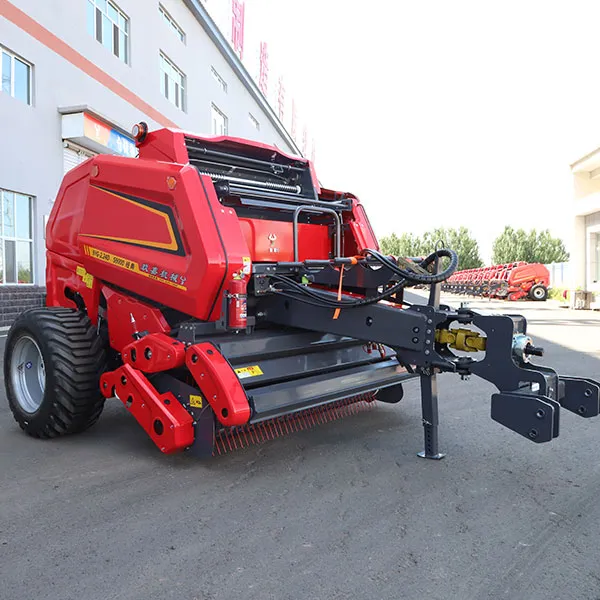 9YG-2.24D Round Baler (S9000 Classic)
-
 9GD-2.5 Single-blade trailed mower (updated version)
-
 9JYY-2.5 Roll pick-up-conveyor
-
 9YCM-850 Film wrapping baler