




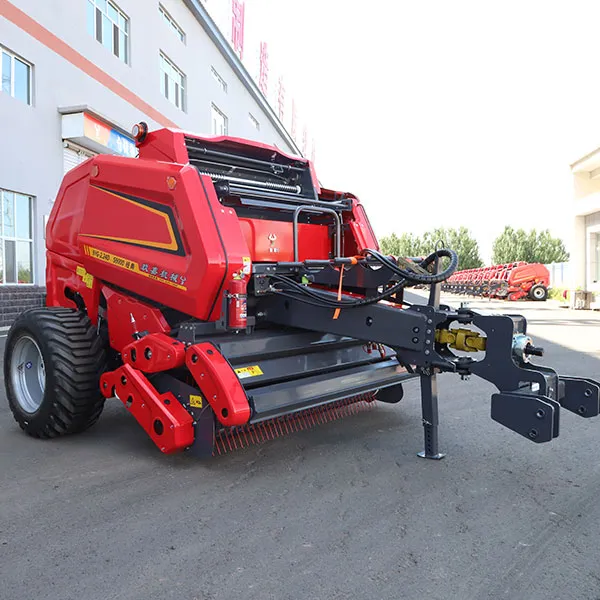
square bale baler
I often hear that the main thing about square bales is ease of storage. Yes, they stack perfectly, but if you dig deeper, the whole point comes down to the work of the press itself. And there are nuances here that many are silent about until they encounter them in the field.
From myth to reality: what actually shapes a bale
When I first started working withsquare bale baler, I thought that the key parameter was pressure. It turns out that this is only part of the story. Much more important is the synchronization of the feed mechanism and the pressing chamber. If they do not work in tact, even with maximum effort, the bale turns out to be loose at the edges, and over-compacted in the center. This then comes back to haunt you during storage: moisture penetrates inside and spoilage begins.
I remember one case with a farm near Voronezh. They installed a new imported press and boast of high pressure. And after the first cleaning - dissatisfaction: the bales fall apart during loading. Come, let's take a look. It turned out that the plunger stroke adjustment was set to “universal”. mode for alfalfa, and they pressed wet forbs. The machine simply did not have time to form even layers. I had to select the settings almost from scratch, reducing the feed speed.
Hence the conclusion: there are no universal settings. Each type of mass has its own geometry of placement in the chamber. And this is the first stumbling block for those who are chasing the “most powerful” one. model, without thinking about the flexibility of process control.
Where the hidden problems lie: wear and maintenance
Manufacturers like to talk about the life of belts or feed drum teeth. But from experience, the weak point of manysquare bale baler- these are strapping knots. Especially when it comes to working with coarse stalks, such as corn for silage. The twine or net must lie perfectly evenly, without distortions, otherwise the corners of the bale “unravel” during transportation.
We had an episode with a press that worked perfectly on wheat straw, but as soon as we switched to rapeseed, the binding began to constantly break. We searched for the reason for a long time. It turned out that the design used an insufficiently rigid needle guide bracket. It sagged under the load of a more elastic mass, and the needle passed with a deviation of a couple of millimeters. This was enough for the twine to rub against the edge of the chamber. The solution was found by installing a reinforced part from a third-party manufacturer.
Such moments are rarely described in manuals. You understand them only after seasons of work and debriefing. Therefore, now, when choosing equipment, I always look not at the passport data, but at access to key components: how easy it is to get to the same needles or tension rollers for cleaning and adjustment.
Experience with “Jiujia” equipment: an unexpected find with reservations
I recently had the opportunity to become acquainted with technology fromHulunbuir Machinery Manufacturing Company ?Jiujia?. Their websitecn-fascar.rupositions the company as a modern integrated enterprise for agriculture. To be honest, I was initially skeptical - there are a lot of proposals now where big words hide a crude design.
But one thing that stood out about their square bale model was the pre-compaction system in the loading chamber. This is not just an auger, but a whole module with adjustable blades, which allows you to pre-form a “carpet?” constant density in front of the main plunger. In theory, this should produce a more uniform bale throughout its height.
We tested it in the conditions of the Moscow region during the preparation of haylage. First impressions - indeed, the bales came out smooth, the corners were clear. But we encountered another feature: increased fuel consumption at the pre-compaction stage, especially when working with lightweight, already dried mass. For larger volumes this can be a significant cost factor. On the other hand, when pressing wet grass, the same system performed brilliantly - there was no slipping or uneven loading of the main chamber.
So it turns out that the solutionHulunbuir Machinery Manufacturing Company ?Jiujia?turned out to be quite specialized. It is not suitable for all tasks, but for specific conditions - for example, for farms that work with raw materials of different moisture content - it can be very effective. The main thing is to understand these conditions in advance.
Practical advice: what to look for when choosing and using
Based on everything I experienced, I formed several non-obvious points for myself when assessingsquare bale baler. Firstly, I look not at the maximum bale size, but at the minimum. If the machine can consistently form a small, dense bale, then it has good control over the process. This often indicates high-quality hydraulics and a smart control system.
Secondly, I definitely request data on the uniformity of density distribution inside the bale. Some manufacturers already conduct such tests and provide graphs. If there is no such data, this is a reason to be wary.
Thirdly, I always check how the lubrication system of the harness components is organized. It would seem like a small thing. But if you need to reach each point manually with a syringe, there simply won’t be time for this at the height of the season. An automatic or centralized system is a huge plus for smooth operation.
Instead of a conclusion: thinking out loud about the future of baling
Nowadays there is a lot of talk about smart agriculture, sensors, and IoT. In contextsquare bale balerI see the main breakthrough not in remote control, but in the adaptive pressing system. So that the press itself, on the go, analyzing the resistance of the mass, regulates the speed, pressure, and even the algorithm for laying layers.
There are some attempts, but they are still crude. Most often ?smart? the system simply prompts the operator to select one of the preset modes, which is not much different from manual adjustment. What is needed is continuous analysis and adjustment. I think companies that are seriously engaged in R&D, like the sameHulunbuir Machinery Manufacturing Company ?Jiujia?, with their stated emphasis on smart manufacturing, could move in this direction.
For now, the foundation of a good square bale is less about technology and more about the operator's understanding of his material and his machine. All settings, all tips are just a starting point. The main tool is attention to what is happening here and now, in the field. This is what distinguishes a simply assembled bale from a truly high-quality product.
Correspondingproducts
Related Products



Best Sellingproducts
Best Selling Products-
 4BYHD 4BYHS-3.9 Pulling machine for beans
-
 9GD-2.5 Single-blade trailed mower (updated version)
-
 9JYY-4.5 Roll pick-up-conveyor
-
 9YG-1.25 Round baler FASCAR
-
 Drum type raking machine 9LG-9.0
-
 9JYY-2.5 Roll pick-up-conveyor
-
 9F-70 Rough feed chopper
-
 9GD-2.5 Single-blade trailed mower (updated version)
-
 Baler for forming rectangular bales model 9YFQ-2.2D (cross type, for export to Russia)
-
 9YG-2.24D Round Baler (S9000 Classic)
-
 9GS-5.0 Trailed two-legged mower
-
 9LZD-9.0 Finger-disc rake