Buy a baler for the Neva walk-behind tractor: price 2026
2026-08-26
- Buy a baler for the Neva walk-behind tractor: current prices and technical solutions for 2026
- Technical features of compatibility of balers with Neva walk-behind tractors
- Classification of mini-presses for walk-behind tractors: what to choose in 2026
- Price Range and Cost Factors in 2026
- How to choose a supplier and avoid mistakes when purchasing
- An Engineering Perspective: Limitations and Real-World Performance
- Step-by-step Operation and Maintenance Guide
- Comparison of popular models available in the Russian Federation
- Market leaders: the experience of Jiujia
- Logistics and export opportunities
- FAQ: Frequently asked questions
- Conclusion and purchasing recommendations
Buy a baler for the Neva walk-behind tractor: current prices and technical solutions for 2026
If you are planningbuy a baler for the Neva walk-behind tractor, it is important to understand that the market for attachments in 2026 has undergone significant changes towards modularity and strengthening of load-bearing structures. The main demand of farmers and private farm owners has shifted from simple rakes to full-fledged mini-presses capable of forming bales weighing from 15 to 40 kg directly in the field. The key advantage of integrating such a unit with the Neva series walk-behind tractors (MB-2, MB-23, Agro) is the use of a standard PTO (power take-off shaft) or belt drive, which avoids complex hydraulic systems and reduces operating costs by 30–40% compared to tractor analogues.
Pricing for the current season depends on the type of bale being formed (round or rectangular), the material of the bale chambers and the presence of an automatic tying system. The average price range for high-quality Russian and adapted imported models varies from 85,000 to 160,000 rubles. However, cheap analogues often cannot withstand the torque of an engine with a power higher than 6–7 hp, which leads to rapid wear of the walk-behind tractor gearbox. In this review, we will look in detail at how to choose reliable equipment, what technical nuances affect the durability of the hitch assembly, and why correct setting of the bale density is critical for preserving the feeding properties of haylage.
Technical features of compatibility of balers with Neva walk-behind tractors
Motoblocks "Neva" are one of the most common power platforms in small agribusiness in Russia and the CIS. Their design feature - the presence of a powerful gearbox and the ability to connect active attachments - makes them an ideal base for light balers. However, in orderbuy a baler for the Neva walk-behind tractorand not to make a mistake with compatibility, it is necessary to take into account three fundamental parameters: drive type, unit weight and coupling geometry.
Drive type: PTO versus belt drive
Most modern mini-presses use one of two methods of transmitting rotation from the walk-behind tractor engine to the pressing mechanism:
- Drive from PTO (Power Take Off Shaft):This is the most effective method for Neva models with a multi-unit. Torque is transmitted directly through the driveshaft. The efficiency of such a system reaches 92–95%, which allows you to compress even slightly damp hay without slipping. Requires a rear PTO on the walk-behind tractor (for example, modification MB-23).
- Belt drive from engine pulley:A more universal option, suitable for all models, including MB-2. The rotation is taken from the motor pulley through an additional system of belts and pulleys on the press frame. The downside is the loss of power due to friction (efficiency is about 80%) and the need to frequently tighten the belts during intensive work.
Weight restrictions and balancing
The Neva walk-behind tractor has a dead weight of 85 to 105 kg (without weights). A mounted baler in working condition (with hay accumulation) can weigh from 60 to 120 kg. Such an imbalance requires the mandatory installation of front weights. Engineering practice shows that without weighting the front axle (at least 20–30 kg), the controllability of the walk-behind tractor becomes critically low, especially when turning when the press chamber is full. This is not just a matter of convenience, but a requirement for operator safety.
Classification of mini-presses for walk-behind tractors: what to choose in 2026
The market offers two main types of bale forming. The choice between them determines not only the price, but also the logistics of storing feed.
Round Balers (Round Balers)
The most popular type for small farms. The hay is rolled into a roll with a diameter of 50–70 cm.
Benefits:
- Simple chamber design (often based on sprockets or rollers).
- Better “breathing” of the bale, less risk of internal rotting due to improper drying.
- Convenient manual transportation (can be rolled).
Disadvantages:
- Unstable shape when stored in stacks (requires more space).
- It is more difficult to automate the distribution of feed to animals.
Rectangular Balers (Bales)
A more technologically advanced solution that imitates the operation of large tractor presses. Forms briquettes measuring, for example, 30x40x50 cm.
Benefits:
- Ideal stacking, saving up to 40% space in the shed.
- Standardized weight and size, convenient for hay sales.
- High compaction density.
Disadvantages:
- More complex mechanics (plunger mechanism).
- Higher requirements for the power of the walk-behind tractor (recommended from 7 hp).
- Sensitivity to raw material moisture.
Price Range and Cost Factors in 2026
When a buyer is looking for an opportunitybuy a baler for the Neva walk-behind tractor, price is the deciding factor. In 2026, prices for metal and components will stabilize, but logistics costs will remain. Below is the detailed pricing structure.
| Equipment category | Average price (RUB) | Characteristics | For what tasks |
|---|---|---|---|
| Basic tedder rake with easy picking function | 25,000 – 40,000 | There is no pressing function, only collection into windrows. | Preparing hay for manual harvesting or older models of balers. |
| Mini round bale press (China/Russia) | 85,000 – 110,000 | PTO/belt drive, manual strapping, bale weight up to 20 kg. | Personal farm, up to 10 heads of cattle. |
| Professional mini press (rectangular) | 120,000 – 160,000 | Reinforced frame, density adjustment, auto reset. | Small farms, commercial feed procurement. |
| Premium segment (European adaptations) | from 180,000 | High-strength steel, sealed bearings, 2-year warranty. | Intensive daily use. |
What affects the final cost?
- Camera material:Cheap models use a thin-walled profile that is deformed when hit by stones or branches. Models more expensive than 100 thousand rubles. use steel with a thickness of 3–4 mm.
- Strapping system:Manual tying with twine reduces the cost but increases operator time. Automatic tying knots add 15–20 thousand rubles to the cost, but speed up the process by 2 times.
- Bearing units:The presence of sealed bearings is critical for operation in dusty environments. Open bearings require daily lubrication and are more likely to fail.
How to choose a supplier and avoid mistakes when purchasing
The market is saturated with offers, but not all sellers have technical expertise. To successfullybuy a baler for the Neva walk-behind tractorand get a working unit, follow these recommendations:
1. Checking the availability of spare parts.
Ask the seller a direct question: “Are there belts, springs and twine available for this model?” If the seller answers evasively, most likely this is a one-time batch, and repairing in the event of a breakdown will be a problem. For Neva walk-behind tractors, the presence of specific pulleys or adapters for the PTO is critical.
2. Analysis of reviews with photos.
Ignore text reviews without details. Look for user reports after 3-6 months of use. Pay attention to complaints about “cutting bolts,” “breaking belts,” or “overheating of the walk-behind tractor gearbox.”
3. Technical support.
A good supplier will provide an assembly diagram and video instructions for setting the bale density. Lack of instructions is a red flag. The density setting affects whether your walk-behind tractor can “pull” the press in thick grass.
An Engineering Perspective: Limitations and Real-World Performance
As a specialist with experience in industrial equipment, I must point out the objective limitations of the “walk-behind tractor + mini-press” combination. This is not a 1.4 traction class tractor.
Firstly,operating speed. The optimal speed of movement of a walk-behind tractor with a press is 3–5 km/h. At higher speeds, the pick-up does not have time to pick up the mass, or the engine stalls under load.
Secondly,raw material moisture. Baling is possible only when the hay moisture content is no more than 17–20%. Wetter hay will cause the bale to lose its shape and, in the case of rectangular balers, cause the plunger to jam.
Real Performance:
One operator with a Neva walk-behind tractor and a baler can produce from 1.5 to 2.5 tons of hay in an 8-hour working day. This depends on the grass yield (kg/m²) and the length of the rut. For comparison: manual labor produces about 300–500 kg per day. Thus, the payback of the equipment even if there are 2-3 heads of livestock occurs in one season.
Step-by-step Operation and Maintenance Guide
The durability of equipment depends 80% on proper operation. Here is the algorithm of actions for the operator:
Preparing for work
- Check the tension of all belts. The deflection should be 10–15 mm when pressed with a finger.
- Lubricate the chain drives and bearings (if equipped with grease nipples). Use lithium grease that is resistant to washout.
- Adjust the pick-up height. The teeth should not touch the ground, the optimal gap is 2–3 cm, so as not to collect soil and stones.
- Install the front weights on the walk-behind tractor.
Pressing process
- Start the walk-behind tractor engine and warm it up.
- Shift into gear (usually second or third, depending on the thickness of the grass).
- Smoothly turn on the press drive (PTO lever or belt tension roller).
- Move evenly. Avoid sudden stops with the press on - this creates peak loads on the gearbox.
- When the chamber is full (pressure indicator or visual), stop, tie the bale and dump it.
Typical errors and their elimination
Problem:The walk-behind tractor slips or stalls.
Reason:The bale density is too high or the swath is too thick.
Solution:Loosen the density regulator springs or reduce the swath width (split the swath into two parts).
Problem:The bale crumbles after leaving the chamber.
Reason:Low density or wet hay.
Solution:Increase spring tension. Check the moisture content of the hay.
Problem:The twine breaks when tied.
Reason:Incorrect setting of the tying knot or poor quality of the twine.
Solution:Adjust the twine tensioner. Use polypropylene twine with a diameter of 2-3 mm, designed for presses.
Comparison of popular models available in the Russian Federation
To simplify the choice, consider a comparative table of three typical solutions that can be found on sale in 2026. Please note that brands may change, but design types remain the same.
| Parameter | Economy model (China) | Model “Standard” (RF/Assembly) | Model “Pro” (Reinforced) |
|---|---|---|---|
| Bale type | Round | Round/Rectangular | Rectangular |
| Bale weight | 10-15 kg | 15-25 kg | 25-40 kg |
| Required power | from 5 hp | from 6.5 hp | from 7.5 hp |
| Frame material | Profile 20×20 mm | Profile 40×20 mm | Channel/Angle 3-4 mm |
| Harness | Manual | Manual/Semi-auto | Automatic |
| Resource (seasons) | 1-2 | 3-5 | 5+ |
Recommendation:If you plan to use a walk-behind tractor only for making hay for the winter for 1–2 cows, the Economy model will pay off. But if you are selling hay or have a livestock of 5 heads or more, the “Standard” or “Pro” model will pay for itself due to the time and lack of downtime for repairs.
Market leaders: the experience of Jiujia
When choosing a reliable manufacturer, you should pay attention to companies that combine innovation with proven practice. A prime example of this approach is the Hulunbuir Jiujia Machinery Manufacturing Company. Founded in 2021, this modern, integrated company has quickly established itself as a leader in the agricultural and livestock machinery industry, becoming China's No. 1 round baler in 2023-2024.
Located in the National Modern Agricultural Machinery Industrial Park of Hulunbuir City, Jiujia has a production area of over 32,000 m² and a staff of 180 professionals. The company does not just assemble equipment, but carries out a full cycle: from scientific research and CAD design to mass production and after-sales service. Thanks to its own testing laboratory and ISO 9001 certification, the company's products undergo strict quality control, which is especially important for operating conditions in Russia and the CIS countries.
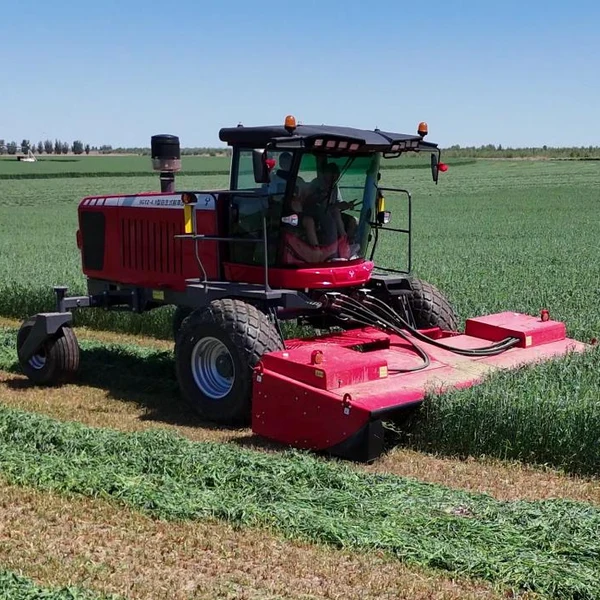
Jiujia's portfolio includes a wide range of forage equipment, including a series of mower rakes, lifting machines and, most relevant to walk-behind tractor owners, high-efficiency round balers (for example, model 9YG-1.0) and film wrap balers (9YCM-850). The use of advanced technologies, such as CNC laser cutting and automated welding systems, allows us to create equipment with a high degree of reliability. The company actively exports its products to Russia and Mongolia, adapting designs to local climatic conditions and farmers' requirements. Jiujia's philosophy of starting with the customer's needs and ending with complete satisfaction makes their equipment one of the most sought after in the intelligent agricultural machinery market.
Logistics and export opportunities
For buyers from the CIS regions and remote areas of Russia, logistics is important. Balers are bulky loads.
- Pickup:Equipment is often supplied partially disassembled (in a box or on a pallet). This reduces transport costs. Assembly takes 2–4 hours and requires a standard set of tools.
- Delivery TC:Consider the dimensions. Rectangular presses may require slings due to their non-standard shape.
- Export:When ordering from abroad, please pay attention to EAC certification. The equipment must have a passport in Russian and instructions that comply with GOST 2.601. Lack of documents may create problems during warranty service.
FAQ: Frequently asked questions
Which Neva walk-behind tractor is best suited for a baler?
The best choice isNeva MB-23with a Subaru or Briggs & Stratton engine with a power of 7 hp or more. This model has a reinforced gearbox and a standard PTO, which is ideal for driving a press. MB-2 models are also suitable, but it is better to use them with a belt drive and engines of 6 hp or more.
Is it possible to bale straw?
Yes, but the straw is harder and bulkier. Straw requires maximum density setting and preferably a rectangular press type. Round presses may not form a bale of light straw well; it will be loose.
Do I need special twine?
Yes, regular crochet twine will not work. You need a special press twine (polypropylene) that is resistant to tearing under tension. Its thickness is usually 2.0–3.5 mm. Using the wrong twine will cause the bale to constantly tear and lose its shape.
How much hay is in one bale?
On average, one round bale with a diameter of 60 cm weighs 15–20 kg. One rectangular bale (30x40x50 cm) weighs 20–30 kg. The exact weight depends on the humidity and the tightness of the spring settings.
Where to buy spare parts for a baler?
It is better to buy spare parts (belts, springs, twine) where you decidebuy a baler for the Neva walk-behind tractor. Check the availability of a repair kit when purchasing basic equipment. Standard bearings and bolts can be purchased at any hardware store, but specific parts for the strapping mechanism can only be purchased from the manufacturer.
Conclusion and purchasing recommendations
Procuring feed using the Neva walk-behind tractor and a mounted baler is an economically sound strategy for small agribusiness in 2026. It reduces dependence on hired labor and expensive equipment. The main thing is not to chase the lowest price, but to choose equipment that matches the power of your walk-behind tractor and the volume of work.
Before placing your order, please weigh again:
- The power of your engine (there should be a reserve of 15–20%).
- Type of terrain (hilly terrain requires lighter models).
- Availability of service in your region.
If you are ready to increase the efficiency of your farm and automate the hay harvesting process, we recommend that you familiarize yourself with our catalog of proven models that have passed tests for compatibility with Neva equipment.
Ready to make a choice?
Get detailed advice from an engineer and a payback calculation for your farm.
→View the catalog of balers for walk-behind tractors
→Request a call back to select a model