Large agricultural machinery factories: ranking of manufacturers 2026
2026-08-26
- Large agricultural machinery factories: rating of manufacturers 2026 and criteria for choosing a reliable partner
- What are large agricultural machinery factories in the realities of 2026?
- Where products from leading manufacturers are used: segmentation and objectives
- Rating and review of key market players in 2026
- Comparative table of technical parameters of leaders
- How to choose large agricultural machinery factories: evaluation criteria
- Typical mistakes when choosing a manufacturer and equipment
- An engineering perspective: what to look for in a specification
- Recommendations for purchasing and negotiations with the factory
- Industry development trends until 2030
- FAQ: Frequently asked questions about agricultural equipment manufacturers
- Conclusion: A strategic approach to choosing a partner
Large agricultural machinery factories: rating of manufacturers 2026 and criteria for choosing a reliable partner
Large agricultural machinery factoriesin 2026, they are high-tech production complexes capable of providing the agro-industrial sector with machines with a component localization level of over 85% and the integration of precision farming systems. For managers of agricultural holdings and buyers, choosing a manufacturer is not just a purchase of hardware, but a strategic decision that determines the profitability of the crop for the next 7–10 years. In the context of the transformation of global supply chains, the key factors are not only price, but also the availability of a service network, the availability of spare parts warehouses and the ability of the plant to adapt equipment to specific soil and climatic conditions.
Modernlarge agricultural machinery plantmust meet strict reliability standards (MTBF - mean time between failures) and provide transparent leasing and post-warranty service conditions. In this review, we will analyze the market leaders in 2026, based on technical parameters, production volume and real feedback from operators, so that you can make an informed engineering and commercial decision.
What are large agricultural machinery factories in the realities of 2026?
The concept of a “large plant” in the agricultural machinery industry has evolved. If ten years ago the criterion was gross output of units per year, then in 2026large agricultural machinery factoriesare assessed based on the combination of technological maturity and ecosystem approach. These are full-cycle enterprises where design, casting, machining, assembly and testing take place on a single territory or within a strictly controlled cluster.
A modern manufacturing giant is characterized by the following features:
- Vertical integration:In-house production of critical components (engines, transmissions, axles), which reduces dependence on external suppliers and stabilizes prices.
- Digital twin of production:Using IoT sensors on assembly lines to monitor the quality of every bolt and connection in real time.
- R&D centers:Availability of our own design bureaus working on adapting equipment to new crop varieties and soil cultivation methods (No-Till, Mini-Till).
- Service density:The ability to ensure that a mobile team can travel within a radius of 150–200 km from any point of sale within 24 hours.
It is important for the buyer to understand that cooperation with such a plant minimizes the risks of equipment downtime during the harvesting campaign. Downtime of a harvester during the ripening window can cost more than the machine itself, so supplier reliability becomes priority No. 1.
Where products from leading manufacturers are used: segmentation and objectives
Products manufactured atlarge agricultural machinery factories, covers the entire cycle of crop production. However, machine specifications vary greatly depending on the region and type of farm. In 2026, there is a clear division into three main application segments, each of which requires a different engineering approach.
1. Grain sector (Wheat, corn, soybeans, sunflower)
High-performance tractors in the 300–500 hp energy class dominate here. and wide-cover sowing complexes (12–18 meters). Large plants focus on reducing the specific pressure on the soil. For example, modern tractors are equipped with central tire inflation systems and caterpillar tracks, which allow them to work on wet soils without ruts. Combines in this segment are characterized by a bunker volume of 10 tons and an unloading speed of 100 l/s, which is critical for working in conjunction with heavy-duty grain carriers.
2. Specialized crops (Gardens, vineyards, vegetable growing)
Equipment for these needs is produced on more niche lines, but often within the same large holdings. The key requirements are compactness, maneuverability and a gentle effect on plants. Robotic platforms for monitoring leaf health and targeted fertilization are becoming standard. Factories are introducing computer vision systems that make it possible to identify weeds and apply herbicides only in a targeted manner, saving up to 40% of chemicals.
3. Livestock husbandry and feed procurement
Forage harvesters and balers require exceptionally robust cutting units. In 2026, the trend is to automate the baling process with control of the density and moisture content of the mass in real time. Large producers are integrating NIR spectrometry sensors directly into chiller drums, allowing the agronomist to instantly obtain data on the nutritional value of the harvested feed.
Rating and review of key market players in 2026
When forming the list of leaders, we took into account not only marketing statements, but also the actual share of the fleet in operation, the frequency of calls for service and the availability of spare parts. Below is an analysis of the types of representatives of the category “large agricultural machinery factories", dominating the market in Eurasia and globally.
Leaders of the heavy class (Tractors 300+ hp and Combines)
In this segment, competition is between several giants with their own foundries. Their equipment is characterized by high mass, which provides better traction, but requires powerful hydraulics.
- Technology Leader A:Specializes in continuously variable transmissions of its own production. The advantage is a smooth ride and fuel savings of up to 15% during transport crossings. The disadvantage is the high complexity of repairing electronics in the field.
- Manufacturer B:Focuses on mechanical reliability and maintainability. Their engines are less demanding on fuel quality, which is important for remote regions. The frame design is reinforced, which allows you to hang heavy wide-cut implements without the risk of deformation.
Middle class (Universal row-crop tractors 150–250 hp)
The most popular segment. Herelarge agricultural machinery factoriescompete on cost of ownership. In 2026, the winners will be those who offer modular design. The ability to quickly replace a hydraulic pump or gearbox sector without dismantling the entire unit reduces repair time from 2 days to 4 hours.
Niche and innovative manufacturers: The case of the Jiujia company
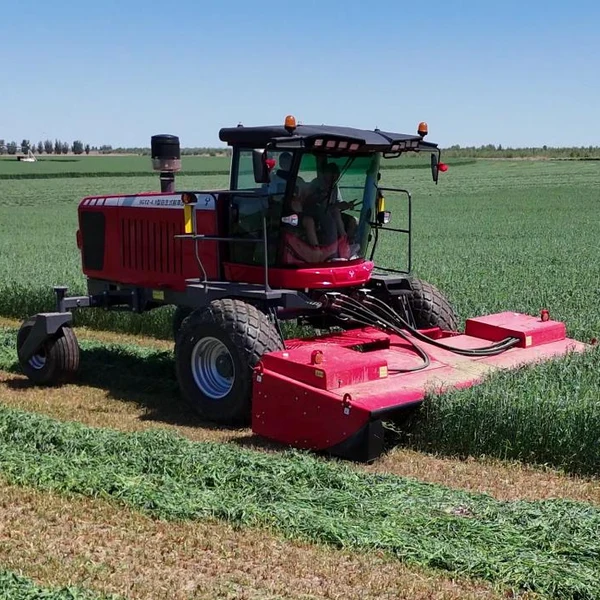
Separately, it is worth noting the factories, which, despite their relatively young age, are demonstrating rapid growth due to narrow specialization and deep technological development of the product. A striking example of this approach isHulunbuir Jiujia Machinery Manufacturing Company.
Founded in 2021 in the National Modern Agricultural Machinery Industrial Park (Hulunbuir City), the company quickly rose to the top position, becoming China's No. 1 round baler sales volume in 2023-2024. This success is based on the principles that we previously defined as the criteria for the “large plant” of the future:
- Smart Manufacturing:The plant, with an area of more than 32,000 m², is equipped with CNC laser machines, automated welding systems and electrostatic spraying lines. Two specialized lines ensure the production of up to 4,000 units of equipment per year.
- R&D and quality:The company has the status of a national high-tech enterprise, owns almost a hundred patents and its own testing laboratory. ISO 9001 certification and level A for information integration confirm the stability of the processes.
- Product adaptability:The range, which includes mower rakes (9GL, 9GD series), round balers (9YG-1.0, 9YCM-850) and specialized bean harvesting equipment (4BYHD), is developed using computer modeling. This allows the machines to be adapted to harsh climatic conditions, which is especially in demand in the regions of Russia and Mongolia, where the company actively exports products.
Manufacturers such as Jiujia prove that plant size is not important in itself, but as a tool for ensuring quality and scalability of service. Their experience shows that focusing on a specific niche (for example, feed procurement) allows them to achieve greater product reliability than the universal giants.
Comparative table of technical parameters of leaders
For clarity, we present a comparison of the average characteristics of equipment from the top 3 types of plants presented on the market in 2026. Data is based on open specifications and tests by independent laboratories.
| Parameter | Plant type "Heavyweight" (Premium) | Reliability type plant (Standard/Specialized, e.g. Jiujia) | Plant type "Innovator" (Techno) |
|---|---|---|---|
| Engine power (hp) | 350 – 600 | 180 – 320 (optimal for attachments) | 100 – 250 (hybrid) |
| Transmission type | CVT/e-CVT (continuously variable) | PowerShift / Mechanics (high maintainability) | Electric / CVT |
| Fuel consumption (g/kW*h) | 195 – 210 | 215 – 230 | 180 – 190 (in Eco mode) |
| Warranty (motor hours) | 3000 hours | 2000–2500 operating hours | 2500 operating hours + software |
| Availability of spare parts | High (central warehouses) | Very high (direct supplies from the manufacturer) | Medium (on order for rare units) |
| ISOBUS integration | Level 3 (offline functions) | Level 2 (task control and telemetry) | Level 3 (AI analytics) |
| Cost of ownership (5 years) | High initial, low maintenance. | Low initial, average exploitation. | High (due to electronics) |
Engineer's Note:Do not blindly trust the passport fuel consumption data. Actual consumption is always 10–15% higher than stated due to operating conditions (soil moisture, terrain, quality of implement settings). "Reliability" brands are often more honest with their ranges, while "Premium" brands give numbers based on ideal laboratory conditions.
How to choose large agricultural machinery factories: evaluation criteria
Selecting a supplier is a multifactorial task. To avoid mistakes, use the following checklist when auditing potential partners among manufacturers.
1. Localization of production and sanctions resistance
In 2026, geopolitical risks remain the No. 1 factor. Check which components are imported. If the engine, hydraulics and electronics are sourced from countries friendly to your region or manufactured locally, the risk of supply disruptions is minimal.Large agricultural machinery factorieswith complete localization of casting and machining have the advantage of price stability.
2. Service infrastructure and SLA (Service Level Agreement)
Request a map of service centers. It is not the number of points that is important, but the presence of mobile teams and warehouses of critical spare parts (filters, belts, sensors) within a radius of 100 km from your fields. Find out the average response time to an application. A good indicator is that the application is accepted within 15 minutes and the mechanic arrives within 24 hours.
3. Availability of staff training
Modern technology is complex. The plant must provide not only instructions, but also courses for machine operators and service engineers. The lack of skilled operators negates the benefits of a high-tech machine. Check if the manufacturer has an online platform with video tutorials and simulations.
4. Financial instruments
Large factories often have their own leasing divisions or partnerships with banks. Compare trade-in, seasonal financing and extended warranty programs. The ability to freeze payments until the end of the harvest season is a significant advantage for cash-flow farming.
Typical mistakes when choosing a manufacturer and equipment
Even experienced buyers sometimes make mistakes. Here are the most common traps that agricultural holdings fall into.
- The “Brand for Brand’s Sake” Error:Buying a heavy-duty tractor for light work. Running the engine at 30% load leads to coking of the diesel particulate filters (DPF) and increased cylinder wear. Always select equipment for typical operations, not maximum ones.
- Ignoring Cost of Ownership (TCO):Focus only on the purchase price. A cheap car may require a hydraulic pump replacement every 2,000 hours, while an expensive one lasts 5,000. Consider the cost per hour, not the sticker price.
- No test drive in your own conditions:Performance characteristics on a flat field and work on your slope with clay soil are two different things. Demand a demonstration of the technology in your fields with your agricultural background.
- Underestimation of compatibility with the existing fleet:Purchasing equipment with a different telematics system or hydraulic connectors of an incompatible standard creates chaos in the control room and requires the purchase of adapters, which are lost at the most inopportune moment.
An engineering perspective: what to look for in a specification
As a technical expert, I recommend paying attention to details that marketers often miss.
Frame and frame.Look at the thickness of the metal and the quality of the welds. Vibrations are the main enemy of electronics. A well-designed cab should have vibration isolation that separates the operator from the frame. If the cabin is rigidly welded to the frame, fatigue cracks will appear in the second season.
Hydraulic system.Check the pump type. Axial piston pumps are more efficient than gear pumps, but are more sensitive to oil purity. An oil cooling system is mandatory for intensive work in summer. Check the location of the filters: they should be easily accessible for daily maintenance.
Electronics.Connectors must have protection IP67 or higher. The wiring must be laid in corrugation and protected from chafing. Ask about the possibility of updating the software over the air (OTA). In 2026, this is the standard for quickly fixing bugs without visiting a dealer.
Recommendations for purchasing and negotiations with the factory
When making direct contact withlarge agricultural machinery factories, use the following strategy:
- Request a reference list.Ask for contacts of 3-5 farms in your region that have been using this model for more than 3 years. Call them. Ask about real breakdowns and the speed of delivery of spare parts. This is the most honest information.
- Put the terms of the guarantee in writing.What is considered a “warranty case”? Factories often refuse a warranty, citing “poor quality fuel” or “operator actions.” Demand a clear examination algorithm.
- Discuss the Start-up package.Include in the contract installation supervision, initial setup and training of your employees at the manufacturer’s expense. This will save you tens of thousands of rubles on beginner mistakes.
- Bargain not for a discount, but for services.It is more difficult for factories to give a direct discount than to add a year of extended warranty or a set of spare filters for TO-1000. It's more valuable to you.
Industry development trends until 2030
The market does not stand still.Large agricultural machinery factoriesThey are already investing today in technologies that will become widespread in 3-4 years.
Autonomy.Unmanned tractors for monotonous operations (plowing, sowing) are leaving the prototype stage. It is expected that by 2028, up to 20% of new vehicles will have the option of full autonomy on closed circuits.
Alternative fuels.Engines running on gas motor fuel (methane) and biodiesel are becoming the norm. Factories are expanding the range of such machines as carbon footprint becomes an important criterion for grain exports.
Precision farming as standard.Systems for differentiated application of fertilizers and plant protection products will be basic equipment, not an option. This is dictated by environmental legislation and resource conservation.
FAQ: Frequently asked questions about agricultural equipment manufacturers
Which major agricultural machinery manufacturers offer the best warranty?
In 2026, market leaders offer a warranty of 2 to 5 years or up to 3000–5000 operating hours. However, it's important to read the fine print: engine and transmission warranties are often different from those for attachments and electronics. The best guarantee is usually provided by factories that are confident in their own component base.
Does the country of production affect the quality of equipment?
The country of production in itself is not a guarantee of quality. More important are the quality control (QC) standards of a particular plant. Many international brands have localized production in the CIS countries and Asia, maintaining global assembly standards. The key factor is the qualifications of workers and the quality of incoming materials inspection.
How to check the reliability of a plant before a large order?
Request a production audit (virtual is possible). Please note the presence of test stands for finished products. Every tractor or combine must undergo a load test before shipment. Also check for ISO 9001 certifications and industry standards (eg OECD for tractors).
Is it worth buying equipment from new market players?
New factories can offer aggressive prices and modern solutions. However, the risk of instability in the supply of spare parts is higher. If you are considering a new player, start by purchasing one unit to test drive for one season. Don't update your entire fleet at once.
How do large agricultural machinery factories solve the problem of spare parts availability?
Leading manufacturers are using AI-powered predictive algorithms to manage dealer inventory. They analyze the fleet of equipment in the region and import the most popular parts in advance. When choosing a factory, check whether they use such a system and whether you can access an online catalog of spare parts availability at your nearest warehouse.
Conclusion: A strategic approach to choosing a partner
Selecting a supplier from amonglarge agricultural machinery factoriesin 2026 requires a comprehensive analysis. You can't just look at price or engine power. You need to evaluate overall ownership efficiency, reliability of service support, and technology compatibility with your business processes.
Remember that technology is a tool for earning money. Every minute of downtime is a loss. Therefore, preference should be given to those manufacturers who have proven their ability to ensure uninterrupted operation in the most difficult conditions. Investments in reliable equipment from a proven plant pay off by preserving the harvest, saving fuel and lubricants and reducing repair costs.
If you are planning a fleet upgrade or production expansion, we recommend conducting a detailed audit of your current tasks and comparing them with the capabilities of specific models. Our specialists are ready to help you choose the optimal solution, taking into account the specifics of your farm and budget.
Ready to discuss technical details?
Receive an individual commercial offer and advice from an engineer on selecting equipment for your needs.
→ Request a cost estimate and equipment parameters