The best agricultural machinery 2026: ratings and prices from manufacturers
2026-08-21
- What are the best agricultural machinery in the 2026 market?
- Selection criteria: how the best agricultural machinery is determined
- Rating of equipment types by application categories in 2026
- Comparison table: Technical characteristics of market leaders
- Examples of manufacturers: focus on quality and specialization
- Where the best agricultural machinery is used: industry scenarios
- How to choose a supplier and avoid common mistakes
- Pricing and factors influencing cost in 2026
- Maintenance and life extension
- FAQ: Frequently asked questions about agricultural machinery
- Conclusion and recommendations for purchasing
What are the best agricultural machinery in the 2026 market?
The best agricultural machinery2026 is not just a set of metal structures with engines, but integrated cyber-physical systems capable of autonomously performing soil cultivation, sowing and harvesting tasks with minimal operator intervention. In the current economic and climate realities, the concept of “best” has shifted from maximum power to the optimal balance of fuel efficiency, maintainability and positioning accuracy (RTK/GLONASS). For agricultural holdings and farms, the choice of equipment is now dictated by the need to reduce the cost per hectare by 15–20% due to precision technologies.
A modern tractor or combine must have a modular architecture that allows you to quickly replace attachments without loss of hydraulic performance. The key evaluation criteria were compliance with Stage V environmental standards (or their equivalents in the Russian Federation and the CIS), the availability of telemetric systems for predictive maintenance and the ability to work in conditions of a shortage of qualified machine operators. If you are looking for a reliable supplier, it is important to understand thatbest agricultural machinerymust be accompanied by the availability of spare parts within a radius of 200 km from the place of operation.
Selection criteria: how the best agricultural machinery is determined
Selecting equipment for agribusiness in 2026 requires an in-depth analysis of technical specifications, which are often masked by marketing slogans. Engineers and buyers must look beyond brochures. Here are the main parameters that form the reliability and efficiency rating:
- Fuel efficiency and engine type.Modern common rail diesel engines with variable geometry turbocharging provide torque at low speeds, which is critical for heavy soil work. Fuel consumption should not exceed 220–240 g/kWh at rated load.
- Hydraulic system.The presence of a closed hydrostatic transmission (HST) or CVT (continuously variable transmission) allows you to seamlessly change the speed without interrupting the power flow. The hydraulic pump capacity must be at least 100–120 l/min for simultaneous operation of complex seeders or sprayers.
- Navigation accuracy.Integration with AutoSteer-class driving systems with 2.5 cm accuracy is standard. This eliminates overlaps when sowing and fertilizing, saving up to 8% of seeds and chemicals per season.
- Cabin ergonomics and control interface.The operator spends up to 12 hours a day in the cabin. The presence of climate control, a vibration-isolated seat with air suspension and an intuitive touchscreen terminal (ISOBUS compatibility) directly affects fatigue and, therefore, work safety.
- Maintainability and service network.Machine downtime during a harvesting campaign costs more than the machine itself. The best agricultural equipment has a modular design of components, allowing the unit to be replaced in 2-4 hours, not days.
It is important to note that there is no universal solution. 300 hp tractor will be ineffective on fields of less than 50 hectares due to high soil pressure and difficulty maneuvering. And vice versa, light equipment cannot cope with deep loosening on heavy black soils.
Rating of equipment types by application categories in 2026
To structure our understanding of the market, we will divide the equipment by functional tasks. Each segment has leaders who set industry standards.
1. Energy-rich tractors (300+ hp)
This class of machines is designed for continuous tillage, transporting grain and working with wide-cut implements. In 2026, the trend was to increase the weight of the vehicle without increasing the specific ground pressure through the use of tracked undercarriages or dual wheels with pressure control systems (CTIS).
Engineering supervision:Many buyers mistakenly believe that more horsepower is better. However, if your soil has a load-bearing capacity below 0.8 kg/cm², using a tractor over 250 hp on wheels will lead to over-compaction of the subsoil horizon, which will reduce the yield by 10–15% in the next 3–5 years. In such casesbest agricultural machinery- These are tracked modifications or vehicles with ultra-low tire pressure.
2. Combine harvesters
The key parameter here is the throughput of the thresher (kg/sec) and the quality of grain cleaning. Modern models are equipped with computer vision systems that analyze the percentage of grain fragility in real time and automatically adjust the drum speed and the gap between the deck and the drum.
- Rotary combines:Better suited for wet grain and complex crops (rice, soybeans), providing gentle threshing.
- Key combines:More fuel efficient and easier to maintain, ideal for standard grains (wheat, barley) in dry conditions.
3. Seeding complexes and seeders
The transition to no-till and mini-till technologies requires seeders that can work in uncultivated soil. The best agricultural equipment in this segment is equipped with an individual drive for each coulter (electric or hydraulic), which allows you to change the seeding rate “on the fly” depending on the fertility map of the field.
Comparison table: Technical characteristics of market leaders
Below is a comparison of the average parameters of equipment of different classes presented on the market in 2026. The data is based on tests by independent laboratories and reviews from large agricultural holdings.
| Parameter | Tractors 150–180 hp | Tractors 300–350 hp | Combine harvesters (7–8 l class) |
|---|---|---|---|
| Transmission type | Powershift/CVT | CVT/Crawler | Hydrostatic / Mechanical |
| Fuel consumption (l/ha) | 8–10 (ploughing) | 12–15 (heavy work) | 18–22 (cleaning) |
| Hydraulics (l/min) | 90–110 | 160–200+ | N/A (internal circuits) |
| Driving accuracy | ±2.5 cm (RTK) | ±2.5 cm (RTK) | ±5 cm (GPS/GLONASS) |
| Payback period (years) | 3–4 | 4–5 | 3–4 (with heavy use) |
| Cost of ownership (RUB/hour) | Average | High (maintenance, tires) | Very high (seasonal peak) |
Please note that the cost of ownership includes not only fuel, but also depreciation, insurance, operator wages and repair costs. In 2026, the share of electronics and software costs in the total cost of ownership increased to 15%.
Examples of manufacturers: focus on quality and specialization
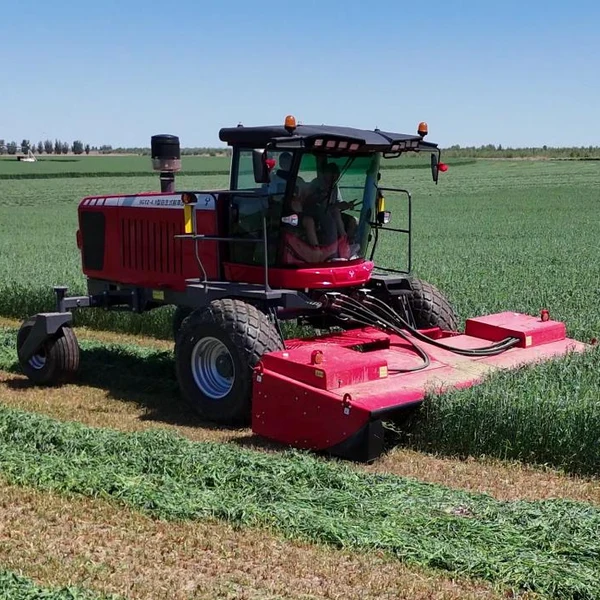
The agricultural machinery market is heterogeneous. Along with global brands, a significant share is occupied by specialized manufacturers offering highly targeted but highly effective solutions. A striking example of this approach is the company"Jiujia", based in the National Modern Agricultural Machinery Industrial Park in Hulunbuir.
Founded in 2021, this company has quickly risen to the top position, becoming China's No. 1 in round baler sales in 2023-2024. Their success illustrates an important trend for 2026: it is not the one who does “everything” who wins, but the one who makes a particular knot perfectly. The Jiujia production base, covering an area of more than 32,000 m², is equipped with CNC laser machines and automated welding systems, which ensures the highest precision of parts. Our own testing laboratory and almost a hundred technological patents allow us to adapt equipment such as the 9GL series mower rakes or the 9YG-1.0 balers to harsh climatic conditions, including export deliveries to Russia and Mongolia. This case confirms that the presence of certified production (ISO 9001) and a focus on R&D are key factors in equipment reliability.
Where the best agricultural machinery is used: industry scenarios
The use of technology must be economically justified. Let's look at two real cases demonstrating the effectiveness of the correct selection of equipment.
Scenario 1: Large grain holding (Southern Federal District)
Task:Harvesting 5000 hectares of wheat in a short agrotechnical time frame (14 days).
Solution:A fleet of 5 8th class combines with a header width of 9–12 meters.
Results:
- Productivity: 40–50 tons of grain per hour per combine.
- Grain losses: Reduced to 1.5% thanks to automatic thresher settings.
- Savings: Due to the high harvesting speed, it was possible to avoid grain shedding (losses from overstaying would have amounted to 5–7%).
In this casebest agricultural machinery- These are high-performance self-propelled combines with a larger volume bunker (10–12 m³) to minimize unloading time.
Scenario 2: Farming, vegetable growing (Central Russia)
Task:Spot treatment of potatoes and vegetables, minimizing soil compaction.
Solution:Specialized tractors with a power of 100–120 hp. with a narrow track and high tires, equipped with cameras for inter-row weeding.
Results:
- Reduce herbicide use by 40% due to mechanical weeding.
- Preservation of soil structure: pressure on the soil does not exceed 0.6 kg/cm².
- Flexibility: Can work in rainy weather thanks to high ground clearance.
How to choose a supplier and avoid common mistakes
Buying equipment is an investment for 5–10 years. Errors at the supplier selection stage can cost millions of rubles in downtime losses. Here is a checklist for the head of the purchasing committee:
- Checking the availability of spare parts warehouse.Don't believe the words "everything is in stock." Ask to see a screenshot of the warehouse program or visit the warehouse in person. Critical parts (injectors, belts, filters) must be available within 24 hours.
- Qualification of the service team.Modern technology requires diagnostics through laptops and specialized software. Does the dealer have mobile service teams with diagnostic equipment? How quickly do they respond to calls in the field?
- Leasing programs and state support.In 2026, many manufacturers are offering preferential leasing. Compare the effective interest rate with bank offers. Often the subsidized rate from the manufacturer is more profitable, even if the base price of the equipment is higher.
- Test drive on your field.Never buy equipment based on the picture. Request a demonstration of working on your soil, with your attachments. Pay attention to the car's cornering behavior, ease of assembly and visibility from the cab.
Typical error:Chasing a low starting price. Cheap equipment from a Chinese or little-known brand can save 20–30% on the purchase, but increase repair costs by 50–100% in the first year due to the low quality of metal, rubber and electronics. Always consider TCO (Total Cost of Ownership).
Pricing and factors influencing cost in 2026
Prices for agricultural machinery continue to adjust under the influence of supply chains, exchange rates and the cost of raw materials. However, the market has stabilized compared to the shock periods of previous years.
The cost is affected by:
- Localization level.Equipment assembled domestically using local components is often cheaper to maintain and may qualify for government subsidies.
- Software package.The basic version without autopilot and telemetry can cost 10–15% less. But is it worth saving? Installing third-party autodriving systems will cost more and will void your factory warranty on electrical components.
- Seasonality.Buying equipment during the winter (November–February) often results in a 5-10% discount from dealers trying to meet annual plans.
To obtain current price lists and leasing calculations, it is recommended to contact official distributors directly. The gray import market has practically disappeared due to difficulties with warranty service and software.
Maintenance and life extension
Evenbest agricultural machineryrequires proper care. In 2026, maintenance standards have become more stringent due to the complexity of engines and transmissions.
Key recommendations from engineers:
- Oils and filters.Use only lubricants recommended by the manufacturer. Switching to cheaper analogues can lead to failure of expensive hydraulic units or injectors.
- Diagnostics before the season.Conduct full computer diagnostics of all systems a month before the start of field work. This will allow you to identify hidden sensor errors and worn components.
- Storage.Proper preservation for the winter (draining water, treating rubber, raising implements) extends the service life of equipment by 2-3 years.
- Operator training.60% of breakdowns occur due to improper use. Invest in training machine operators to work with specific models of equipment.
FAQ: Frequently asked questions about agricultural machinery
Q: What is the most reliable tractor brand in 2026?
A: The concept of “most reliable” depends on the operating conditions. European brands lead in comfort and precision, Russian and Belarusian brands lead in maintainability and availability of spare parts in the CIS regions. Chinese manufacturers have significantly improved quality, occupying the middle segment. The best choice is one that has service in your area.
Q: Is it worth buying used equipment?
A: Yes, if it is equipment up to 3-5 years old with a confirmed service history. Avoid cars older than 7-8 years with more than 5,000 engine hours, as engine and transmission overhauls can exceed 50% of the cost of the car.
Q: How does the weight of equipment affect productivity?
A: Excessive weight leads to soil compaction, poor aeration and water permeability. This reduces yield by 10–20%. Use equipment with low ground pressure (wide tires, tracks) and follow the Controlled Traffic Farming technology (driving on constant tramlines).
Q: What is ISOBUS and why is it needed?
A: ISOBUS is a universal communication protocol between tractor and implement. It allows you to control a seeder or sprayer from a terminal in the tractor cab, without installing separate monitors for each implement. This is the standard for modernthe best agricultural machinery.
Q: How to get a government subsidy for the purchase of equipment?
A: Conditions vary by region and year. Typically, it is necessary to purchase equipment from the list of the Ministry of Agriculture, participate in leasing programs and comply with deadlines for the disbursement of funds. It is recommended to consult with local agricultural authorities.
Conclusion and recommendations for purchasing
Choosing agricultural equipment in 2026 is a strategic decision that will determine the profitability of your business for years to come.The best agricultural machinery- this is not the one that is the most expensive, but the one that optimally matches your soil and climatic conditions, the structure of the acreage and financial capabilities.
Don't chase brands. Look at the numbers: fuel consumption per hectare, cost of a standard hour of repair, percentage of crop loss. Demand from suppliers not just an invoice for payment, but a feasibility study for the purchase. Remember that equipment downtime during cleaning costs tens of times more than the savings on a service contract.
If you are planning to upgrade your fleet or expand your production, we recommend starting with an audit of your current processes and selecting equipment for specific tasks. Our experts are ready to conduct a free payback calculation and select the equipment configuration that will become the driver of your profit growth.
→Ready to discuss your goals?Contact us for a personalized quote and engineer consultation.