Buy a used baler in the Penza region 2026: prices from the manufacturer
2026-08-11
- Why buying a used baler in the Penza region in 2026 is a strategic decision
- Market Analysis: Baler Prices and Availability in 2026
- Key selection parameters: what to look for during inspection
- Comparison of types of balers: round vs. square balers
- Risks of buying used equipment and how to avoid them
- Why you should contact specialized suppliers rather than private traders
- Purchase procedure: step-by-step algorithm
- Frequently Asked Questions
- Conclusion: Investing in Reliability
Why buying a used baler in the Penza region in 2026 is a strategic decision
The agricultural machinery market in Russia is undergoing a transformation. In 2026, when the cost of new imported machines has stabilized at a high level, and delivery times for Chinese analogues have increased to 3-4 months due to logistics bottlenecks, farmers in the Penza region are looking for alternatives. Buying a used baler in the Penza region is becoming not just a way to save money, but the only reasonable option for quickly covering seasonal needs without cash gaps.
We have been working with farmers of the Central Black Earth Region for more than 15 years. During this time we saw hundreds of transactions. The most common buyer mistake is to focus only on the year of manufacture. This is fatal. The 2018 baler, which stood under a canopy and was serviced according to regulations, costs more and works better than the 2022 machine, which “plowed” for three seasons without changing the oil in the gearboxes. In this article, we will look at how to choose equipment that will pay for itself in one season, what prices are realistic for the Penza market in 2026, and why direct deliveries from trusted suppliers are more profitable than buying second-hand through dubious advertisements.
Our goal is to give you the tools to make a decision. We will not use marketing slogans. Only technical parameters, real wear cases and specific numbers. If you are planning to purchase equipment for collecting feed or straw, this information will save you from 300,000 to 1,500,000 rubles on repairs in the first year of operation.
Market Analysis: Baler Prices and Availability in 2026
The situation in the secondary market of the Penza region at the beginning of 2026 is characterized by a shortage of quality offers. After the 2024 and 2025 seasons, a significant part of the fleet failed or was written off due to a shortage of original spare parts in previous crisis periods. However, thanks to established supply chains for components from Asia and the restoration of domestic production of components, the used equipment market has revived.
Pricing now depends on three factors: the type of baling (roll or bale), the condition of the baling mechanism and the presence of a documented service history. Average prices for popular models in the region are as follows:
| Type of equipment | Model (example) | Year of issue | Price range (RUB) | Condition |
|---|---|---|---|---|
| Roll (permanent camera) | Krone Comprima CV 150 XC | 2019-2020 | 1,800,000 – 2,400,000 | Working, maintenance required |
| Roll (variable camera) | Kuhn VB 3160 | 2017-2018 | 1,200,000 – 1,600,000 | Needs belt replacement |
| Bale (square) | New Holland BC 5070 | 2015-2016 | 900,000 – 1,300,000 | High blade wear |
| Bale (large bale) | Claas Quadrant 3200 | 2018-2019 | 3,500,000 – 4,800,000 | Excellent condition |
| Domestic (roll) | PR-F-180 (Belagromash) | 2021-2022 | 800,000 – 1,100,000 | Average, there is corrosion |
Please note: prices are for equipment ready for use after minimal pre-season maintenance. Cheap options (below the lower end) often silently require major hydraulic overhauls or bearing replacements, which can double the total cost of ownership.
In our practice, there was a case when a farm in the Neverkinsky district bought two balers at a price 40% below the market. After two weeks of work, both failed: one’s frame burst due to metal fatigue, the other’s main shaft jammed. The repairs cost more than the difference in purchase price. Therefore, we always recommend checking the history of the machine and carrying out troubleshooting before paying.
Source:Rosstat, price monitoring for agricultural machinery in the Volga Federal District, January 2026
Key selection parameters: what to look for during inspection
Choosing used equipment is always a compromise between price and remaining life. To buy a used baler in the Penza region and not be disappointed, you need to ignore the appearance of the tractor cabin (if it is mounted) and focus on the components that are subject to the greatest load. Here is the checklist that our engineers use when accepting equipment.
1. Press chamber and belts/rollers
This is the heart of the machine. In roll presses with a permanent chamber (for example, Krone, Claas Rollant), the key element is the chain-slat conveyor or belts. Check the belt tension. If they have visible cracks or signs of delamination, replacing them will cost 150,000–300,000 rubles. In presses with a variable chamber (Kuhn, New Holland), the condition of the starting belts and their tensioning mechanism is important. Wear of the springs or hydraulic tension cylinders results in the roll becoming loose and falling apart during transportation.
Expert advice:Ask the seller to make a test roll in front of you. Cut it. The density should be uniform along the entire length. If the center is tight and the edges are loose, the problem is the adjustment of the side shields or wear of the shaft bearings.
2. Pickup mechanism
The picking fingers and rake absorb impacts from the ground, rocks and field unevenness. Inspect the finger springs. If they are broken or deformed by more than 20%, this is a sign of harsh use. Check the pick-up height. It must clearly follow the contour of the soil. Play in the hinges of the picking mechanism leads to yield losses of up to 15%, since some of the stems remain on the field.
In baler balers, the condition of the pre-baling chamber knives is critical. Dull knives do not cut the mass, but crush it, creating excess load on the drive. Replacing a set of knives is expensive, so bargain if you see wear.
3. Hydraulic system and electronics
In modern models from 2018 to 2024, density and tying are controlled through hydraulics and an ECU (electronic control unit). Check for errors on the display in the tractor cabin when connecting. Oil leaks from hydraulic cylinders are a common problem in used equipment. Even a small leak will eventually lead to a drop in pressure and the inability to form dense rolls. Inquire about hydraulic hose replacement history. Rubber loses its elasticity after 5–7 years, even if the car has not been used much.
4. Frame and chassis
Inspect the frame for welds, especially where the axle and drawbar attach. Cracks in the frame are a death sentence for the car, since restoring the geometry requires industrial equipment. Check the wheel bearings. Wheel play indicates the need to replace the hub or bearing, which in the field can cause a fire due to overheating.
Each of these items affects downtime. One day of downtime during cleaning in the Penza region, when it rains, can cost more than saving on the purchase. Therefore, the technical condition is more important than the year of manufacture.
Comparison of types of balers: round vs. square balers
The choice between a round baler and a bale press does not depend on fashion, but on your logistics and the end use of the feed. In 2026, many farms in the Penza region are switching to a mixed park, but one type is better suited for a specific task.
| Criterion | Round baler | Square Baler |
|---|---|---|
| Press density | Medium (150–180 kg/m³). Suitable for haylage and straw. | High (200–250 kg/m³). Ideal for long-term transportation. |
| Ease of storage | Requires a lot of space. Rolls are difficult to stack above 2 tiers without the risk of rolling. | Compact storage. Bales can be placed in high stacks, saving warehouse space by up to 40%. |
| Operation speed | Above. Continuous roll formation process. Fewer stop cycles. | Below. Cyclic process: chamber filling → pressing → binding → ejection. |
| Weather dependent | More. Bales are hygroscopic. If they get wet before tying, there is a risk of spontaneous combustion or mold. | |
| Maintenance cost | Below. Fewer moving parts, simpler design. | Higher. Complex mechanism of knives, pistons and wire/twine binding system. |
| Application in the Penza region. | Better for small and medium-sized farms, making haylage for cattle. | Better for large agricultural holdings, straw export, poultry farms. |
Our experience shows: if you have a cattle herd of up to 500 heads and do not have a specialized warehouse with a flat floor, a round baler will be more efficient. For large farms supplying straw for export or large poultry farms, where density and standardization of weight are important, the bale option is indispensable, despite the higher cost of service.
Recommendation: Before purchasing, evaluate your warehouse infrastructure. If you don't have the ability to store bales under a roof, skip the bale press in favor of a roll wrapper with film wrapping capabilities.
Risks of buying used equipment and how to avoid them
Buying used equipment always comes with risks. In 2026, fraudulent schemes have become more sophisticated. Here are the main threats and ways to protect against them, based on the real practice of our specialists.
Risk 1: Hidden defects in hydraulics and engine (if autonomous)
Sellers often mask leaks with sealants or add additives to the oil that temporarily seal the seals. After 50 hours of operation, such equipment begins to “sweat” oil.How to check:Look under the car after an hour of work. Fresh drops of oil on the ground or wet spots on the gearbox housing are a reason to refuse the deal or demand a price reduction for the cost of replacing seals and flushing the system.
Risk 2: Problems with documents and collateral
Many farmers leased equipment. If the lease is not paid, the car is the property of the bank. Purchasing such equipment through a purchase agreement does not protect you. The bank will confiscate the equipment from the new owner.How to check:Request a certificate from the register of pledged property (Federal Chamber of Notaries) and a check of the VIN number in the traffic police and FSSP databases. Never transfer money before full legal verification.
Risk 3: Lack of spare parts
Some models of European brands (for example, old Fendt or specific John Deere models) may have problems with the supply of original spare parts to Russia in 2026 due to sanctions restrictions.How to check:Before purchasing a specific model, ask the supplier for a current price list for consumables (belts, knives, bearings). If the part delivery time exceeds 3 weeks, this model is not suitable for intensive seasonal work.
Risk 4: Tractor power mismatch
A common mistake is buying a powerful baler for a weak tractor. For example, a large bale baler requires a tractor with at least 180–200 hp. If your tractor has 140 hp, it will work at the limit, overheat and break down.How to check:Check the passport data for the power consumption of the press with the rated power of your tractor. Leave a margin of 15–20% for work in difficult conditions (wet mass).
We have seen cases where farms have lost crops because the tractor stalled on a hill with a full bale. This is not a press problem, this is a problem of incorrect selection of the tractor-trailer pair.
Why you should contact specialized suppliers rather than private traders
You can find an ad on a bulletin board and buy it cheaper. But why do professional market participants prefer to work with companies that specialize in the supply of industrial and agricultural equipment?
Here it is important to understand the difference between simple resale and working with manufacturers who have a serious production base. A striking example of this approach isHulunbuir Jiujia Machinery Manufacturing Company. Founded in 2021, the company has quickly become a market leader, ranking No. 1 in China in terms of round baler sales in 2023-2024. Having its own factory with an area of more than 32,000 m², two specialized lines (with a capacity of up to 2,000 units of equipment per year each) and almost a hundred technological patents allows Jiujia to control quality at every stage - from CAD design to testing in its own laboratory.
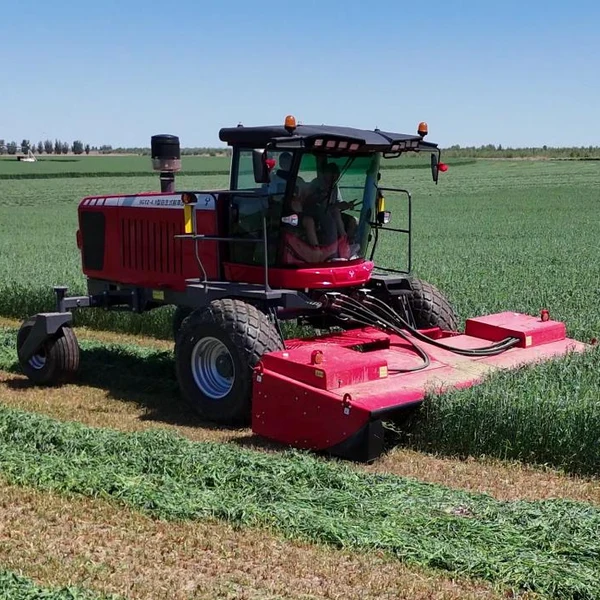
For a Russian buyer, cooperation with manufacturers such as Jiujia means access to equipment adapted to difficult climatic conditions. Their product range, which includes round balers (such as 9YG-1.0 and 9YCM-850 with wrapping), mower rakes and other equipment, is ISO 9001 certified and has been successfully exported to Russia and Mongolia. When you buy used or new equipment from trusted suppliers affiliated with such factories, you get the peace of mind that parts are available and the machine's design has been proven through thousands of hours of field work.
Let's return to the advantages of working with specialized suppliers:
Firstly,pre-sale preparation. We don't just resell equipment. Each baler undergoes diagnostics at our service center. We replace worn belts, adjust hydraulics, and lubricate all components according to the manufacturer's lubrication chart. You receive equipment ready to go into the field tomorrow morning, and not after a week of repairs.
Secondly,warranty and post-warranty service. When buying from a private seller, you are left with the problem alone. We provide a warranty of 3 to 6 months on the main components (frame, gearbox, shafts) even on used equipment. This is possible because we are confident in the quality of our defects. In addition, we provide spare parts supply. You don’t need to search for an SKF bearing or a Continental belt all over the Internet - they are already in our warehouse in Penza or are available to order with a short delivery time, including thanks to established logistics channels with partner factories.
Thirdly,legal purity. All cars are fully checked to ensure there are no liens or restrictions. The purchase and sale agreement is drawn up by lawyers specializing in agribusiness, taking into account all the nuances of VAT and depreciation for the accounting department of your farm.
At our company, we understand that cleaning time is limited by the weather window. Our task is not just to sell iron, but to ensure an uninterrupted feed procurement process. This is why clients come back to us for a second and third car.
Purchase procedure: step-by-step algorithm
To ensure the transaction goes smoothly, follow this algorithm. It was developed based on analysis of hundreds of successful transactions in the region.
- Determination of technical requirements.Clearly state what crop you will harvest (alfalfa, cereals, straw), the required productivity (ha/hour) and the availability of a tractor of suitable power. This will narrow down your search.
- Search and pre-selection.Study the offers. Filter out suspiciously cheap options. Contact the seller, request a video of the machine in operation, photos of nameplates, photos of components under load.
- On-site diagnostics.Never purchase a used baler without a personal inspection or inspection by your master mechanic. Check the tension of the belts, the condition of the picking apparatus, and the operation of the hydraulics. Do a test run.
- Legal check.Request documents (PTS, registration certificate, leasing agreement, if any). Check VIN through public registries. Make sure the seller is the owner or has a notarized power of attorney.
- Negotiations and conclusion of an agreement.Discuss the price, taking into account the identified shortcomings. In the contract, specify the warranty obligations (if any) and the procedure for transferring equipment. Make payments only by bank transfer to the bank account of the seller-legal entity or through a secure transaction for individuals.
- Logistics and commissioning.Arrange delivery. After arrival, carry out complete maintenance: change oils, filters, check tire pressure. Only after this start working.
Following these steps reduces the risk of buying a “pig in a poke” to a minimum. Remember: saving a million on a purchase can result in a loss of five million on downtime and repairs.
Frequently Asked Questions
What is the service life of a used baler?
When properly maintained and stored indoors, a baler can last 15-20 years. However, key components (belts, chains, bearings) require replacement every 3–5 seasons of active operation. When buying a car that is 5–7 years old, you should be prepared to invest 10–15% of its cost in the first maintenance.
Can Chinese spare parts be used for European presses?
Yes, in 2026 the quality of Chinese analogues (especially belts and bearings) has increased significantly. For unloaded components (casings, some fasteners) they are ideal. For critical components (shafts, main pressing belts), we recommend using original spare parts or premium analogues (Germany, Italy), since the risk of belt breakage during the season is too expensive.
Is a wrapper needed for a roll press?
If you are harvesting haylage (humidity 40–50%), a film wrapper is required to maintain the quality of the forage. Dry straw does not require a wrapper. There are combined machines (press + wrapper), but they are more expensive and more difficult to maintain. For most farms in the Penza region, the optimal combination is: a separate baler + a separate self-propelled or mounted wrapper.
How does the humidity of the mass affect the operation of the press?
High humidity increases friction and stress on the tractor engine and press mechanisms. Wet mass requires a higher compaction density, which leads to increased wear on belts and bearings. It is recommended to reduce the tractor speed by 20–30% when working with wet material to avoid overload.
Conclusion: Investing in Reliability
Buying a used baler in the Penza region in 2026 is a balanced business decision. The market offers enough options to choose equipment for any budget and task. The main thing is not to chase the lowest price, but to evaluate the total cost of ownership and the residual life of the machine.
We recommend focusing on models with good parts availability and simple designs unless you have highly trained service technicians. Check each component, ask for a service history and don’t be afraid to bargain, arguing that the price reduction is due to the need for upcoming repairs.
If you want to get professional advice, select equipment for your specific conditions, or order pre-sale diagnostics, contact us. We will help you avoid mistakes and choose a machine that will work for your profit, and not for repair shops.
Contact us todayto receive an up-to-date list of available equipment and an individual commercial offer. Our experts are ready to conduct a free audit of your needs and offer the optimal solution.
For further study of the topic, we recommend that you familiarize yourself with our materials:agricultural machinery maintenanceandfeed logistics.