Self-propelled hay baler: prices from the manufacturer 2026
2026-08-23
- Self-propelled hay baler: prices from the manufacturer and technical solutions in 2026
- What is a self-propelled hay baler and its key differences
- Where is a self-propelled hay baler used: industry specifics
- Main technical characteristics and architecture of the machine
- How to choose a self-propelled hay baler: parameters guide
- Comparison of models and types of pressing
- Pricing: price range and influencing factors in 2026
- Logistics, service and operation: an engineer's view
- The role of modern manufacturers: the experience of the Jiujia company
- Typical mistakes when choosing and purchasing
- FAQ: Frequently asked questions about self-propelled balers
- Conclusion and recommendations for purchasing
Self-propelled hay baler: prices from the manufacturer and technical solutions in 2026
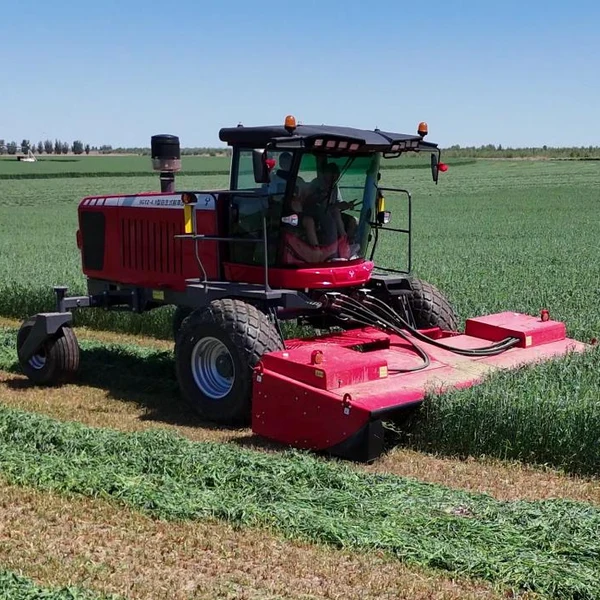
Self-propelled hay baleris a high-tech unit that combines the functions of a mower, pick-up and pressing device in a single chassis with its own engine. Unlike trailed analogues, this equipment provides complete autonomy, high maneuverability on difficult terrain and maximum productivity due to the synchronization of all working units through a single control system. For agricultural holdings and large farms in 2026, the choice of a self-propelled model will become a key factor in reducing the cost of feed procurement, making it possible to reduce the fleet of equipment used and the number of operators.
Currentprices for self-propelled hay balerare formed based on engine power, type of pressing chamber (roll or bale), working width and level of process automation. Direct deliveries from the manufacturer eliminate intermediary markups, guaranteeing not only a favorable price, but also full technical support, the availability of original spare parts and adaptation of hydraulic systems to the climatic conditions of a particular region. In this material, we will analyze in detail the design features, economic efficiency and criteria for choosing equipment that will become a reliable asset of your agribusiness for the next 10–15 years.
What is a self-propelled hay baler and its key differences
The traditional hay harvesting scheme involves the use of a tractor with a power of 150 hp or more. in conjunction with a separate pick-up compactor.Self-propelled hay balerchanges this paradigm. This is a specialized machine where the chassis, power plant and working element are an inextricable engineering complex. The main goal of such integration is to optimize the energy balance. The engine operates in optimal load mode, transmitting torque directly to the shafts of the fender, conveyor and pressing mechanism without losses on long cardan shafts and tractor PTO.
The key difference is mass and weight distribution. Self-propelled models are heavier, which provides better traction and less slipping in wet areas, but require special low-pressure tires to minimize soil compaction. Modern 2026 models are equipped with precision farming systems that allow mapping the yield of each hectare in real time, the data from which is integrated into the general ERP systems of the farm.
It is important to understand that this class of equipment is not intended for small farms with a land area of up to 500 hectares. Economic payback begins with harvest volumes of 2000–3000 tons of hay per season. This is where the potential for high speed (up to 15–18 km/h when picking up) and wide coverage (up to 4.5–5 meters), which is inaccessible to most trailed units, is revealed.
Where is a self-propelled hay baler used: industry specifics
The scope of application of this technology is strictly regulated by economic feasibility and agrotechnical requirements. Main sectors of use include:
- Large scale dairy farming.To provide diets for dairy herds, high quality hay is required (high protein content, low ash content). Self-propelled machines provide quick collection of wilted grass, minimizing the loss of nutrients from exposure to sun and rain. The speed of work allows you to remove huge areas in a narrow “window” of favorable weather.
- Production of export alfalfa hay.The export market requires standardized high density bales. Self-propelled balers have more powerful bale chambers, capable of producing bales with densities of up to 220–240 kg/m³, which is critical for logistics and storage.
- Seed farms.When harvesting herbs for seeds, it is important to minimize the loss of small seeds. Specialized modifications of self-propelled pickers are equipped with closed casings and aspiration systems that prevent seeds from being blown away by the wind during picking.
- Bioenergy.Harvesting biomass for fuel pellets or briquettes requires large volumes of raw materials. The high productivity of self-propelled equipment (up to 60–80 tons per hour) makes it indispensable for supplying biogas stations.
Engineering practice shows that the use of self-propelled vehicles is most effective on flat or slightly hilly landscapes. On steep slopes (>15 degrees) their use is limited by the center of gravity, although some modern models are equipped with cab and chassis leveling systems to compensate for tilt.
Main technical characteristics and architecture of the machine
When analyzing offers on the 2026 market, it is necessary to pay attention to a set of parameters, and not just to engine power. Constructionself-propelled hay balerincludes several critical components that determine its reliability and efficiency.
Powerplant and transmission
The heart of the car is a diesel engine with power ranging from 250 to 400 hp. In 2026, engines with electronically controlled Common Rail injection became the de facto standard, meeting Stage V / Tier 4 Final environmental standards. The most important element is the transmission. Most leading manufacturers use hydrostatic transmission (HST) or continuously variable transmissions. This allows the operator to smoothly adjust the driving speed from 0 to 20 km/h without changing gears, maintaining constant engine speed for stable operation of the pressing unit.
Picking device
The working width varies from 2.4 to 5.2 meters. The key parameter here is the number of tines and the type of drive. Modern models use an eccentric rake drive, which provides a gentle lift of the mass even at high speeds. The lifting height is adjusted by hydraulic cylinders and follows the topography of the field, which reduces soil contamination of hay (ash content).
Press chamber
Roll models are characterized by two types of chambers: with a fixed volume and with a variable volume. Variable volume chambers start bale forming with a small diameter, producing a high core density, and then expand. This is especially important for light hay that is difficult to bale evenly. Net or twine wrapping systems operate in automatic mode, controlled by bale diameter sensors.
Control and monitoring system
The operator's compartment in 2026 models is a command center. The control panel includes a touch screen with a diagonal of 12 inches, displaying:
- Current compaction density;
- Diameter of the formed roll;
- Engine load and hydraulic temperature;
- Yield map (if equipped with a GPS module);
- Real-time fault diagnosis.
How to choose a self-propelled hay baler: parameters guide
The choice of technology is a compromise between performance, cost of ownership and operating conditions. A mistake at the selection stage can cost an enterprise millions of rubles in the form of downtime and excessive fuel consumption. Below are the critical parameters that need to be assessed.
| Parameter | Recommended value for medium-sized farms | Recommended value for large agricultural holdings | Impact on Operation |
|---|---|---|---|
| Engine power | 250–300 hp | 350–400+ hp | Power reserve is necessary to work in high humidity and maintain momentum. |
| Working width | 3.0–3.6 m | 4.2–5.2 m | A wide grip requires a perfectly flat field, otherwise losses will occur. |
| Pressing type | Rolled (soft) | Roll (high density) / Bale | Density affects logistics and storage capacity. |
| Hopper volume (if any) | N/A | Up to 3–4 m³ (for crushed fractions) | Allows you to work without stopping for unloading. |
| Control system | Basic diagnostics | GPS + Telemetry + Autopilot | Telemetry allows the dispatcher to see the operation of all machines in the fleet. |
Engineering advice:Do not chase the maximum working width if your fields have complex geometry or uneven terrain. A wide pick-up will “jump” on bumps, leaving the windrows untouched and picking up soil. It is better to take a model with a width of 3.6 m, but with a more advanced relief copying system.
Cost of Ownership (TCO) Analysis
The purchase price is just the tip of the iceberg. When calculating efficiencyself-propelled hay balerconsider:
- Fuel consumption.Self-propelled vehicles consume from 12 to 25 liters of diesel per hour, depending on the load. A difference of 2 liters per hour over a season of 1000 hours will result in an overconsumption of 2000 liters.
- Wear of the picking apparatus.Pins and springs are consumables. Evaluate the availability and cost of repair kits.
- Hydraulics.High pressure hoses experience enormous pulsating loads. The quality of hydraulic components determines the frequency of leaks and downtime.
Comparison of models and types of pressing
The 2026 market is dominated by two main types of self-propelled balers: round and square (rectangular) balers. The choice between them is dictated by the ultimate purpose of using the hay.
Self-propelled roll presses
The most common type. Cylindrical rolls with a diameter of 1.2–1.8 meters are formed.
- Benefits:Simpler design, lower price, better suited for storage in open areas (water rolls off a rounded surface), less damaging to the stems.
- Disadvantages:More difficult to stack for transportation over long distances, lower packing density in a truck.
- Application:Local cattle feeding, local markets.
Self-propelled square (rectangular) balers
Form dense rectangular bales.
- Benefits:Ideal geometry for stacking, maximum density (saving on logistics), possibility of automatic loading into transport.
- Disadvantages:High cost, complex mechanics (connecting rods, flywheels), high dynamic loads on the frame, requiring a powerful chassis foundation.
- Application:Hay export, long-term storage, transportation over hundreds of kilometers.
In 2026, there is a trend toward hybridization: the emergence of modular systems that allow changing pressing chambers, but such solutions still remain niche due to the complexity of changeover.
Pricing: price range and influencing factors in 2026
The question "how much does it cost"self-propelled hay baler" has no clear answer without specification. Prices from the manufacturer in 2026 vary in the following ranges (approximately, taking into account inflation and logistics costs):
- Basic models (250–280 hp, 3 m width):from 18,000,000 to 25,000,000 rubles.
- Middle segment (300–350 hp, width 3.6–4.2 m, telemetry):from 28,000,000 to 38,000,000 rubles.
- Premium segment (380+ hp, width 4.5+ m, autopilot, high density):from 45,000,000 rub. and higher.
What affects the final cost?
1.Hydraulics kit.The use of Bosch Rexroth or Danfoss components increases the price, but guarantees reliability.
2.Electronics.The presence of automatic density control systems, GPS navigation and integration with Farm Management Software adds 10–15% to the cost.
3.Logistics and customs.For imported components or finished machines, shipping costs and disposal fees can be a significant portion of the price. Buying from a local manufacturer who uses localized assembly often avoids these markups.
4.Service package.Many manufacturers include an extended warranty (2-3 years) and a starter kit of spare parts in the price. It's not "free", but it is an investment in no downtime.
Logistics, service and operation: an engineer's view
Purchasing equipment is the beginning of a relationship with the manufacturer. In the B2B industrial sector, the deciding factor is not the price, but the response time of the service. A self-propelled baler is a complex machine. A breakdown at the height of the season (when it rains and you need to remove the hay) costs more than the machine itself.
Recommendations for organizing the service:
- Require a mobile parts warehouse at the dealer within a 200 km radius of your fields.
- Train your own mechanics. The manufacturer must conduct an on-site seminar for your technical service before the start of the season.
- Check software availability. If the “brains” of the machine are blocked by the manufacturer, you will not be able to reset errors yourself or adapt the settings to a specific crop.
Limitations and risks:It must be honestly admitted that self-propelled balers are sensitive to the quality of field preparation. Stones hidden in windrows can destroy the picking mechanism in seconds. A prerequisite for operation is the preliminary cleaning of fields and the use of metal detectors on pick-ups, if such an option is provided.
The role of modern manufacturers: the experience of the Jiujia company
Choosing a reliable partner is as important as choosing the machine itself. Against the backdrop of growing requirements for the quality and manufacturability of equipment, leading positions are occupied by enterprises that combine advanced production with deep adaptation of products to customer needs. A striking example of this approach isHulunbuir Jiujia Machinery Manufacturing Company.
Founded in 2021 in Hulunbuir National Modern Agricultural Machinery Industrial Park, Jiujia quickly became one of the market leaders, ranking first in China in terms of round baler sales in 2023-2024. The company has its own production base with an area of more than 32,000 m², equipped with CNC laser systems, automated welding complexes and electrostatic spraying lines. The annual production capacity is up to 4000 units of equipment.
The key advantage of Jiujia is the integration of scientific development and mass production. The company has almost a hundred technological patents and its own testing laboratory, which allows it to test products at all stages of creation. All equipment, including a series of round balers and mower rakes, are designed using computer simulation (CAD) and certified to ISO 9001. Particular attention is paid to adapting the machines to harsh climatic conditions, which makes Jiujia equipment in demand not only in 30 provinces of China, but also in the export markets of Russia and Mongolia.
The company's philosophy “We start with customer needs, end with customer satisfaction” is implemented through direct deliveries and a developed service network. The presence of a subsidiary in Mongolia and active participation in Chinese-Russian exhibitions confirm the status of Jiujia as a reliable international partner offering cost-effective and technologically sophisticated solutions for agribusiness.
Typical mistakes when choosing and purchasing
An analysis of calls to service centers shows that 80% of problems are not related to factory defects, but to incorrect selection or operation.
- Underestimating the power of the tractor (for comparison) or chassis.An attempt to operate at extreme conditions constantly leads to overheating of the hydraulics. Always leave 15-20% engine power reserve.
- Ignoring track width.If your main equipment (tractors, spreaders) has a certain track width, the self-propelled press must be compatible with it so as not to damage the crops during subsequent passages or in order to be able to be aggregated with the same vehicle for removal.
- Refusal to test drive on your own field.The characteristics indicated in the booklet were obtained on an ideal, level field with a homogeneous mass. Your reality may differ. Insist on demonstrating work on your property with your grass.
- Savings on the weighing system.The absence of scales in the cabin deprives you of the ability to accurately take into account the volume of production (output) and plan the logistics of removal.
FAQ: Frequently asked questions about self-propelled balers
What is the actual productivity per hour of a self-propelled hay baler?
Depending on the model and conditions, actual productivity ranges from 30 to 80 tons per hour. On light crops (alfalfa) the speed can reach 15–18 km/h, on heavy cereals – 8–12 km/h.
Is it difficult to operate a self-propelled press?
Modern models are as automated as possible. The operator controls the direction of movement and overall speed. The processes of picking, pressing and tying are controlled by an on-board computer. However, expertise is required to adjust density and diagnose systems.
Can a self-propelled straw baler be used?
Yes, most models are universal. However, straw requires lower bale density settings and possibly the installation of a chopper. Check your specific model's straw handling specifications.
What is the payback period for such equipment?
With intensive loading (season 250-300 hours per year) and used for commercial purposes (selling hay or providing a large livestock), the payback period is 3-4 years. For small farms, the period can stretch up to 7 years or more, which is not economically feasible.
What is the main advantage of buying from a manufacturer in 2026?
Direct contract with the manufacturerself-propelled hay balergives access to the latest software updates, priority service and the ability to customize the machine to suit your needs (for example, installing specific tires or hydraulic circuits).
Conclusion and recommendations for purchasing
Investment inself-propelled hay balerin 2026 is a strategic step to increase the competitiveness of agribusiness. This technique makes it possible not to depend on the availability of free tractors, reduces dependence on the human factor due to automation and ensures the highest quality of the feed supply.
We recommend that you approach the choice comprehensively: evaluate not only the initial price, but also the cost of an hour of work, the availability of service and the compliance of technical characteristics with your specific agronomic conditions. Feel free to request detailed payback calculations from the manufacturer’s engineers.
If you are ready to increase the efficiency of feed procurement and are looking for a reliable partner with transparent terms of delivery and service support, contact our specialists. We will help you choose a configuration that will ideally solve the problems of your farm.
Ready to discuss technical details?
Receive an individual commercial offer and payback calculation for your farm.
→Contact the sales department and receive the 2026 model catalog